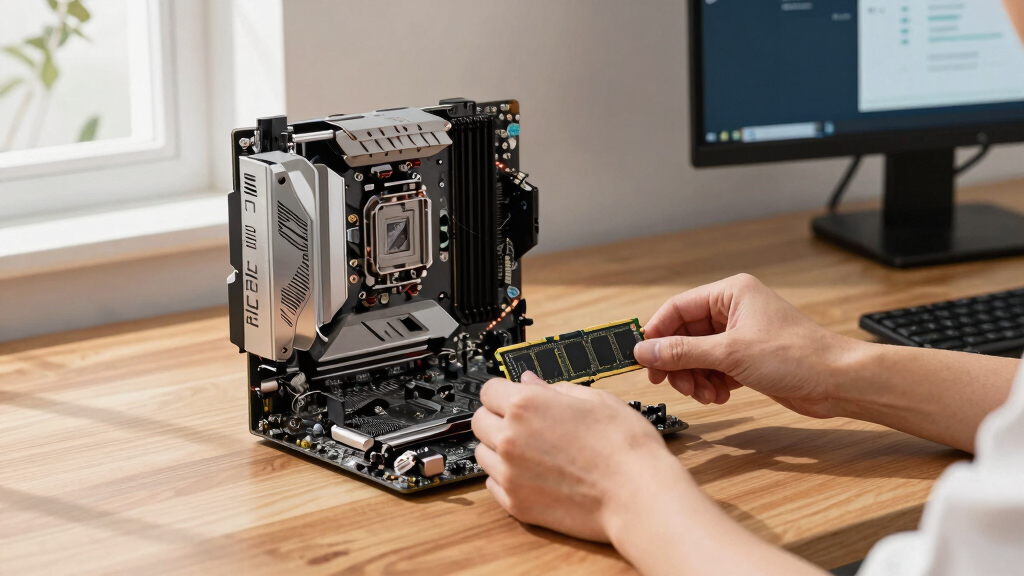

TL;DR
Manufacturers have officially confirmed that DDR5 memory modules will support Error-Correcting Code (ECC), a feature crucial for enterprise and mission-critical systems. This marks a significant update in DDR5 technology, expanding its use cases.
Manufacturers have confirmed that DDR5 memory modules will support Error-Correcting Code (ECC), a feature essential for high-reliability computing environments. This development signals a shift in DDR5 technology, potentially broadening its adoption in servers and enterprise systems, where ECC is a standard requirement.
Multiple industry sources and memory manufacturers, including Micron and Samsung, have publicly stated that DDR5 modules will support ECC functionality. This confirmation comes after months of speculation about DDR5’s capabilities and compatibility with ECC features traditionally associated with DDR4 and server-grade RAM.
ECC support in DDR5 is expected to enable error detection and correction during memory operations, significantly reducing data corruption risks in critical systems. However, the implementation details, such as whether ECC will be available in all DDR5 modules or limited to specific SKUs, are still being clarified. Early indications suggest that ECC support will be available primarily in modules aimed at enterprise and data center markets.
Implications for Enterprise and Data Center Markets
This confirmation is significant because it indicates DDR5’s readiness for use in environments that demand high reliability, such as servers, cloud infrastructure, and enterprise computing. The inclusion of ECC support could influence system builders and OEMs to adopt DDR5 in their high-end products, replacing DDR4 in critical applications.
Moreover, ECC support in DDR5 could accelerate the transition from DDR4 in enterprise markets, where error correction is non-negotiable. It also signals that DDR5 is evolving beyond consumer-grade applications, aligning with industry standards for data integrity and system stability.
As an affiliate, we earn on qualifying purchases.
Evolution of DDR Memory Standards and ECC Integration
ECC support has traditionally been a feature associated with DDR4 and server-grade RAM, used extensively in data centers and mission-critical systems. DDR5 was initially marketed as a consumer-oriented memory standard, with some skepticism about its suitability for enterprise use due to uncertainty around ECC support.
Recent industry developments have gradually clarified DDR5’s capabilities, with major manufacturers hinting at or confirming ECC support. This aligns with broader trends in memory technology, where error correction and data integrity are increasingly prioritized as data centers and high-performance computing (HPC) environments grow more complex and demanding.
Prior to this announcement, some DDR5 modules lacked explicit ECC support, leading to confusion among system builders and enterprise users. The current confirmation suggests that DDR5 is now positioned to serve both consumer and enterprise markets, depending on the module specifications.
As an affiliate, we earn on qualifying purchases.
Remaining Questions About ECC Implementation in DDR5
It is not yet clear whether ECC support will be included in all DDR5 modules or limited to specific enterprise-grade SKUs. Details about the compatibility with existing motherboards and whether firmware updates are required are still emerging. Additionally, the exact performance impact and cost implications of ECC-enabled DDR5 modules remain uncertain.
DDR5 server RAM with error correction
As an affiliate, we earn on qualifying purchases.
As an affiliate, we earn on qualifying purchases.
Next Steps for Manufacturers and System Integrators
Manufacturers are expected to release DDR5 modules with ECC support in the coming months. System builders and OEMs will need to update BIOS and firmware to enable ECC functionality fully. Industry events and product launches scheduled for mid-2024 are likely to feature DDR5 ECC modules prominently, providing more clarity on availability and specifications.
As an affiliate, we earn on qualifying purchases.
Key Questions
Will all DDR5 memory modules support ECC?
Currently, it is not confirmed that all DDR5 modules will support ECC. Support is expected mainly in modules designed for enterprise and data center use, but some consumer modules may also include ECC features.
How does ECC support benefit high-reliability systems?
ECC detects and corrects single-bit errors during memory operations, reducing data corruption risks and improving system stability in critical environments like servers and data centers.
When will DDR5 ECC modules be available on the market?
Manufacturers plan to release ECC-enabled DDR5 modules within the next few months, with widespread availability expected by mid-2024.
Will ECC support increase DDR5’s price?
Adding ECC support may increase manufacturing costs, potentially raising prices for ECC-enabled modules, but exact pricing details are still unclear.
Do current motherboards support ECC in DDR5?
Support depends on motherboard BIOS and chipset compatibility. Firmware updates may be required, and users should verify motherboard specifications for ECC support.
Source: hn