

TL;DR
President Donald Trump said US companies would face restrictions or “a tremendous tax” if they build data centres overseas. As of November 21, no order or rule implementing the threat had been published, and the remarks supplied no rate, start date or defined scope.
President Donald Trump said on November 20 that the United States would not allow American companies to build data centres abroad and threatened “a tremendous tax” if they did, but no order or rule implementing the warning had been published by the next morning. The distinction matters to cloud and AI operators with overseas projects: the remarks alone do not specify a tax, ban, effective date or which facilities would be covered.

Get the latest gadgets delivered free with Prime
- Fast, free delivery on millions of items
- Prime Video, Amazon Music and more included
- Member-only deals all year
Trump made the comments at a White House news conference after returning from a trip to Asia. In a transcript published by The Verge, he said, “We’re not going to allow our companies to build data centers outside of our country.” He then described a possible consequence in different terms: “If they do that, they can, but we’re going to put a tremendous tax on them.” That shift leaves unclear whether he was proposing a prohibition, a tax that would make projects more expensive, or both.
Trump said he had not told his staff before making the announcement: “I don’t know if that’s a breaking story. But I haven’t even said that to my people, but I’m telling them now.” As of 08:00 UTC on November 21, the source material reported no relevant presidential action on the White House website and no related rule in the Federal Register. The White House referred Newsweek to Trump’s remarks when asked for details.
The remarks named China and Finland but did not identify a list of affected countries or companies. Newsweek reported that it was not immediately clear whether Trump’s Finland reference concerned Google’s planned investment there. The source material also says no tax rate, legal basis, implementation date or treatment of existing projects had been provided.
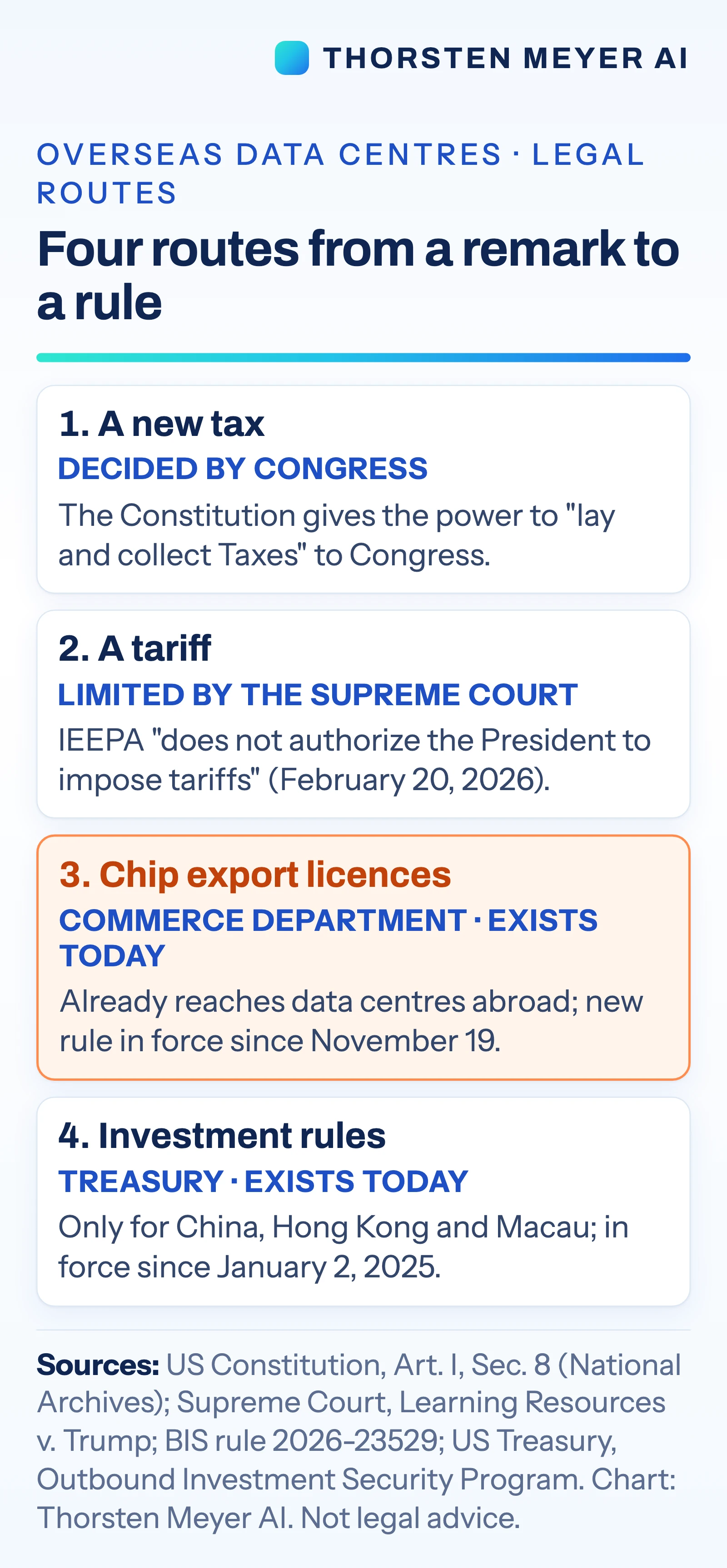
What Operators Can Rely On Today
For companies planning AI capacity overseas, the immediate issue is policy uncertainty, rather than a newly published tax or ban. A formal restriction could affect investment decisions, data centre construction and where cloud providers offer computing capacity, but the remarks do not establish what those effects would be or when they might begin.
There are already rules relevant to some overseas AI infrastructure. The source material describes a Commerce Department rule effective November 19 that requires licences for advanced AI chips in five countries and applies to certain data centres serving China-headquartered companies at scale. It also describes a reporting lane for US-headquartered companies. Those requirements concern chip exports and specified operations; they are not the same as a general restriction on US companies building data centres abroad.
That distinction is practical: operators should assess the rules already in force separately from a threat whose scope and legal form have not been set out. The source material gives no basis to conclude that a company must halt an overseas project on Monday because of Trump’s comments.
Products Worth Considering

Amazon Kindle Scribe (16GB) with Premium Pen, Tungsten

Jackery Solar Generator 1000 v2 with 200W Solar Panel, 1024Wh LiFePO4 Battery

DJI Mic 3 Wireless Microphone (2 Transmitters, 1 Receiver, Charging Case)
As an affiliate, we earn on qualifying purchases.
Existing Rules Target AI Chips
The source material points to two existing federal measures relevant to overseas AI infrastructure. A Commerce Department rule, identified there as BIS rule 2026-23529, took effect on November 19. It requires licences for advanced AI chips in five countries and sets conditions for certain data centres serving China-headquartered companies at scale, with reporting requirements for US-headquartered firms.
A July 2025 executive order also set a US policy of supporting “the global deployment of United States-origin AI technologies,” including data centres, according to the source material. That stated policy provides context for the new remarks but does not, by itself, resolve whether the administration intends to change course.
The source material identifies legal constraints on some possible routes. The Constitution assigns Congress the power to lay and collect taxes. It also says the Supreme Court ruled on February 20, 2026, in Learning Resources v. Trump, that the International Emergency Economic Powers Act does not authorize the president to impose tariffs. Those points do not settle every possible legal approach to overseas facilities; they show why the specific instrument matters.
Key Details Still Missing
The official record described in the source material contained no new executive order or Federal Register rule as of the morning of November 21. It remains unclear whether the administration intends to pursue a tax, a prohibition, another kind of penalty, or no formal measure following the remarks.
Trump did not specify which companies or countries would be covered, whether existing projects would be affected, or whether leasing overseas capacity or providing cloud services would count as building a data centre. The reference to Finland was not tied to a named project in the remarks, and Newsweek said its connection to Google’s planned investment was unclear. No rate, start date, exemptions or enforcement details were given.
Watch for a Formal Proposal
The next concrete indication would be a published presidential action, proposed rule, legislation or other official notice that sets out the policy and its legal basis. Until one appears, Trump’s statements describe a threat but do not tell companies how a new measure would work.
For now, the source material’s dated status is November 21, 2026: the existing chip licensing and reporting requirements remain the identified rules affecting certain overseas AI data centre operations, while the wider tax or restriction Trump described has no published details.
Key Questions
Did Trump’s remarks immediately ban US companies from building data centres abroad?
No ban had been published as of November 21, 2026. Trump made the warning at a news conference, but the source material reported no implementing order or rule by the following morning.
Did the president specify the tax rate or when it would begin?
No. The remarks cited in the source material gave no tax rate, effective date or implementation details.
Are there already rules affecting overseas AI data centres?
Yes. The source material says a Commerce Department rule effective November 19 requires licences for advanced AI chips in five countries and sets requirements for certain data centres serving China-headquartered companies at scale. It is not described as a general ban on building facilities abroad.
Was Trump referring to Google’s planned Finland investment?
That was not confirmed. Newsweek reported that it was not immediately clear whether Trump’s reference to Finland concerned Google’s planned investment there.
Source: Thorsten Meyer AI