
TL;DR

Get the latest gadgets delivered free with Prime
- Fast, free delivery on millions of items
- Prime Video, Amazon Music and more included
- Member-only deals all year
Qblox says it has integrated NVIDIA DGX Spark with its quantum system controller using NVIDIA NVQLink. The company reports measured round-trip latency below 7.2 microseconds on DGX Spark and below 4.0 microseconds on an NVIDIA RTX PRO 6000 Blackwell, with potential uses in real-time calibration and quantum error correction.
Qblox has connected an NVIDIA DGX Spark system to its quantum system controller using NVIDIA NVQLink, reporting measured round-trip latency below 7.2 microseconds on DGX Spark. The integration links GPU computing with quantum hardware control, and is intended to support real-time hybrid workloads such as qubit calibration and quantum error correction.
Qblox reported a second latency result of below 4.0 microseconds using an NVIDIA RTX PRO 6000 Blackwell. The company did not provide further measurement details in the supplied announcement, including the test configuration, workload, or how latency was calculated. The figures are company-reported results, rather than independent validation cited in the announcement.
The setup uses Qblox’s Q1 sequence processors and LINQ to connect its Cluster quantum control system with GPU computing. Qblox says the design brings GPU acceleration into the control loop: calibration routines could update qubit parameters while experiments are running, while quantum error-correction syndrome data could be sent to GPU-based decoders for processing.
The development also uses NVIDIA CUDA-Q, which Qblox says lets researchers develop and test workloads on desktop hardware. The companies describe the same code as transferable to GPU servers as quantum systems grow. This is a stated development pathway; the announcement does not establish how widely the integration has been deployed or report results from customer quantum systems.
Connecting GPUs to Quantum Control
Quantum processors require classical systems to coordinate operations, process measurement results and respond to errors. Linking a GPU to the control system with low reported latency could let some computational tasks run alongside experiments rather than waiting for a separate processing stage. That could matter for real-time calibration and error-correction research, both of which involve repeated measurement and computation.
The announcement describes an engineering integration and latency measurements, not a demonstration that the arrangement improves the performance of a quantum computer or enables fault-tolerant operation. If the approach works across larger systems and representative workloads, it could offer researchers a way to develop hybrid applications on a desktop before moving them to larger GPU infrastructure. The practical benefit will depend on measured performance, system compatibility and the quantum hardware being controlled.
As an affiliate, we earn on qualifying purchases.
Earlier Qblox and NVIDIA Work
The announcement builds on earlier cooperation between the companies. Qblox and NVIDIA announced work involving NVQLink in October 2025, according to the supplied report. Qblox later said it supported the NVIDIA CUDA-Q real-time API in March 2026.
Qblox characterizes the latest milestone as moving from an architecture proposal to measured hardware performance. The reported figures provide latency benchmarks for two GPU configurations, but they do not by themselves establish performance across different quantum processors, workloads or operating conditions.
“Quantum computers will scale only as fast as the classical control systems around them.”
— Niels Bultink, Qblox CEO and co-founder
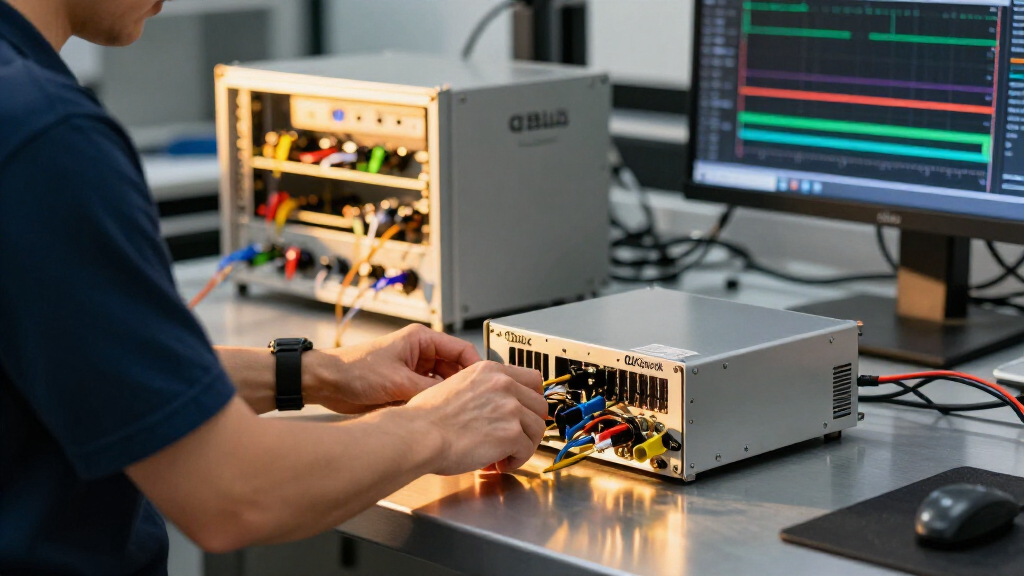
quantum system controller with NVQLink
As an affiliate, we earn on qualifying purchases.
As an affiliate, we earn on qualifying purchases.
Measurement and Deployment Details
The announcement does not state the test methodology, workload conditions, sample size or whether the reported latency is an average, a best-case result or a measurement under another defined condition. It also does not identify an independent evaluator. The numbers should therefore be understood as Qblox-reported measurements.
It is also unclear which quantum hardware was used in the tests, whether researchers or customers can access the integration now, and how the results compare with other control-and-GPU configurations. The announcement describes possible applications in calibration and error correction but does not report a completed error-correction demonstration or a measurable improvement in quantum-device performance.
As an affiliate, we earn on qualifying purchases.
Testing Across Quantum Systems
The next evidence to watch for is further technical detail on the latency tests and demonstrations using specific quantum workloads or hardware. Such results could show whether the reported performance holds under experimental conditions and how much it helps calibration or decoding tasks.
Qblox and NVIDIA say researchers can develop with CUDA-Q on desktop systems and carry code to GPU servers as systems scale. The announcement does not give a release schedule, customer rollout plan or named next milestone. Wider availability and practical results remain to be confirmed.
GPU acceleration for quantum computing
As an affiliate, we earn on qualifying purchases.
As an affiliate, we earn on qualifying purchases.
Key Questions
What did Qblox announce?
Qblox said it integrated NVIDIA DGX Spark with its quantum system controller using NVIDIA NVQLink, connecting GPU computing to quantum control.
What latency did Qblox report?
Qblox reported round-trip latency below 7.2 microseconds on DGX Spark and below 4.0 microseconds on an NVIDIA RTX PRO 6000 Blackwell. The supplied announcement does not detail the test methodology.
What could the integration be used for?
The companies cite GPU-accelerated calibration and processing quantum error-correction syndrome data with GPU-based decoders. These are intended applications; the announcement does not report a completed error-correction demonstration.
Can researchers use the system now?
The announcement describes a desktop development platform using NVIDIA CUDA-Q, but does not specify availability, customer access, pricing or a deployment schedule.
Are the latency results independently verified?
No independent verification is cited in the supplied announcement. The figures are reported by Qblox, and details such as workload and measurement conditions are not provided there.
Source: rss
Halloween Picks
halloween
As an affiliate, we earn on qualifying purchases.