

TL;DR
Labour MP Jess Asato is suing SpaceX Super Intelligence LLC, the company behind Grok, over sexualised fake images generated with the tool. The company denies liability, arguing that viewers would recognise the images as fictitious and that users supplied the prompts. The High Court has not ruled on the claim.
SpaceX Super Intelligence LLC, the company behind Grok, has denied liability in a High Court claim brought by Labour MP Jess Asato over sexualised fake images of her generated with the AI tool, according to Reuters. The defence argues that viewers would recognise the images as artificial and that users, rather than the company, wrote the prompts. No court has ruled on the claim, which puts responsibility for AI-generated intimate imagery before a UK judge.

Get the latest gadgets delivered free with Prime
- Fast, free delivery on millions of items
- Prime Video, Amazon Music and more included
- Member-only deals all year
Asato filed her claim in England’s High Court on June 3, 2026, alleging misuse of private information and breaches of data protection law, according to AWO, the law firm representing her. AWO says the images included a video. The claim alleges that Grok’s design and training enabled the creation of sexualised material. Asato is seeking damages, a declaration and an order requiring the company to implement permanent technical measures to stop Grok creating manipulated images of her.
Reuters reports that the defence, dated October 29, denies liability. SpaceXSI says it removed images that breached its terms. It argues that reasonable viewers would understand the images to be “AI-generated, fictitious and implausible” rather than realistic, and says it “did not determine the content of the relevant users’ prompts.” The company also disputes Asato’s entitlement to the order she seeks.
Asato’s lawyers dispute the company’s position. AWO quoted her as saying: “SpaceX SI wants to have it both ways.” That is her response to the defence, not a finding by the court. The filings present competing positions: Asato says the system’s design contributed to the harm; the company points to users’ prompts and the images’ apparent artificiality.
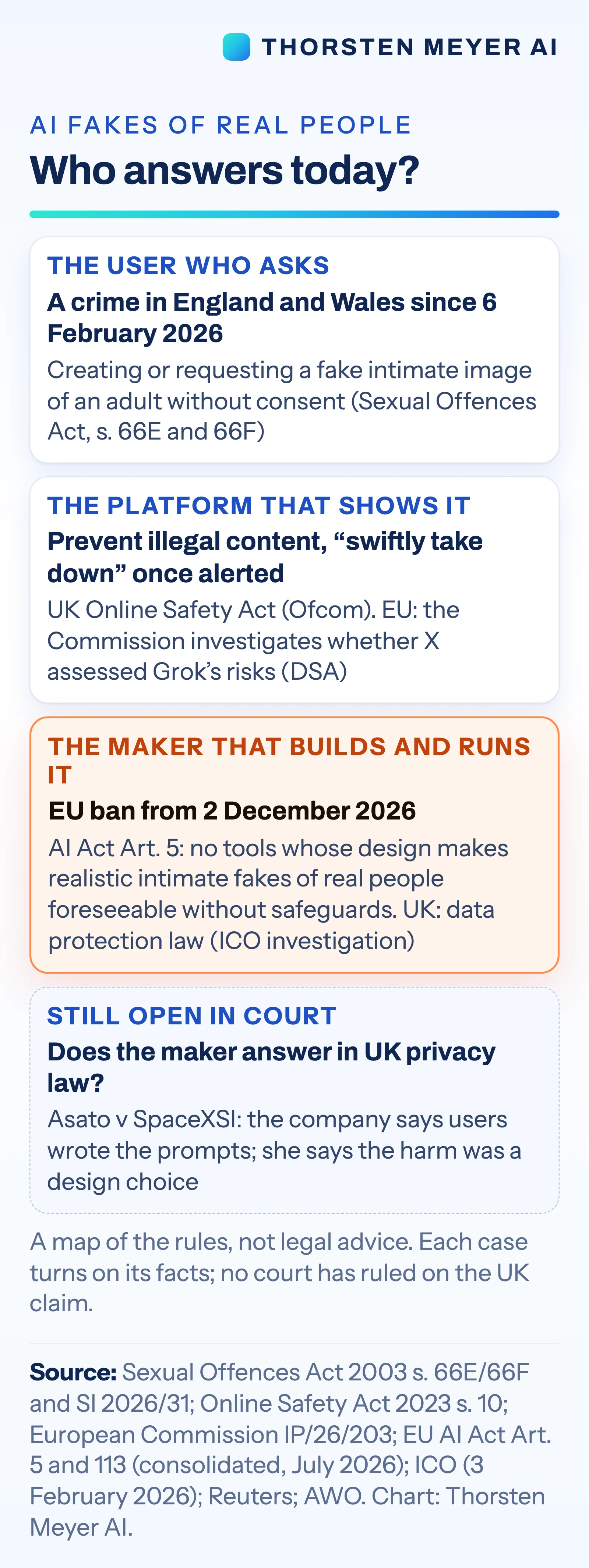
Who Answers for Grok’s Outputs
The case tests where responsibility may fall when a generative AI tool produces sexualised images of a real person: with the person who requested them, the platform that made them available, or the company that built and operates the model. The court has not answered that question. The dispute could help clarify how existing privacy and data protection rules apply to the design and operation of image-generation systems.
For companies that offer image generators, the arguments put safeguards, system design and responses to reported material into focus. Those issues may become relevant to how a court assesses the claim, though the case has not yet established a legal standard. For people targeted by manipulated images, the outcome could affect what remedies are available against a service provider as well as against individual users.
There is also a separate criminal-law development in England and Wales. According to the source material, creating or requesting a fake intimate image of an adult without consent has been a crime since February 6, 2026. That law concerns the conduct of people who create or request the material; Asato’s civil claim raises separate questions about the company’s responsibility.
Products Worth Considering

Amazon Kindle Paperwhite (2024), 16 GB, 7-inch Display, Black

Bose TV Speaker Compact Soundbar with Bluetooth and HDMI-ARC, Black

Amazon Kindle Scribe (16GB) with Premium Pen, Tungsten
As an affiliate, we earn on qualifying purchases.
How the Dispute Reached Court
Asato’s lawyers say Grok was used to manipulate her images in early January 2026. On January 7, the Information Commissioner’s Office said it had contacted X and xAI to seek information about their safeguards and compliance with UK data protection law. The source material says the ICO opened formal investigations into X and X.AI LLC on February 3. Those regulatory steps are separate from Asato’s court claim and do not establish that the companies broke the law.
The European Commission opened a Digital Services Act investigation concerning X and Grok on January 26, according to the source material. On March 26, an Amsterdam court ordered Grok and X to stop generating or distributing certain undressing images, with a stated penalty of €100,000 per day for non-compliance. That Dutch order applies in its own legal context; it is not a ruling on Asato’s UK claim.
The company’s name and ownership changed during the period covered by the source material. Reuters identifies the defendant as SpaceX Super Intelligence LLC (SpaceXSI), formerly xAI and later SpaceXAI, now part of Elon Musk’s SpaceX. The claim concerns images generated using Grok, a tool distributed through X.
““did not determine the content of the relevant users’ prompts””
— SpaceX Super Intelligence LLC, as quoted in its defence by Reuters
Questions the Judge Must Resolve
No judgment has been issued, and the allegations in Asato’s claim remain allegations. The court has yet to decide whether the company’s design or operation of Grok breached privacy or data protection law, whether viewers would regard the images as implausible, or whether the company can rely on users’ prompts to avoid liability.
The source material does not provide a hearing date, a timetable for a ruling or the full pleadings. It is also unclear what evidence each side will present about how Grok generated the images, what safeguards were in place at the time, and what steps the company took after complaints. The status and findings of the separate UK and EU regulatory investigations are not established by the information available here.
The Claim Awaits Its Next Hearing
The next major development will be the High Court’s consideration of the claim and defence. No hearing or decision date is specified in the source material. The case will need to address the parties’ competing accounts and the legal basis for the remedies Asato seeks.
A separate EU measure is scheduled to apply from December 2, 2026. According to the source material, the AI Act will prohibit systems that generate realistic intimate images of identifiable people without consent when that outcome is foreseeable from the system’s design and safeguards are missing. How that rule applies in practice, and how it relates to the UK case, remain open questions.
Key Questions
What is Jess Asato suing over?
Asato alleges misuse of private information and breaches of data protection law over sexualised fake images, including a video, generated with Grok. Her claim seeks damages, a declaration and technical measures to prevent Grok from creating manipulated images of her.
What does Grok’s maker say?
SpaceXSI denies liability. Reuters reports that it says users wrote the prompts, that it removed images violating its terms, and that viewers would understand the images to be artificial and implausible.
Has the High Court decided who is responsible?
No. The source material reports a claim and a defence, but no court ruling. The company’s position and Asato’s allegations have not been resolved.
What other rules or investigations are relevant?
The source material says creating or requesting a fake intimate image of an adult without consent has been a crime in England and Wales since February 6, 2026. UK and EU regulators have also investigated Grok-related issues, and a Dutch court issued a separate order in March. Those developments do not decide Asato’s UK civil claim.
Source: Thorsten Meyer AI