
TL;DR
Anthropic introduced Claude Meetings on November 12, 2026, a beta that joins Google Meet as a visible participant to transcribe calls, answer questions and create documents or other artifacts. Team and Enterprise plans have different default settings, and Anthropic says meeting records include text and screen descriptions but not audio. The company has not stated how long it retains those records or what artifact creation will cost after February 10, 2027.
Anthropic announced Claude Meetings on November 12, a beta feature that joins Google Meet calls as a visible participant to transcribe discussions, answer questions and create documents, whiteboards or slides during a meeting. The feature is available to Team and Enterprise customers, but its default access settings differ by plan, making those settings relevant to organizations deciding whether Claude should join calls with outside guests.

Get the latest gadgets delivered free with Prime
- Fast, free delivery on millions of items
- Prime Video, Amazon Music and more included
- Member-only deals all year
Anthropic’s Help Center says users can add Claude to a meeting from a connected Google Calendar or configure personal auto-join. An organization owner must first enable Google Calendar for the organization. Claude usually joins without asking the host; if it requests entry and the host declines, it will not try that call again unless someone adds it. The participant posts a notice in the meeting chat, and its answers there are visible to everyone on the call.
During a meeting, Claude maintains a live transcript and can respond to spoken requests or messages in Meet chat. It can create documents, whiteboards and slides linked to a meeting page. Anthropic says the page can contain the transcript, summary and screen descriptions, but not audio. A meeting can last up to eight hours, according to the source material. Afterward, colleagues on the invitation receive a recap email; outside guests do not.
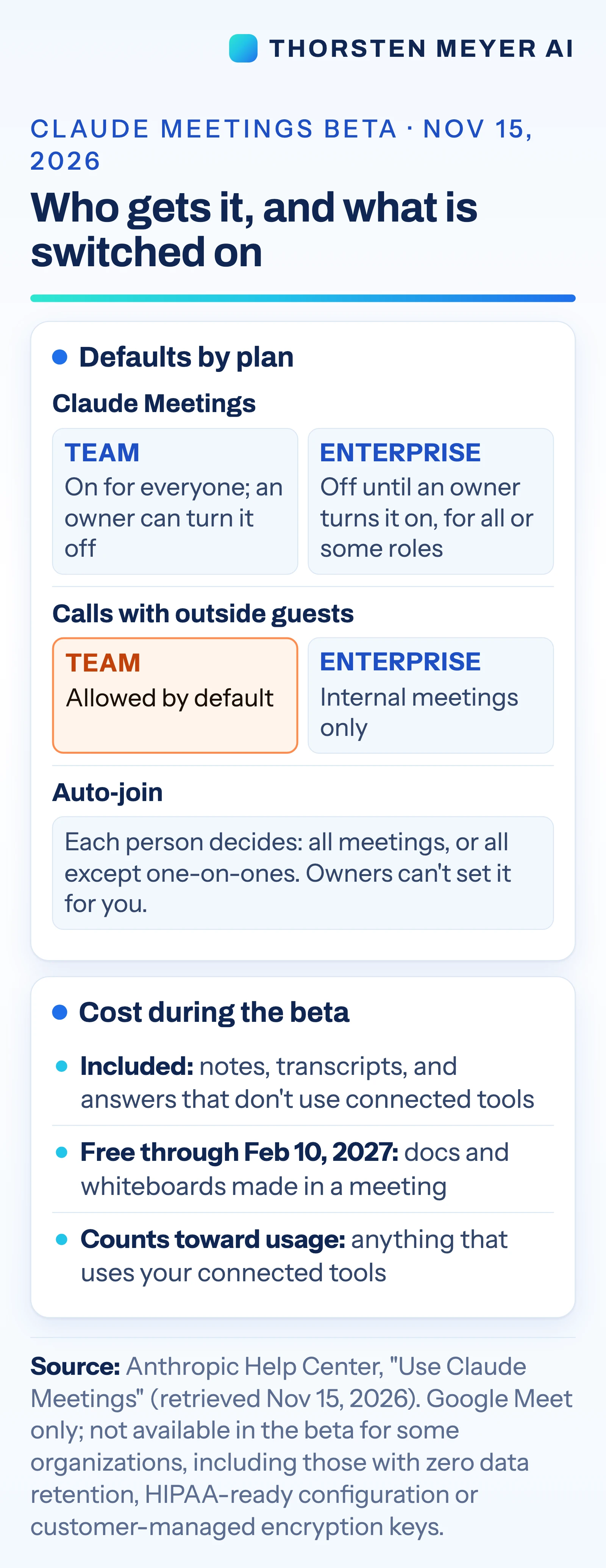
On Team plans, Claude Meetings is on by default and calls with outside guests are allowed by default. On Enterprise plans, the feature is off until an owner enables it, and it is limited to internal meetings by default. During the beta, it is unavailable to some organizations, including those using zero data retention, HIPAA-ready configurations or customer-managed encryption keys. Anthropic says notes, transcripts and answers are included in the plans; documents and whiteboards created in meetings are free through February 10, 2027. Use of connected tools counts toward usage.
Guest Access Changes the Decision
The default settings determine whether Claude may be present when people outside an organization join a call. Anthropic says that if outside guests are not allowed, Claude leaves when one joins. If guests are allowed, Claude can continue taking notes but does not reply in the chat. That distinction matters for calls involving customers, suppliers or other people who may not expect an AI participant.
Anthropic says users are responsible for making sure everyone on a call is comfortable being transcribed. The visible participant and chat notice provide cues that Claude has joined, but the source material does not describe an organization-wide consent process. Teams should review their meeting practices alongside the settings, particularly where calls include sensitive information or external attendees.
The feature also does more than produce minutes: it can create shared work products and, with permission, use connected tools. Anthropic gives Slack messaging as an example. That can bring meeting work into other systems, while tool use counts toward usage. The combination makes access controls, permissions and meeting records relevant to administrators as well as individual hosts.
Products Worth Considering

LG UltraGear 27-inch QHD OLED Gaming Monitor, 240Hz

Samsung 57 Odyssey Neo G9 (G95NC) Dual 4K UHD 1000R Curved Gaming Monitor

Amazon Kindle Paperwhite Signature Edition (2024), 32 GB, Metallic Black
As an affiliate, we earn on qualifying purchases.
From Call Notes to Live Artifacts
Claude Meetings is initially limited to Google Meet. Anthropic says support for other platforms is coming soon, but has not provided a date in the material available. The company’s example describes a team planning a customer event: Claude drafts a document from the discussion, helps answer a question about a past event after requesting approval to consult a connected tool, and leaves notes and action items on the meeting page.
AI note-taking tools already operate in video calls, according to the source article, which cites a Gartner report described by Computerworld as calling Claude Meetings “a beta entrant in a mature market.” Anthropic’s stated distinction is that Claude can build documents and other artifacts while the conversation is underway, in addition to recording its contents. That description is the company’s account of the product, not an independent assessment of its performance.
To use the feature, a user connects Google Calendar after an organization owner enables it, selects a meeting and chooses “Add Claude.” Auto-join is a personal setting for all meetings or all except one-on-ones; Anthropic says owners cannot set it on a user’s behalf. The feature may also be absent for organizations with certain privacy or compliance configurations during the beta.
““It takes the notes, answers questions, and builds artifacts, such as docs, whiteboards, and slides, live during the call.””
— Anthropic Help Center, “Use Claude Meetings”
Retention and Later Pricing Undisclosed
The Anthropic pages cited in the source material do not state how long meeting records are retained. They also do not specify the price for documents and whiteboards after February 10, 2027, or give a launch date for platforms beyond Google Meet. Those details could affect organizations’ decisions about records management, budgeting and rollout.
The announcement describes the feature’s intended behavior, but the source material does not provide independent performance results or establish how accurately Claude transcribes speakers in different conditions. It also does not set out a standard consent workflow beyond telling users to make sure participants are comfortable with transcription. Availability restrictions during the beta mean some organizations cannot evaluate the feature under their current configurations.
Review Settings Before the Next Call
Team and Enterprise customers can check whether Claude Meetings is available to them and review the settings that govern guest access, auto-join and organization-wide enablement. Enterprise owners need to turn the feature on; individual users control their own auto-join preferences. Before adding Claude to a call, users should tell participants what it will record and check that they are comfortable with transcription, as Anthropic instructs.
Anthropic says other meeting platforms are planned, but has not announced when they will be supported. Customers will also need further information from the company about meeting-record retention and pricing for artifacts after February 10, 2027.
Key Questions
Who can use Claude Meetings?
Anthropic says the beta is available to Team and Enterprise plans in Claude and Claude Desktop. It is limited to Google Meet for now, and some organizations with specific privacy or compliance configurations cannot use it during the beta.
Is Claude Meetings on by default?
It is on by default for Team plans. For Enterprise plans, an owner must enable it. Auto-join is a separate personal setting that users can configure for all meetings or all except one-on-ones.
What does Claude save from a meeting?
Anthropic says the meeting page can include a transcript, summary and screen descriptions, not audio. Its Help Center information cited in the source material does not state a retention period.
Can Claude join calls with outside guests?
On Team plans, outside guests are allowed by default; on Enterprise plans, meetings are limited to internal participants by default. If outside guests are disallowed and one joins, Anthropic says Claude leaves. If guest access is allowed, Claude takes notes but does not reply in chat.
Will creating documents in a meeting cost extra?
Anthropic says notes, transcripts and answers are included with Team and Enterprise plans. Documents and whiteboards created during meetings are free through February 10, 2027; pricing after that date is not stated in the available material. Connected-tool use counts toward usage.
Source: Thorsten Meyer AI