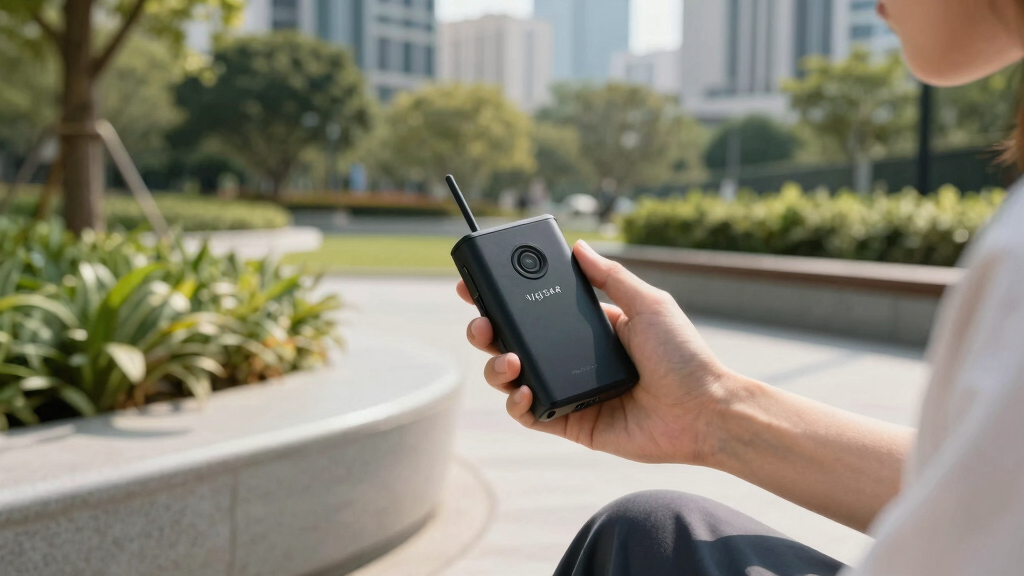

📊 Full opportunity report: VigilSAR: The Object That Isn’t Transmitting on ThorstenMeyerAI.com — validation score, market gap, and execution plan.

Get the latest gadgets delivered free — and shop member deals
- Fast, free delivery on millions of items
- Access to Prime Big Deal Days deals on October 6–7
- Prime Video, Amazon Music and more included
TL;DR
VigilSAR, a radar-based surveillance system, detects ships that turn off transponders, improving maritime security and safety. Its core relies on fusion of radar data with public signals.
VigilSAR has confirmed its ability to detect ships that do not broadcast transponder signals, a critical capability for maritime security and safety. The platform integrates synthetic-aperture radar (SAR) data with signals like AIS and ADS-B to identify vessels that are ‘dark,’ or unreported, in real-time, regardless of weather or lighting conditions.
The core demonstration of VigilSAR is based on publicly available Sentinel-1 SAR data from the European Space Agency, confirming its detection capabilities. The platform combines classical detection techniques with neural classifiers to identify objects on the surface, then fuses these detections with open-source signals such as AIS and ADS-B broadcasts.
The key innovation lies in the fusion process: by subtracting explained detections (those with active transponders), VigilSAR highlights vessels that are present but not reporting, which are often linked to illegal activities or distress situations. This method provides a significant advantage over optical imagery, which is limited by weather and darkness, making VigilSAR a valuable tool for maritime authorities, coast guards, and security agencies.
VigilSAR — the object that isn’t transmitting
Radar sees through cloud and darkness, when cameras can’t. Fuse it with transponder data and the signal is the one detection no transponder explains.
Independent commentary on public positioning, produced with AI assistance under human editorial oversight. The views are the author’s own and may change. This does not verify or endorse VigilSAR’s capabilities, contracts, or performance. Capabilities on Sentinel-1 / Copernicus reflect a free, public data foundation; commercial-constellation and air-gapped-deployment references reflect stated positioning, not independently demonstrated fact. ISR and related technologies may be subject to export controls and dual-use regulations — lawful, ethical use is solely the operator’s responsibility. Nothing here is an offer, pricing, or operational/safety/legal advice. AI detection and classification can err and require human verification. Product and company names are trademarks of their respective owners; mention does not imply endorsement.
Impact of Detecting Dark Ships on Maritime Security
Identifying vessels that turn off transponders is vital for enforcing maritime law, combating illegal fishing, sanctions evasion, and smuggling. It also enhances search and rescue efforts by locating vessels in distress that are not broadcasting signals. The ability to operate in all weather and lighting conditions makes VigilSAR a crucial addition to maritime surveillance infrastructure, filling a gap left by traditional optical sensors.
As an affiliate, we earn on qualifying purchases.
Background on SAR and Maritime Domain Awareness
Synthetic-aperture radar (SAR) has long been valued for its all-weather, day-and-night imaging capabilities, especially for monitoring oceans, borders, and infrastructure. However, interpreting SAR data requires advanced AI techniques to distinguish objects and classify them effectively. VigilSAR builds on this foundation by integrating SAR detections with open-source signals, addressing a longstanding challenge of identifying unreported or ‘dark’ vessels that evade conventional tracking systems.
Previously, maritime surveillance relied heavily on AIS and radar, but vessels could turn off transponders to hide illicit activities. VigilSAR’s fusion approach offers a practical solution to this problem, with potential applications in security, safety, and environmental protection.
“VigilSAR’s ability to detect vessels that are not broadcasting transponder signals marks a significant advancement in all-weather maritime situational awareness.”
— Thorsten Meyer, remote sensing expert
As an affiliate, we earn on qualifying purchases.
Limitations and Unconfirmed Aspects of VigilSAR
While VigilSAR’s detection and fusion capabilities have been demonstrated using Sentinel-1 data, it remains unclear how well the system performs across different commercial SAR satellites and in operational environments. Details about cost, deployment scale, and integration with existing maritime surveillance systems are still under development. The full extent of its accuracy and false-positive rates has not been publicly disclosed.
synthetic aperture radar (SAR) device
As an affiliate, we earn on qualifying purchases.
As an affiliate, we earn on qualifying purchases.
Next Steps for VigilSAR Deployment and Validation
VigilSAR is expected to expand its commercial offerings through ongoing briefings and demonstrations. Further testing in diverse maritime environments will clarify its operational readiness. The platform aims to integrate with existing maritime security infrastructure and potentially expand its detection capabilities to include smaller vessels and different object types. Public and private sector partners will likely evaluate its effectiveness in real-world scenarios.
maritime vessel tracking equipment
As an affiliate, we earn on qualifying purchases.
As an affiliate, we earn on qualifying purchases.
Key Questions
How does VigilSAR detect ships that are not broadcasting transponder signals?
It uses synthetic-aperture radar (SAR) to identify surface objects regardless of weather or lighting, then fuses these detections with open-source signals like AIS and ADS-B. By subtracting known, reported vessels, it highlights ‘dark’ ships that are not broadcasting signals.
What are the main applications of VigilSAR?
Its primary uses include maritime security enforcement, illegal fishing detection, sanctions monitoring, smuggling interdiction, and search-and-rescue operations, especially in challenging weather conditions.
Is VigilSAR available for commercial or government use now?
The platform is currently in a demonstration and briefing phase, with no public pricing announced. It is positioned within the defense and intelligence sectors, with ongoing discussions for deployment and integration.
What are the limitations of VigilSAR?
Its performance across different SAR satellites and operational environments remains to be fully validated. Details on accuracy, false positives, and operational scale are still emerging.
Why is detecting unreported ships important?
Unreported ships are often involved in illegal activities, sanctions evasion, or are in distress. Detecting them enhances maritime security, safety, and law enforcement efforts worldwide.
Source: ThorstenMeyerAI.com
Halloween Picks
halloween
As an affiliate, we earn on qualifying purchases.