
📊 Full opportunity report: Lab And Symptom Tracker For TRT Patients on IdeaNavigator AI — validation score, market gap, and execution plan.

Get the latest gadgets delivered free — and shop member deals
- Fast, free delivery on millions of items
- Access to Prime Big Deal Days deals on October 6–7
- Prime Video, Amazon Music and more included
TL;DR
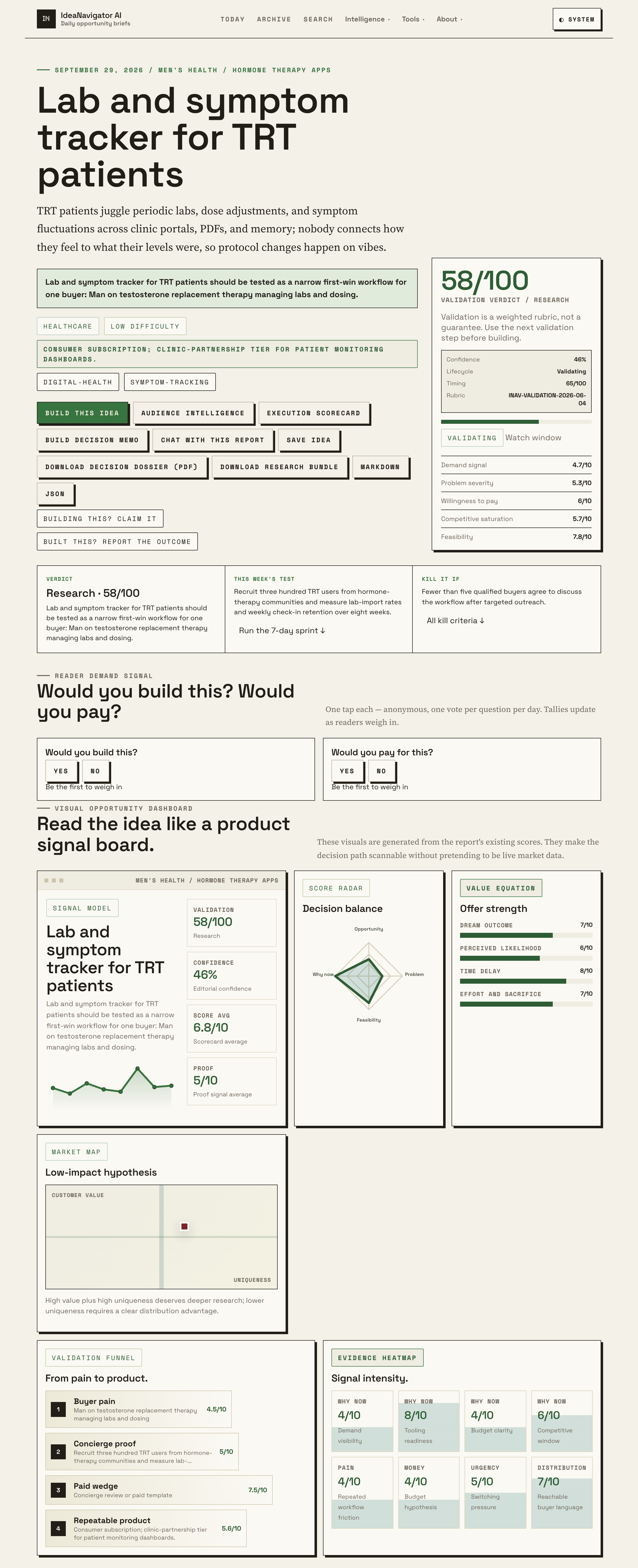
IdeaNavigator AI has published a product proposal for a lab and symptom tracker aimed at men on testosterone replacement therapy (TRT). The app would import lab PDFs, chart hormone panels against dose changes and daily symptom check-ins, and generate trend summaries for clinic visits. The proposal calls for a validation study of 300 TRT users over eight weeks before further investment.
IdeaNavigator AI has published a product proposal for a lab and symptom tracker built specifically for men on testosterone replacement therapy (TRT), arguing that a surging population of telehealth TRT patients is managing hormone levels, dose adjustments, and side effects across disconnected clinic portals, PDF lab reports, and memory. The proposed app would import lab results, chart hormone panels over time against dose changes and daily symptom check-ins, and generate trend summaries patients can bring to clinic visits.
The proposal defines a single target user rather than a broad health-app audience: a man on TRT actively managing labs and dosing. According to IdeaNavigator AI, the core problem is that nobody connects how these patients feel to what their blood levels actually were, so protocol changes end up driven by impressions rather than data. Patients typically receive lab work every few months, and dose adjustments happen across appointments with limited longitudinal visibility.
The minimum viable product, as specified in the proposal, has four concrete functions: import of lab PDFs; charting of hormone panels over time, overlaid against dose changes and daily symptom check-ins; generation of trend summaries formatted for clinic visits; and automatic flagging of values drifting outside target ranges. The design is deliberately narrow — it is a tracking and summarisation tool, not a diagnostic or prescribing service.
On the business side, the proposal outlines two revenue streams: a consumer subscription for individual patients, and a clinic-partnership tier that would give hormone-therapy practices monitoring dashboards across their patient panels. The target market is identified as men’s health and hormone therapy apps. The proposed validation plan calls for recruiting 300 TRT users from hormone-therapy communities and measuring two metrics over eight weeks: lab-import rates and weekly check-in retention.
Why Fragmented TRT Care Creates an Opening
The proposal’s rationale rests on a structural shift in how testosterone therapy is delivered. According to IdeaNavigator AI, TRT prescriptions and telehealth clinics have surged, producing a large population of patients who are, in practice, self-managing their therapy across providers by design. One patient may use one telehealth clinic for prescriptions, a separate lab network for blood draws, and a primary-care physician for unrelated issues — with no single system holding the combined record.
For those patients, the practical value proposition is correlation: matching a symptom like fatigue, irritability, or low libido against a specific lab value and a specific dose at a specific time. If the tracking layer works as described, clinic visits shift from recollection to review — a doctor sees a prepared trend summary rather than reconstructing months of history from a patient’s memory. The clinic-partnership tier also gives hormone-therapy practices a monitoring surface for patients between the periodic lab draws that standard TRT protocols require.
The relevance extends beyond this single app. The proposal functions as a template for narrow, single-buyer digital health tools: pick one well-defined patient population, solve one workflow completely, and validate with usage metrics before scaling. That approach contrasts with broad symptom-tracking apps that struggle to demonstrate retention across heterogeneous users.
Top picks for "symptom tracker patient"
As an affiliate, we earn on qualifying purchases.
Telehealth-Driven Demand for Hormone Tracking
Testosterone replacement therapy has moved increasingly online over the past several years, with direct-to-consumer men’s health platforms prescribing TRT after remote consultations and mail-order lab kits. That model puts routine monitoring in the patient’s hands: the patient books the lab, receives a PDF or portal result, and reports symptoms at the next appointment, often months later.
Existing general-purpose tools — note-taking apps, spreadsheet templates, and lab-portal histories — address pieces of this workflow but, as the proposal frames it, do not join the three variables that matter together: lab values, dose changes, and symptom fluctuations. The men’s health and hormone-therapy app market already includes clinics’ own patient portals and commercial symptom trackers; the differentiator claimed here is the explicit lab-to-dose-to-symptom correlation plus clinic-ready output. This is a proposal at the idea-validation stage: no product, user base, or clinical study exists yet, according to the published plan.
What the Proposal Has Not Yet Shown
No validation has been run. The 300-user, eight-week study is a plan, not a result — there is no data yet on whether TRT patients will actually import lab PDFs at meaningful rates or sustain daily symptom check-ins, which are the two behaviours the entire model depends on. Retention for health check-in apps is historically a common failure point, and the proposal does not yet address it beyond measuring it.
Several practical questions are also unresolved. The proposal does not specify how lab PDFs from different providers and lab networks would be parsed reliably, how target ranges would be personalised per patient, or how data privacy and health-data regulation would be handled in the clinic-partnership tier. Whether hormone-therapy clinics would pay for monitoring dashboards is untested. The surge in TRT prescribing described as the market driver is presented without a specific figure or source, so its exact scale is not independently quantified in the proposal.
The Eight-Week Validation Test First
The stated next step is recruitment of 300 TRT users from hormone-therapy communities, followed by an eight-week measurement window tracking lab-import rates and weekly check-in retention. Those two numbers would determine whether the idea advances to a build or is cut as a failed first-win test — the proposal explicitly frames this as a narrow, cheap experiment rather than a committed product roadmap.
If metrics clear whatever threshold is set, subsequent work would presumably cover PDF-import reliability, clinic-facing dashboards, and the consumer subscription launch. If they do not, the framework calls for discarding the idea and testing a different narrow workflow. No timeline for the validation recruitment, and no development milestones beyond the MVP specification, have been announced.
Key Questions
Does a TRT lab and symptom tracker app currently exist?
Not as a built product. What exists is a published proposal from IdeaNavigator AI describing an MVP, a monetisation model, and a validation plan. No app has been released and no user data has been collected.
How would the app help someone on testosterone replacement therapy?
Per the proposal, it would import lab PDFs and chart hormone panels over time, overlaid with dose changes and daily symptom check-ins. Patients could see whether symptoms correlate with specific levels or doses, and bring generated trend summaries to clinic visits instead of reconstructing history from memory.
How would the idea be validated?
The plan calls for recruiting 300 TRT users from hormone-therapy communities and measuring lab-import rates and weekly check-in retention over eight weeks. No results exist yet.
Can the app adjust TRT doses or give medical advice?
No. The proposal describes a tracking, charting, and flagging tool that summarises data for clinic visits. Dosing decisions would remain with the treating clinician; the app’s role is to inform those conversations.
How would the business make money?
The proposal lists two revenue streams: a consumer subscription for individual TRT patients, and a clinic-partnership tier offering practices patient-monitoring dashboards. Neither pricing nor willingness to pay has been tested.
Source: IdeaNavigator AI
Fall Picks
fall essentials
As an affiliate, we earn on qualifying purchases.