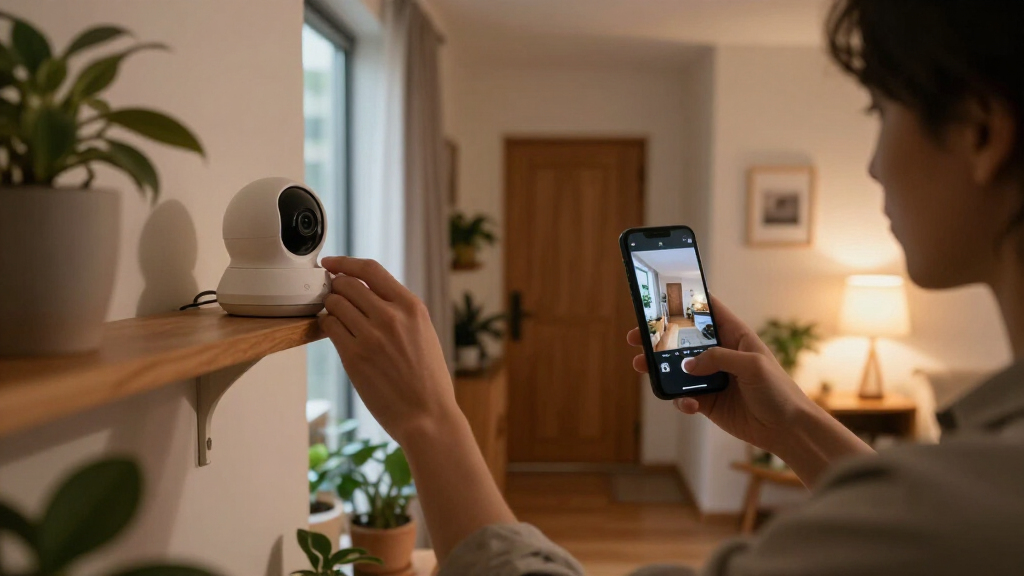

Choosing smart home security cameras often comes down to a practical tradeoff: do you want a dependable system installed in fixed locations, or cameras that are easy to set up and move? Wired smart security cameras connect to power, a recorder, or both through cables. Wireless models typically use Wi-Fi and may run on batteries, though some still need a power cord.

Get the latest gadgets delivered free with Prime
- Fast, free delivery on millions of items
- Prime Video, Amazon Music and more included
- Member-only deals all year

Blink Outdoor 4 Wireless Security Camera System, 3 Cameras
- ✔ Camera count: 3
- ✔ Video resolution: 1080p HD
- ✔ Night vision: Infrared
Blink Outdoor 4 Wireless Smart Security Camera System, 5 Cameras
- ✔ Camera count: 5
- ✔ Video resolution: 1080p HD
- ✔ Field of view: 143° diagonal
Blink Outdoor 4 Wireless Smart Security Camera System, 2-Camera Kit with Sync Module Core
- ✔ Camera count: 2
- ✔ Video resolution: 1080p HD
- ✔ Night vision: Infrared
Wired cameras suit homeowners who can plan a lasting installation and value consistent recording. Wireless cameras fit renters, smaller homes, and people who want to start monitoring quickly without running cable. The difference affects more than setup: it shapes outage resilience, maintenance, storage choices, and long-term cost. The right choice depends on where cameras will go and how much upkeep you are willing to accept.
At a Glance
| Criteria | Wired smart security cameras | Wireless smart security cameras | Winner |
|---|---|---|---|
| Installation and placement | Requires cable routing or a compatible existing connection; best for fixed locations. | Fast to install and easier to reposition; battery models offer the most flexibility. | B |
| Power and upkeep | Usually draws continuous power; fewer battery checks or charging interruptions. | Battery models need recharging or replacement; plug-in wireless models still need nearby power. | A |
| Connection reliability | Can use wired networking or a direct recorder connection, reducing reliance on Wi-Fi. | Depends on Wi-Fi for remote access and often for alerts; walls and congestion can weaken service. | A |
| Recording and storage | Often pairs well with local recorders; capabilities and costs vary by system. | Frequently offers cloud plans; some models also support local storage. | Depends |
| Smart alerts | Features vary by model; local processing may be available. | Often offers accessible app controls and alerts; advanced features may require a subscription. | Depends |
| Privacy and outage resilience | A local recorder can keep footage available during internet outages, depending on setup. | Cloud features can be limited by internet outages; account, app, and device settings shape privacy. | A |
| Long-term value | Higher installation effort or upfront cost can pay off through less maintenance. | Lower setup effort may come with battery replacements, accessories, or recurring service costs. | Depends |
Blink Outdoor 4 Wireless Security Camera System, 3 Cameras
For most households, the three-camera Outdoor 4 kit strikes the most useful balance: enough cameras to cover several likely approach points, without requiring a five-camera plan from the outset. It keeps the same core experience as the other kits, including 1080p live view, infrared night vision, two-way talk, and Alexa compatibility. The cameras run on included lithium AA batteries and are rated for up to two years, which can make placement simpler where a power outlet is inconvenient.Compared with the two-camera kit, this package gives us a third viewpoint for a side gate, garage, or rear entrance. The five-camera option is more appropriate when we need broad coverage across a larger property, but its extra cameras do not change the detection or storage limitations. The shared Sync Module Core cannot store footage locally, and cloud clip storage and person detection require a subscription. That makes this a practical fit for buyers who value straightforward wireless placement and can accept the subscription model, but a poor match for anyone seeking included local recording.
Pros:
- Three cameras cover more approaches than the two-camera kit while staying less extensive than the five-camera bundle.
- 1080p live view, infrared night vision, and two-way audio support basic monitoring day and night.
- Included lithium batteries are rated for up to two years, subject to use and conditions.
- Works with Alexa for compatible smart home control.
Cons:
- The included Sync Module Core does not support local storage.
- Cloud clip storage and person detection require an optional subscription.
Best for: Households that want to monitor several common entry points with a moderate camera count and use Alexa-compatible devices.
Not ideal for: Buyers who need local recording included, want person detection without a subscription, or only need to watch one or two locations.
Bottom line: We recommend this kit for balanced multi-entry coverage, provided its subscription-based storage model fits our needs.
“We recommend this kit for balanced multi-entry coverage, provided its subscription-based storage model fits our needs.”
Blink Outdoor 4 Wireless Smart Security Camera System, 5 Cameras
When the priority is watching multiple sides of a house, five cameras provide the widest coverage in this comparison. The kit can serve a front entrance, driveway, back door, and additional outdoor approaches without mixing camera systems. Its 143-degree diagonal field of view and up to 30 fps video are listed specifications, while 1080p HD, infrared night vision, and two-way audio match the other Outdoor 4 bundles.That additional coverage is the reason to choose it over our three-camera pick; the camera capabilities themselves are not a step up. We should also account for the practical burden of installing and maintaining five battery-powered devices. Each uses two non-rechargeable AA lithium batteries, and actual battery life depends on activity and settings. Like the smaller bundles, this one ships with a Sync Module Core that has no local storage. Person detection and cloud storage also require a subscription, so the kit is best for buyers who genuinely need several views and are comfortable with that ongoing feature model.
Pros:
- Five cameras make it easier to cover more entrances and outdoor approaches with one kit.
- 1080p video, infrared night vision, and two-way audio match the core capabilities of the smaller kits.
- The listed 143-degree diagonal field of view can help capture more of a scene from each camera position.
- Includes five mounting kits and ten lithium AA batteries.
Cons:
- The cameras use non-rechargeable batteries, and maintaining five units takes more attention.
- Local storage is not supported by the included Sync Module Core.
- Person detection and cloud clip storage require a subscription.
Best for: Owners of larger homes or properties who want several outdoor viewpoints managed through one Alexa-compatible camera family.
Not ideal for: Small homes, buyers with only a couple of monitoring points, or anyone seeking rechargeable batteries or included local recording.
Bottom line: We’d choose this kit when broad coverage is worth installing and maintaining more cameras, not for a feature upgrade over the smaller bundles.
“We’d choose this kit when broad coverage is worth installing and maintaining more cameras, not for a feature upgrade over the smaller bundles.”
Blink Outdoor 4 Wireless Smart Security Camera System, 2-Camera Kit with Sync Module Core
The two-camera kit makes sense when we have a clear, limited plan: perhaps one camera for the front door and another for a driveway or patio. It includes the same essentials found in the larger packages: 1080p live view, infrared night vision, two-way talk, dual-zone enhanced motion detection, Alexa compatibility, and batteries rated for up to two years. Fewer cameras can also mean fewer mounting decisions and battery-powered units to manage.Compared with the three-camera bundle, this kit is less flexible if we later want to watch a side entrance or rear approach; compared with the five-camera version, it leaves more of a property’s perimeter uncovered. It does not otherwise give up a listed core camera feature. The same storage compromise applies: the included Sync Module Core offers no local storage, while cloud storage and person detection depend on an optional subscription. Choose it for a deliberately small setup, but skip it if we already know that several locations need monitoring or want recording without recurring service requirements.
Pros:
- Two cameras suit a focused setup without placing extra devices around the home.
- Includes 1080p live view, infrared night vision, and two-way talk.
- Batteries are rated for up to two years, depending on use and conditions.
- Dual-zone enhanced motion detection and Alexa compatibility are included.
Cons:
- Two viewpoints offer less flexibility than the three- and five-camera kits.
- The included Sync Module Core does not support local storage.
- Person detection and cloud storage require a subscription.
Best for: Renters or homeowners who want to monitor two specific outdoor locations with wireless, Alexa-compatible cameras.
Not ideal for: People planning to cover multiple entrances or needing local recording and person detection without a subscription.
Bottom line: We’d pick the two-camera kit for two clearly defined monitoring points, while choosing the three-camera option if broader coverage is likely.
“We’d pick the two-camera kit for two clearly defined monitoring points, while choosing the three-camera option if broader coverage is likely.”
As an Amazon Associate we earn from qualifying purchases.
Key Differences
The first major difference appears at installation. Wireless cameras can usually be placed and connected through an app with little more than a Wi-Fi password, which is a real advantage for renters or anyone avoiding wall work. Wired systems take more planning and may require cable routing, but their fixed setup is less likely to need attention after installation. “Wireless” does not always mean cord-free: many Wi-Fi cameras still need a nearby outlet.
Power and connectivity shape reliability over time. A wired camera with steady power avoids battery downtime, while a network cable or local recorder can reduce dependence on Wi-Fi. Battery cameras can be dependable, but recording settings, activity levels, and weather affect how often they need charging. Wireless cameras also rely on a strong signal at every placement point, so a convenient location may not be a useful one if the connection is weak.
Cost and privacy vary more by model than by the wired or wireless label. Some systems save footage locally; others charge for cloud history, person detection, or longer retention. A lower purchase price can become less attractive if a subscription is required for features you expect to use. Check how footage is stored, what happens when the internet goes down, and whether alerts or recordings depend on a paid plan before choosing.
Detailed Comparison
Installation and placement (Wireless smart security cameras wins — major)
Wireless wins; the gap is major for renters and anyone who wants a quick setup. A Wi-Fi camera can often be mounted without routing data cable, and a battery model can go where there is no outlet. Wired cameras need a suitable cable path and fixed mounting point. That takes more planning, but it can produce a cleaner, lasting installation for a homeowner who knows where coverage is needed.
Power and upkeep (Wired smart security cameras wins — moderate)
Wired wins; the gap is moderate. Continuous power avoids the recurring task of charging batteries and the risk that a camera is offline while charging. Battery life varies with model, temperature, recording frequency, and settings, so high-traffic areas may need more frequent attention. Plug-in Wi-Fi cameras avoid battery care but still require an outlet at the chosen location.
Connection reliability (Wired smart security cameras wins — moderate)
Wired usually wins; the gap is moderate and depends on the connection design. A camera connected to a recorder or wired network is less exposed to Wi-Fi interference and weak signal through walls. Wi-Fi cameras are simpler to install, but their performance depends on router range and network congestion. A strong mesh network can narrow the difference; it cannot make a distant or obstructed camera location automatically reliable.
Recording and storage (moderate difference)
Neither format wins across the board; the gap depends on the specific system. Wired kits commonly include or support a local recorder, which can make continuous recording and longer retention practical without a monthly cloud plan. Many wireless cameras emphasize cloud storage for easy remote playback, while some also offer local cards or hubs. Compare retention limits, recording modes, and what remains available if service ends.
Smart alerts (minor difference)
It is a model-level comparison; neither camera type has a consistent advantage. Both can offer motion, person, vehicle, or package alerts, but detection quality and notification controls differ. Some systems perform analysis locally, while others process events through cloud services or restrict advanced detections to paid plans. Choose based on the alerts you need and their included cost, rather than assuming a cable determines intelligence.
Privacy and outage resilience (Wired smart security cameras wins — moderate)
Wired systems with local recording often win; the gap is moderate. A local recorder can preserve footage through an internet outage, though remote access and alerts may still stop. Cloud-dependent wireless cameras can lose some functions when the connection fails. Neither format guarantees privacy: review account security, encryption information, retention controls, and whether recording or detection sends data to a provider.
Long-term value (moderate difference)
The winner depends on installation and service costs. Wired cameras can cost more to install, especially if cabling or professional labor is needed, but may avoid frequent battery care and can pair with local storage. Wireless cameras reduce setup expense and make expansion easy, yet battery replacements, extra hubs, or subscriptions can add up. Paying more for wired equipment makes sense when it solves a real coverage or reliability problem.
Wired smart security cameras: Pros and Cons
Pros:
- Steady power supports continuous operation without battery charging.
- Wired networking or a local recorder can reduce reliance on Wi-Fi and cloud storage.
- Well suited to fixed, high-priority areas such as entrances and driveways.
Cons:
- Cable routing makes installation slower and less flexible.
- Moving or expanding the system can require additional wiring.
- Installation costs can be high where cable runs or professional work are needed.
Wireless smart security cameras: Pros and Cons
Pros:
- Quick setup and flexible placement, especially with battery-powered models.
- A practical option for renters or homes where cable routing is difficult.
- Easy to reposition or expand as monitoring needs change.
Cons:
- Battery models need recharging and can have recording gaps during maintenance.
- Wi-Fi quality affects connection and access to remote features.
- Cloud history and advanced alerts may add recurring subscription costs.
Who Should Choose What
Choose Wired smart security cameras if:
- You own your home, know the camera locations, and want a lasting installation.
- You want steady power for busy areas or prefer a system built around a local recorder.
- Your Wi-Fi is unreliable near the places that need monitoring.
Choose Wireless smart security cameras if:
- You rent, want to avoid drilling or cable runs, or need to move cameras often.
- You want to install a small system yourself and prioritize convenience.
- The camera locations have good Wi-Fi, and you are comfortable maintaining batteries or using nearby outlets.
Skip both if: Neither type will work well if your camera locations lack dependable power and network coverage and you cannot improve either. Address those limits before buying, or consider a camera designed for standalone local recording.
Value for Money
Wireless is often the better value when avoiding installation work matters more than recurring upkeep. A modest system can cover a rental or small home without paying to route cable, and battery models make placement possible where outlets are scarce. That value holds only if the camera’s included storage and alerts meet your needs. Add the subscription and battery costs over the time you expect to own it before comparing sticker prices.
Wired is worth paying more for when the cameras protect fixed, frequently used entrances, when Wi-Fi coverage is poor, or when you want local recording without depending on a cloud plan. The initial cost can buy fewer charging interruptions and a more stable connection. For a couple of low-traffic locations with strong Wi-Fi, that reliability premium may not deliver enough benefit to justify extensive wiring.
Final Verdict
For most homeowners building a permanent system around key entrances, choose wired cameras if the installation is practical: steady power and a reliable path to local recording are meaningful advantages where missed footage matters. Choose wireless cameras if fast installation, flexible placement, or avoiding cable work is the priority. Before paying extra, confirm whether the features you want—especially recording history and smart alerts—are included or subscription-based. The deciding factor is whether long-term reliability at fixed locations is worth the added installation effort.
Frequently Asked Questions
Are wireless security cameras completely wire-free?
No. Wireless usually describes the network connection. Battery models can avoid a power cord, but many Wi-Fi cameras still need an outlet. Check both power and network requirements before deciding where to mount one.
Do wired cameras keep recording during an internet outage?
They can if the system records to a local recorder or storage device and still has power. Remote viewing, cloud backups, and phone alerts may stop during the outage. Confirm which functions work offline for the specific system.
Do wireless cameras require a monthly subscription?
Not always. Some support local storage or include basic event history, while others charge for longer cloud retention or advanced detection. Check the plan details before purchase, including what happens to saved footage if you cancel.
Which type is better for renters?
Wireless is usually easier for renters because it avoids long cable runs and can be repositioned when you move. A plug-in model still needs a convenient outlet, and a battery camera needs occasional charging. Verify any mounting restrictions in your lease.