
🔍 Read the full analysis: 15 Best AI Automation Tools For Small Businesses In 2027 on ThorstenMeyerAI.com

Get the latest gadgets delivered free with Prime
- Fast, free delivery on millions of items
- Prime Video, Amazon Music and more included
- Member-only deals all year
TL;DR
This is a roundup of 15 books about AI automation for small businesses, not a review of 15 working software platforms. The source ranks the titles using their stated audiences and topics, but does not provide enough detail to verify their contents, integrations, or results.
A roundup presented as “15 Best AI Automation Tools for Small Businesses in 2027” actually compares 15 books about using AI in business, not software platforms that automate tasks, as explained in the original analysis. The distinction matters for owners choosing a resource: the books may help readers plan workflows, but businesses still need to select, configure and check the software that performs them.
The roundup’s top overall pick is AI Automation for Small Businesses: A Practical Guide to Automating Marketing, Sales, Customer Service, Operations, and Everyday Work. Its stated scope spans several common business functions. The source does not provide a full contents list, sample pages or evidence about outcomes, so the title’s description—not verified performance—is the basis for that assessment.
For readers seeking a more directed starting point, the source highlights AI Automation Made Simple for Small Business for its no-code workflow focus and ChatGPT for Business: The 10X Playbook for workflow ideas that readers can adapt. Other titles are characterized through signals in their names, including practical business processes, everyday tasks, entrepreneurship, or a structured plan. The source does not supply enough information to summarize each book’s contents independently.
The ranking is based on stated audience, promised format and named topics, with extra weight given to practical workflow coverage, accessibility for nontechnical owners and relevance to marketing, sales, customer service and operations; the features that matter most in automation software are a separate consideration. The source says specialized books may suit a specific tool or learning preference, even if broader guides are placed higher. It does not report controlled testing, interviews with authors or comparisons of implemented automations.
The 15 picks
- 1
 Smart AI for Small Business: 50 Simple Hacks to Grow Revenue, Cut Costs, and…View on Amazon →
- 2
 The Small Business Owner’s AI Handbook: How to Use Artificial Intelligence to…View on Amazon →
- 3
 AI Tools for Small Business: A Practical Guide to Automation, Saving Time, an…View on Amazon →
- 4
 AI-Powered Automation and Workflows for Small Business OwnersView on Amazon →
- 5
 ChatGPT for Business: The 10X Playbook — 100 AI Workflows to Save Time, Grow…View on Amazon →
- 6
 AI Automation for Small Businesses: Build Smarter Workflows, Save Time, Reduc…View on Amazon →
- 7
 Claude AI Made Practical: A Beginner’s Guide to Everyday Work, Small-Business…View on Amazon →
- 8
 AI Automation for Small Businesses: A Practical Guide to Save Time, Work Smar…View on Amazon →
- 9
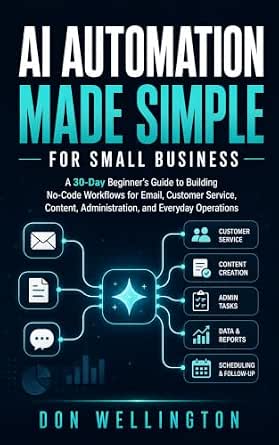 AI Automation Made Simple for Small Business: A 30-Day Beginner’s Guide to No…View on Amazon →
- 10
 AI Automation for Small Business: Simple AI Workflows for Everyday TasksView on Amazon →
- 11
 AI Automation for Small Business: A Practical Guide to Automating Marketing,…View on Amazon →
- 12
 AI for Small Business, Volume I: Getting Started — Set It Up Yourself, No Tec…View on Amazon →
- 13
 AI for Small Business: From Marketing and Sales to HR and OperationsView on Amazon →
- 14
 AI Automation for Small Businesses: Build Semi-Passive Income Systems Without…View on Amazon →
- 15
 AI for Entrepreneurs and Small Business Owners: How to Compete with Larger Bu…View on Amazon →
1. AI Automation for Small Businesses
The roundup’s overall choice is a broad guide whose title names marketing, sales, customer service, operations and everyday work. That makes it a possible fit for owners comparing needs across departments. The title indicates intended coverage; the source does not verify how deeply each function is covered.
Products Worth Considering

Samsung Galaxy Tab A11+ Tablet, 6GB RAM, 128GB Storage, Expandable Storage, Gray

Bose Lifestyle Ultra Wireless Home Speaker, White Smoke

Samsung 27-Inch Odyssey G5 QHD Gaming Monitor (G51F)
As an affiliate, we earn on qualifying purchases.
2. AI Automation Made Simple for Small Business
This title is presented as a beginner-oriented option focused on no-code workflows. It may appeal to owners who want to explore automation without starting with programming. Readers should check a sample or description to confirm how much setup guidance the book offers.
3. ChatGPT for Business: The 10X Playbook
The source describes this book as emphasizing ready-to-adapt workflow ideas. Its stated focus is ChatGPT in a business setting, rather than automation across every possible AI platform. The roundup does not verify specific instructions or business results.
4. A guide centered on everyday work
The source says some titles focus on everyday tasks rather than broad departmental coverage. Such a guide may be more relevant to an owner seeking help with recurring administrative work, but the provided material does not identify its specific examples or tools.
5. A title with a 30-day plan
A structured plan in a title can signal a staged learning path for readers who want a schedule. That wording alone does not establish the plan’s detail, workload or effectiveness. Prospective readers should check the book description and sample pages.
6. A guide for setting up workflows
The roundup notes titles that signal a set-up-yourself approach. This framing may suit owners ready to put a process into practice. The source does not confirm which services or integrations are covered.
7. A practical business-process guide
Some picks are described as emphasizing repeatable processes. That orientation may help readers think beyond prompts and map how work moves through a business. The available material does not provide enough detail to assess the instructions.
8. A guide for entrepreneurs
Entrepreneur-focused titles are described as emphasizing growth and competition. They may address a different goal from books aimed at reducing routine administrative work. The source offers no measured evidence that using these approaches increases growth.
9. A marketing-focused resource
Marketing is one of the functions named in the broader books’ stated scope. A more specialized marketing guide could be relevant to owners with a defined promotional workflow, but the source does not specify its coverage or recommended platforms.
10. A sales-focused resource
Sales is another named area in the roundup’s broad coverage. Readers should match any sales workflow advice to their own customer records and follow-up practices, and verify details against the software they use.
11. A customer-service resource
A customer-service focus may help owners consider how AI fits into inquiry handling. Customer-facing messages need review rules, since an inaccurate response can affect a customer. The supplied information does not establish what safeguards any particular book recommends.
12. An operations-focused resource
Operations-oriented titles may be relevant to recurring internal processes. Before automating, owners should define consistent steps and the result they expect. The source does not identify specific operational examples for this pick.
13. A guide to AI concepts
The roundup advises readers to distinguish resources that explain AI from those that help map or build workflows. A conceptual introduction may suit someone early in the learning process, but its usefulness depends on whether it connects ideas to the reader’s work.
14. A guide to mapping processes
Process mapping can help a business identify repetitive work before choosing AI automation software. The source presents this as a useful distinction among learning paths, but does not confirm which individual title provides detailed mapping exercises.
15. A tool-specific learning resource
Some titles are described as more specialized around a particular tool or learning style. Such a book may fit readers who have already chosen an assistant, but owners should verify that its advice matches current software and their existing systems.
Choosing a Book Is Not Choosing Software
For a small business, a book can help clarify what to automate, but it does not itself connect email, customer records, calendars or payment systems. The difference affects budgeting and expectations: the owner may still need a separate platform, time for configuration and a plan for checking results. The source explicitly frames these picks as learning resources, not automation tools.
The practical value depends on the task. Owners can start by identifying work that consumes time, recording how it is handled and choosing a guide whose stated scope matches that process. They should also set review rules for AI-generated customer messages, financial details and sensitive information. These are selection considerations, not evidence that any particular book guarantees savings or improved performance.
How the 15 Books Were Ranked
The source says it compared the titles as business learning resources, giving weight to practical workflow coverage, an accessible entry point and relevance to common business functions. Its judgments rely on titles and stated descriptions. It acknowledges that those signals cannot confirm precise instructions, compatible integrations or results.
That limitation is especially relevant in a fast-changing software market. A guide’s broad advice may remain useful while platform features change, but readers should verify current integration and setup details with the software providers. The supplied source gives no publication dates or edition information for the individual books.
“These are learning resources, not automation platforms.”
— ThorstenMeyerAI.com roundup
What the Roundup Cannot Verify
The supplied material names the leading picks and describes broad categories among the 15, but it does not provide complete bibliographic details, author information, publication dates, individual descriptions or a full item-by-item list of titles. It also does not include book samples or independent testing. As a result, claims about each title’s depth, accuracy, software compatibility and usefulness remain unverified by the source material.
It is also unclear whether the books address current versions of AI services or how often their advice is updated. No implementation results, cost comparisons or measured time savings are reported. Readers should treat the ranking as a guide to stated topics, not proof that a book will produce a particular business outcome.
Check Fit Before Buying
Owners considering a title can begin by writing down a repetitive task, who performs it and how often it occurs. They can then compare the book’s description and sample pages with that need, check whether its examples fit existing software and confirm how much hands-on setup guidance it offers. For customer-facing or sensitive work, set approval rules before putting AI-generated output into use.
The source does not announce new editions, follow-up testing or a next publication milestone. The next step for readers is to verify current book details and software compatibility directly with publishers and providers, then test any workflow on a limited basis before relying on it in routine operations.
Key Questions
Are these 15 picks AI automation software?
No. The roundup compares books and learning resources. Businesses must choose and configure separate software to carry out workflows.
Which book does the source rank highest?
It names AI Automation for Small Businesses: A Practical Guide to Automating Marketing, Sales, Customer Service, Operations, and Everyday Work as its overall pick, based on the broad scope indicated by its title.
What does the source recommend for beginners?
It highlights AI Automation Made Simple for Small Business for its stated no-code workflow focus. The source cautions that a title alone cannot confirm the depth of its setup instructions.
Does the roundup show that the books save time or increase sales?
No. It reports no measured outcomes or comparative testing. The ranking is based on stated audiences, formats and topics, not demonstrated business results.
What should a small business check before using an AI workflow?
Identify the process and software involved, verify that the services support the needed connections, and decide which outputs need human review—especially customer messages, financial information and sensitive records.
Source: ThorstenMeyerAI.com