TL;DR
The cost of a given level of AI performance has fallen about 13 times per year since 2023, while Google’s reported monthly token volume rose from 9.7 trillion in May 2024 to more than 3.2 quadrillion in May 2026. The International Energy Agency says efficiency gains are helping broaden AI adoption and projects data-center electricity use will rise from 485 terawatt-hours in 2025 to about 950 TWh in 2030. The pattern is consistent with the Jevons paradox, but whether efficiency increases total resource use depends on how much demand grows.
Google’s monthly token count rose from 9.7 trillion in May 2024 to more than 3.2 quadrillion in May 2026, according to the source material. These are reported usage figures; the material does not specify a baseline that would support treating the change as a measure of energy use or comparing it directly with electricity consumption.

Get the latest gadgets delivered free with Prime
- Fast, free delivery on millions of items
- Prime Video, Amazon Music and more included
- Member-only deals all year
The IEA counted 485 terawatt-hours (TWh) of electricity used by data centres in 2025. It said electricity use was up 17% overall that year and up 50% at data centres built for AI. The agency projects data-centre electricity use will reach about 950 TWh in 2030. That projection covers data centres, not AI alone.
In the IEA report, efficiency improvements are “also fuelling broader adoption of AI services, a dynamic known as the Jevons paradox.” The agency says total electricity use from AI “is set to increase in the near term.” That is the IEA’s assessment; the figures presented do not establish how much of the increase is caused by lower costs, or isolate AI’s share of all data-centre demand.
Lower AI Costs, Rising Power Needs
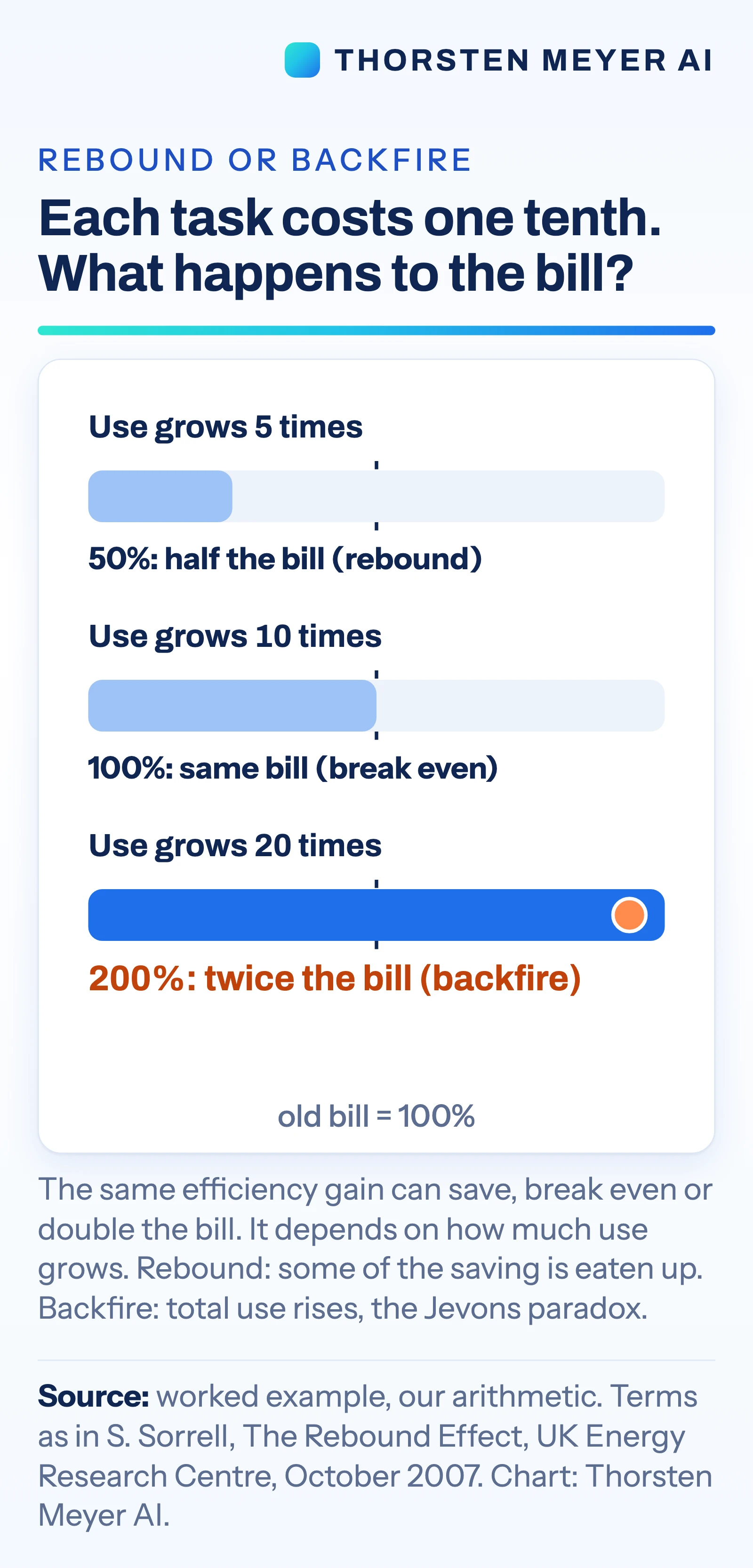
For companies, a lower price per token can make AI economical in more tasks and lead teams to use it more often. That means the cost of a single operation may fall even as the total bill rises. The source analysis recommends budgeting by the cost per completed task and tracking uses that consume more tokens, including reasoning and agent systems.
For electricity planning, the key measure is total demand across data centres, not the energy used by one simple prompt. The analysis points to heavier uses such as video generation and agents as relevant to power demand, while cautioning that the overall totals matter more than an individual interaction. The available figures show growth but do not quantify the contribution of each kind of AI use.
The Jevons framework helps explain why efficiency gains do not guarantee lower total consumption. It does not, by itself, prove that AI efficiency is causing the observed rise in electricity use. Demand growth, new applications and other data-centre workloads may also contribute.
Products Worth Considering

Bose Home Speaker 500 Smart Bluetooth Speaker, Black

Apple Watch Series 12 GPS 42mm Smartwatch

Apple Watch SE 3 GPS 40mm Smartwatch
As an affiliate, we earn on qualifying purchases.
Jevons’s Coal-Era Argument
British economist William Stanley Jevons set out the idea in his 1865 book The Coal Question. He argued that more efficient steam engines could make coal-powered work cheaper, encouraging wider industrial use. In his account of Scottish iron production, he said coal needed per ton of iron fell to less than a third of its former amount while total consumption increased tenfold.
The modern terms rebound and backfire describe different outcomes. If efficiency makes a task cheaper and people do more of it, some of the expected resource savings are offset: that is rebound. If the increase in use exceeds the efficiency gain and total consumption rises, it is called backfire, the stronger form associated with Jevons’s paradox.
The source cites a 2007 review for the UK Energy Research Centre, which found that efficiency gains usually still reduce energy use overall, though by less than engineers expect. In other words, backfire is a possibility rather than a universal law. The current AI figures are presented as suggestive of that pattern, not as proof that it applies in every AI market or use.
““It is wholly a confusion of ideas to suppose that the economical use of fuel is equivalent to a diminished consumption. The very contrary is the truth.””
— William Stanley Jevons, The Coal Question (1865)
How Much Demand Comes From Efficiency?
The figures supplied do not show how much of the increase in data-centre electricity use is attributable to AI, lower AI prices, or other factors. Nor do they establish that the rise in reported token volume translates into a proportional rise in energy use. The IEA’s 2030 projection covers data centres as a whole, and the source does not provide a forecast isolating AI’s electricity consumption.
It is also unclear whether efficiency-led demand will keep growing fast enough to outweigh reductions in energy per task. As the UK Energy Research Centre review indicates, efficiency often lowers total consumption even when it produces a rebound. The extent of any rebound or backfire will depend on how much usage expands and what resources each task requires.
Track Tasks, Tokens and Electricity
Businesses can monitor spending per completed task alongside token use, especially for reasoning and agent workloads, to see whether lower unit prices are changing total consumption. That gives teams a more useful view of costs than token prices alone.
For the broader energy picture, subsequent reporting will need comparable figures that separate AI workloads from other data-centre activity and show how efficiency changes over time. The IEA projects total data-centre electricity use at about 950 TWh in 2030; the supplied material does not specify a later milestone that will determine whether AI efficiency leads to a lasting increase in total use.
Key Questions
What is the Jevons paradox?
It is the possibility that making a resource more efficient lowers the cost of using it, encourages more use, and raises total consumption. It is not an automatic outcome.
Are AI systems using more electricity because they are cheaper?
The IEA says efficiency gains are helping broaden AI adoption and that AI electricity use is set to rise in the near term. The figures provided do not establish how much of the increase is caused by lower costs.
How much electricity did data centres use in 2025?
The IEA counted 485 TWh in 2025, up 17% overall from the prior year. It reported a 50% rise at data centres built for AI.
Does the 2030 electricity projection cover AI alone?
No. The projected 950 TWh refers to data centres overall. The supplied material does not give a separate 2030 figure for AI electricity use.
Source: Thorsten Meyer AI