
🔍 Read the full analysis: Google Calls Genie 4 A “Key Stepping Stone” To AGI. Can An AI That Paints Worlds Understand The Real One? on ThorstenMeyerAI.com

Get the latest gadgets delivered free with Prime
- Fast, free delivery on millions of items
- Prime Video, Amazon Music and more included
- Member-only deals all year
TL;DR
Google DeepMind describes Genie 4’s ability to generate realistic environments as a “key stepping stone” toward AGI. That is a research goal, not a measured result: published tests of related video models show a gap between visual realism and physical understanding, and Genie 4 itself has not been tested on the cited benchmark.
Google DeepMind says Genie 4’s ability to generate realistic environments is a “key stepping stone” on the path to artificial general intelligence (AGI), arguing that simulated worlds could give AI agents and robots places to practise. The statement describes a research direction, not a finding that Genie 4 understands physical laws: the model has not been evaluated on the cited physics benchmark, and tests of related video models show that realistic-looking output can fall short of physical reasoning.
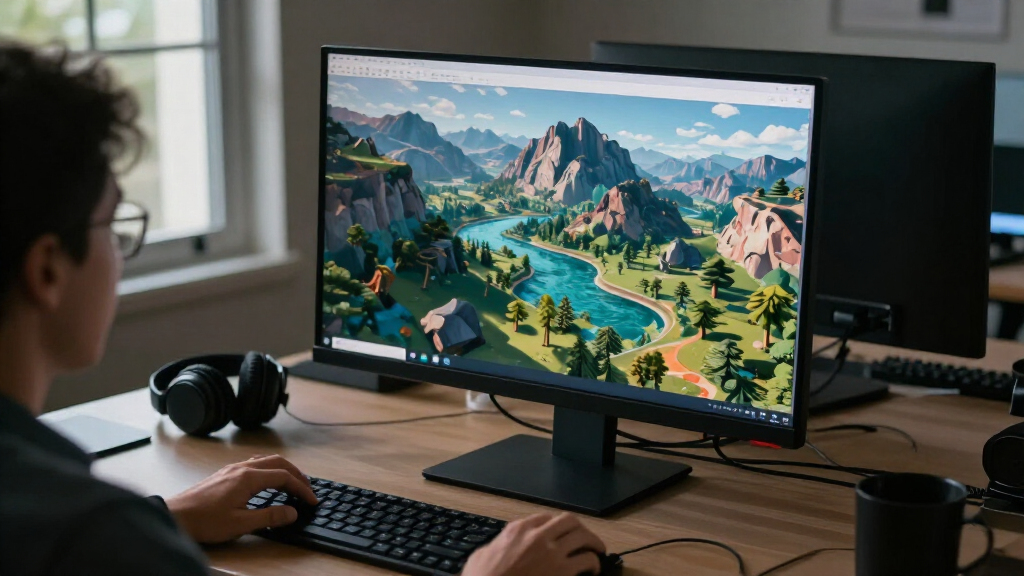
Genie 4 generates interactive scenes from visual input and user actions. A person can provide a key press, mouse movement or written instruction, and the model predicts what appears in subsequent frames. The source account describes the output as photorealistic and accompanied by sound, but says there is no conventional game engine or stored three-dimensional map underneath. Its performance in producing a convincing scene does not, by itself, establish that it has learned the rules governing that scene.
Google’s argument is that agents need broad and varied practice before operating in the physical world, while real-world training can be slow, costly and difficult to stage safely. DeepMind has reported that its SIMA 2 agent could navigate and follow instructions in environments generated by Genie 3, and that the agent could improve in newly created environments. Waymo has said its driving simulator is built on Genie 3 and can produce unusual scenarios. These are company-reported examples involving earlier systems, not independent proof of Genie 4’s physical reasoning.
The counterpoint includes research from Google’s own researchers. The source account says the 2025 Physics-IQ benchmark found video models’ physical understanding “severely limited” and unrelated to visual realism. On Physics-IQ Verified, where real videos score 100, the best image-to-video result cited was 55.1 across eight attempts; Gemini Omni 1.1 Flash scored 35.3. The account says Genie 4 has not been tested on that benchmark. DeepMind’s described system also divides work: a Gemini model plans scenes and checks frames, while Genie generates the images.
THE AGI CLAIM, VERSION BY VERSION
Three Genies, one promise
Google DeepMind has tied every recent Genie to the path to AGI. Here is what each version could do, what was claimed, and who said it.
- 4 Dec 2024Genie 23D worlds from one image, consistent for up to about a minute.“…the breadth and generality required to progress towards AGI.”Company claim
- 5 Aug 2025Genie 3First real-time Genie: 720p, 24 frames per second, a few minutes of consistency.“World models are also a key stepping stone on the path to AGI…”Company claim
- 13 Nov 2025SIMA 2 in Genie 3 worldsDeepMind's game agent orients itself and self-improves in newly generated worlds.“…a major milestone toward training general agents across diverse, generated worlds.”Company report
- 6 Feb 2026Waymo World ModelWaymo says its driving simulator is built on Genie 3 and can generate rare events.“…from a tornado to a casual encounter with an elephant.”Company report
- 27 Oct 2026Genie 4Photorealism, native sound, live text steering, Gemini in the loop. Trusted testers only.“…a key stepping stone on the path to AGI.”Company claim
- 31 Oct 2026TechRadar pushes backColumnist Eric Hal Schwartz: realism is not understanding.“Faking plausibility is easier than grasping the underlying rules…”Opinion
The Genie 2 and Genie 3 capability notes are DeepMind’s own descriptions. No Genie post measures progress toward AGI; DeepMind published no benchmark numbers for Genie 4.
Sources: Google DeepMind, Genie 2 (4 Dec 2024), Genie 3 (5 Aug 2025), SIMA 2 (13 Nov 2025), Genie 4 model page (read 1 Nov 2026); Waymo (6 Feb 2026); TechRadar (31 Oct 2026, opinion).
Powered by Thorsten Meyer AI
Why Simulated Practice Matters
If generated worlds help agents learn skills that transfer to real settings, they could reduce the time, expense and risks of training robots and other systems on physical equipment. Simulations could also let developers test rare situations—such as unusual road hazards—that are difficult or unsafe to reproduce on demand. DeepMind’s reports about SIMA 2 and Waymo’s simulator point to possible uses, though they concern Genie 3 and are company statements rather than independent evaluations of Genie 4.
For businesses, the distinction affects how much weight to place on demonstrations. A model may be useful for sketching scenarios or stress-testing an idea without reliably predicting what a real robot, vehicle or structure will do. Buyers evaluating world-model products would need evidence from relevant physical tests, not only appealing clips. For the broader AGI debate, Google’s wording signals an ambition and a theory about useful training environments; it does not show that the model has achieved general intelligence or that its generated worlds accurately capture the real one.
Products Worth Considering

Apple MacBook Air 15-inch (2026) with M5 chip, 16GB memory, 512GB SSD, Silver

Bose TV Speaker Compact Soundbar with Bluetooth and HDMI-ARC, Black

LG UltraGear 32GX850A-B 32-Inch 4K UHD Glossy OLED Gaming Monitor
As an affiliate, we earn on qualifying purchases.
From Genie 2 to Genie 4
Google’s language about world models and AGI predates Genie 4. According to the source account, DeepMind described Genie 2 in December 2024 as pointing toward the breadth and generality needed for progress toward AGI. In August 2025, its Genie 3 post called world models a “key stepping stone” on that path. The Genie 4 model page repeats the phrase while linking realistic environments to training and testing agents.
The term “world model” covers different approaches. One approach is a learned environment in which an agent imagines what may happen next and practises, as in research on game-playing agents. Genie 4 is presented as a system that predicts video frames in response to input. Other systems use structured data and explicit rules; the source account gives a construction model trained on building data as an example. A visual simulation can show a bridge, but that image alone does not show whether the system can calculate how much weight the bridge can hold.
Google’s stated case is about providing practice environments, not claiming Genie 4 has reached AGI. The distinction matters because a visually convincing simulation and a physically reliable model are different capabilities, even when both are described as representing a world.
“The ability to explore an unlimited range of realistic environments is a key stepping stone on the path to AGI.”
— Google DeepMind, on the Genie 4 model page
What Genie 4 Has Not Shown
There is no cited Physics-IQ result for Genie 4, and the source account says DeepMind published no benchmark numbers measuring its progress toward AGI. The available comparison figures concern other video models and cannot establish how Genie 4 performs. Nor do reported uses of Genie 3 by SIMA 2 and Waymo answer whether Genie 4’s generated scenes preserve the physical rules needed for reliable real-world transfer.
It is also unclear how well skills learned in generated environments carry over to robots or other systems outside those environments, and how reliably the models handle unusual cases. A demonstration that produces plausible motion is not the same as a controlled test of whether the system predicts outcomes correctly. The source material does not provide independent evaluations, detailed testing methods or results that resolve those questions.
Evidence Needed Beyond Demonstrations
The next useful evidence would be published Genie 4 evaluations that test physical prediction, consistency across different conditions and transfer from simulated practice to real tasks. Comparisons should explain the benchmark, scoring scale and baseline, so results can be interpreted rather than inferred from isolated examples. Until those results are available, Google’s “key stepping stone” description remains a statement about its research strategy.
Companies considering world models can ask vendors for task-specific physics and transfer tests, including how performance changes in rare or unfamiliar scenarios. Readers can follow for further benchmark releases and independent testing; the source material does not identify a date for either.
Key Questions
Is Google saying Genie 4 is AGI?
No. Google DeepMind describes realistic environment generation as a “key stepping stone” on a path to AGI. That is a statement about the model’s proposed role in research, not a claim that Genie 4 has achieved AGI.
What does Genie 4 do?
According to the source account, Genie 4 generates interactive video scenes by predicting later frames based on earlier frames and user input, such as a key press or written instruction. A convincing scene alone does not establish that the model understands the scene’s physical rules.
Has Genie 4 passed the Physics-IQ benchmark?
The source account says Genie 4 has not been tested on Physics-IQ Verified. The cited scores—55.1 for the best of eight image-to-video attempts and 35.3 for Gemini Omni 1.1 Flash—are results for other models, not Genie 4.
Why would AI developers use generated worlds?
Simulated environments could give agents and robots more opportunities to practise, including in scenarios that are expensive, slow or unsafe to stage in the physical world. Whether those skills transfer reliably to real settings remains an open question.
What evidence would show that Genie 4 understands physics?
Useful evidence would include published tests of its physical predictions, performance across varied conditions and demonstrations that skills learned in simulation transfer to real tasks. The source material does not report those results for Genie 4.
Source: ThorstenMeyerAI.com