
🔍 Read the full analysis: When Almost Everyone Farmed on ThorstenMeyerAI.com

Get the latest gadgets delivered free with Prime
- Fast, free delivery on millions of items
- Prime Video, Amazon Music and more included
- Member-only deals all year
TL;DR
An article published Nov. 3 traces how tools, fertilizer and improved seeds reduced farming’s share of the U.S. workforce from about 73.7% around 1800 to roughly 1.5% today. The author cites an International Labour Organization estimate that 928 million people still work in agriculture worldwide and presents further automation as a forecast, not an established outcome.
Thorsten Meyer published an installment of his “Work After Work” series on Nov. 3, describing how farming’s share of the U.S. workforce fell from an estimated 73.7% around 1800 to about 1.5% today as farm output rose. The account matters as a historical test of claims about automation: the shift took generations, and an estimated 928 million people worldwide still work in agriculture.
Meyer draws on economic historian Stanley Lebergott’s estimates, later published by the U.S. Census Bureau, for the early American figures. The 1800 estimate counts about 1.4 million agricultural workers in a labor force of 1.9 million people aged 10 and older. It includes roughly 530,000 enslaved people. Because figures before 1840 are estimates rather than census counts, Meyer describes the result as about three in four workers, not as a precise census measurement.
The employment share fell before the number of farm workers did. In the United States, the number of agricultural workers continued rising until about 11.8 million around 1910. Germany’s agricultural share fell from 43% in 1882 to 25% in 1939, while its farm workforce remained between eight million and 10 million, according to the figures cited in the article. These examples show that a shrinking share of workers does not necessarily mean an immediate fall in the sector’s headcount.
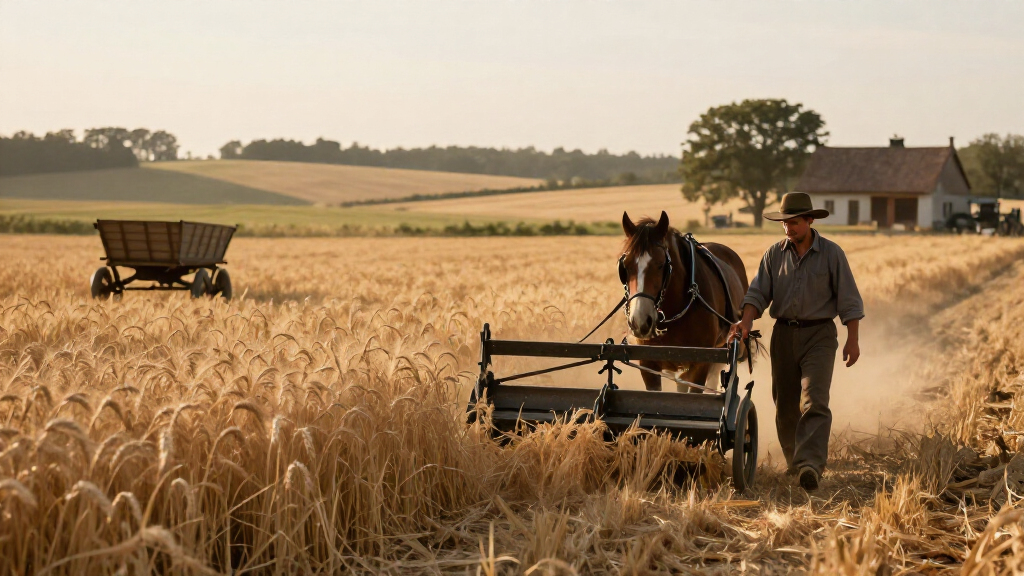
Meyer describes change through a sequence of tools, fertilizer and crop breeding rather than a single invention. He cites Deere & Company’s account of a steel plough made in 1837, and the development of synthetic ammonia fertilizer after Fritz Haber filed a patent in 1908. He also points to dwarf wheat varieties introduced in India and Pakistan in the 1960s. Indian wheat production rose from 12.3 million tonnes in 1964–65 to 26.4 million tonnes in 1971–72, based on government statistics cited in the article.
Agricultural Work Has Not Disappeared
The history complicates the idea that automation quickly removes workers from an industry. In the U.S. example, farming’s employment share fell over roughly two centuries, and its workforce kept growing for decades even as the wider economy expanded. The shift combined new equipment with fertilizer, improved seeds and changes in production, rather than following a single technological breakthrough.
Meyer cites an International Labour Organization estimate for 2025 that 928 million people work in agriculture, about one in four workers globally. The source gives national shares of roughly 43% in India, 1.5% in the United States and 1% in Germany. Those differences matter: the U.S. history is not a timetable that can simply be applied to countries where agriculture still employs a large portion of the workforce.
The article also challenges the claim that fewer farmers must mean less food. It reports that global cereal harvests increased 4.2-fold from 1961, while the world population increased 2.7-fold over the same period. That comparison describes output and population growth; it does not by itself explain the contributions of technology, trade, food distribution or access. The broader lesson is that productivity can rise while employment shares fall, but the pace and effects vary.
Products Worth Considering

Bose QuietComfort Headphones (2nd Gen), Wireless Over-Ear Noise-Cancelling Headphones, Hazelnut Taupe

Apple Watch SE (2nd Gen) GPS 40mm with Starlight Aluminum Case and Sport Band (S/M)

Apple Watch Series 8 GPS, 41mm, Midnight Aluminum Case with Midnight Sport Band (S/M)
As an affiliate, we earn on qualifying purchases.
A Long Chain of Farm Changes
Meyer frames farming as the first of three sectors—field, factory and office—in a series about how economies are built. The Nov. 3 installment focuses on why so many people once had to work on farms: before modern inputs and equipment, food production relied heavily on human and animal labor, and a household could produce little beyond what it consumed.
The figures he assembles come from different kinds of records and should not be treated as one uniform global dataset. The U.S. estimate for 1800 is a historical reconstruction; Japan’s figure for 1872 is an estimate by economic historians; Germany’s early figures combine a reconstruction with later occupational census results. China’s series begins in 1952, when 83.5% of employed people worked in the primary sector, while India’s 1951 census counted cultivators and agricultural laborers as 69.7% of workers.
The article connects several changes in farming capacity. Steel ploughs could work soils that had clogged wooden or iron equipment. Synthetic ammonia made a concentrated source of nitrogen fertilizer possible, while short-straw wheat varieties could support heavier grain heads when combined with fertilizer and irrigation. Meyer says the U.S. farm output figure for 2023 was nearly three times its 1948 level with only a small rise in total inputs, citing the USDA’s productivity data. These are distinct developments accumulated over time, not evidence that one invention alone caused the transformation.
“The share fell long before the headcount.”
— Thorsten Meyer, author of the Nov. 3 installment
Limits of the Historical Comparison
The historical employment shares rely on different definitions, periods and methods. Some early figures are estimates rather than direct counts, and the German census cited by Meyer undercounted women who helped on family farms. The country figures are useful snapshots, but they do not establish a single path or timeline for agricultural change.
The source material does not provide enough detail to independently assess every productivity comparison or its underlying methodology. The global cereal and population multipliers cover the period from 1961, but do not isolate the effect of machinery, fertilizer, crop breeding, land use or other factors. The article’s U.S. output comparison likewise does not, on its own, show how gains were distributed among farmers, workers and consumers.
Meyer’s suggestion that automation could affect up to 90% of a sector within a decade or a few decades is explicitly his thesis. The installment offers no defined sector, measurement method or forecast model for that estimate. It should not be read as an established prediction about when agricultural jobs—or jobs in other sectors—will disappear.
Further Installments on Work
The article identifies itself as Episode 2, Arc 1 of “Work After Work.” Meyer says the preceding installment introduced a three-sector framework and that Episode 3 will cover mechanical reapers, threshers and tractors. Those topics are presented as part of the series, rather than as a newly announced policy or research milestone.
For readers following the wider argument, the next installment may add detail on how farm machinery changed labor needs. The current article does not provide a schedule for future episodes, announce new data or set out a verified forecast for the next stage of agricultural automation. Its immediate contribution is a historical account whose estimates and claims can be compared with later installments and their sources.
Key Questions
What is the news in “When Almost Everyone Farmed”?
Thorsten Meyer published an installment on Nov. 3 tracing the long decline in farming’s share of the workforce and the technologies associated with rising agricultural output. It is a reported historical piece, not an announcement of a new study or policy.
How many U.S. workers farmed around 1800?
The article cites an estimate of 73.7% of the U.S. labor force, or about 1.4 million of 1.9 million workers aged 10 and older. The figures are historical estimates, not a census count, and include enslaved people.
How many people work in agriculture worldwide?
Meyer cites an International Labour Organization estimate for 2025 of 928 million people, about one in four workers globally. The article also reports large differences among countries, including a much higher agricultural employment share in India than in the United States or Germany.
Does the article predict that 90% of jobs will be automated?
No. Meyer calls the possibility that automation could affect a sector of up to 90% within a decade or a few decades his thesis. The installment does not present this as a confirmed result or a forecast supported by a defined method.
What farming changes does the article describe?
It points to improved tools, synthetic ammonia fertilizer and higher-yield crop varieties, including dwarf wheat introduced in India and Pakistan in the 1960s. Meyer presents these as stages in a longer shift, rather than attributing agricultural change to one invention.
Source: ThorstenMeyerAI.com