
📊 Full opportunity report: Retirement Care Planner on IdeaNavigator AI — validation score, market gap, and execution plan.

Get the latest gadgets delivered free with Prime
- Fast, free delivery on millions of items
- Prime Video, Amazon Music and more included
- Member-only deals all year
TL;DR
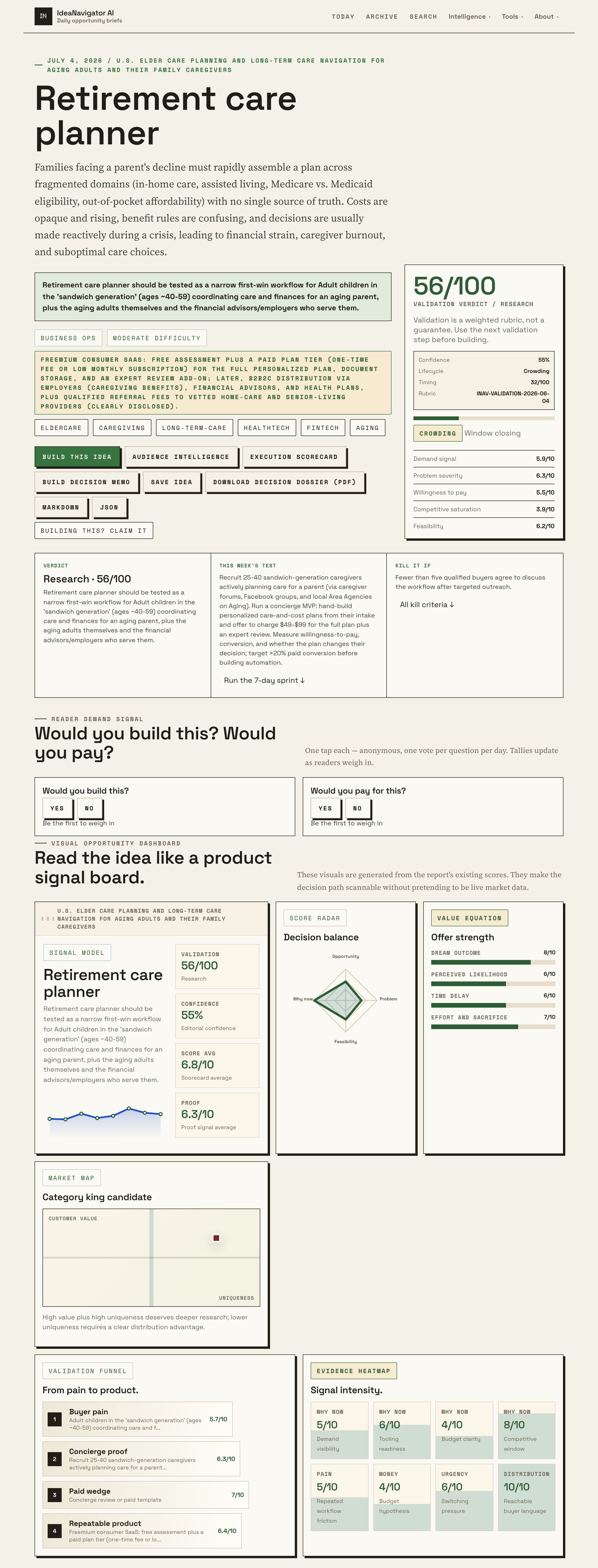
A new web-based retirement care planner is in pilot testing, aimed at helping middle-aged adult children coordinate care and finances for aging parents. The tool offers personalized plans based on local costs and eligibility, addressing a critical market need.
A new retirement care planning web app is being tested as a targeted solution for middle-aged caregivers in the ‘sandwich generation’ to streamline care and financial decisions for their aging parents. The initiative aims to address the fragmented, confusing process families currently face, which often leads to reactive decisions and financial strain. Appointment no-show recovery planner for therapy practices
The proposed platform offers a guided, personalized assessment based on a brief intake of the parent’s health, location, and finances. It then generates a localized cost comparison for in-home care, assisted living, and nursing homes, along with an explanation of Medicare and Medicaid eligibility and a projection of affordability. The initial pilot focuses on a single high-cost state to manage data complexity.
This effort is part of a broader move to provide structured, accessible guidance amid rising long-term care costs—median assisted living costs now reach approximately $6,200 per month, and nursing home expenses average around $115,000 annually. The tool’s development is driven by the increasing demographic demand, with about 73 million Americans expected to be 65+ by 2030, and nearly 70% of those turning 65 likely to need long-term care.
Implications for Family Caregivers and the Elder Care Market
This initiative could significantly improve how families plan for long-term care, reducing reactive decision-making and financial surprises. By providing a clear, data-driven roadmap, it aims to alleviate caregiver stress, prevent financial burnout, and promote better care choices. The tool also opens new revenue streams for providers through freemium models, employer partnerships, and referral fees, potentially transforming elder care navigation in the US.
Products Worth Considering

LG 27GS60QC-B Ultragear 27-inch Curved Gaming Monitor (QHD, 180Hz, 1ms, 1000R)

Amazon Kindle Scribe Colorsoft 64GB with Premium Pen

DJI Mini 3 Drone with DJI RC Controller
As an affiliate, we earn on qualifying purchases.
Growing Need for Structured Long-Term Care Planning
Current elder care planning in the US is hampered by fragmented information, opaque costs, and complex benefit rules. Families often make urgent decisions during crises, leading to suboptimal outcomes. The rising costs of long-term care and demographic shifts have heightened the urgency for accessible, reliable planning tools. Previous efforts have focused on broader education or simplified guides, but a comprehensive, personalized digital solution has yet to gain widespread adoption.
The concept of a dedicated retirement care planner aligns with recent trends toward digital health and financial planning tools, but its application to elder care remains in early testing stages. This pilot aims to validate whether families are willing to pay for such guidance and whether it influences their decision-making process.
“Families face a complex, often confusing landscape when planning for a parent’s long-term care. A guided, personalized approach could change that.”
— an anonymous researcher
Uncertainties Around Pilot Outcomes and Adoption
It is not yet clear how many families will adopt the platform during the pilot phase, or whether they will find it sufficiently helpful to pay for the full service. The effectiveness of the localized cost comparisons and eligibility explanations in influencing decisions remains to be validated. Additionally, the scalability of the tool and its integration into existing elder care services are still uncertain.
Next Steps for Pilot Testing and Market Expansion
The initial testing involves recruiting 25-40 caregivers actively planning for a parent, with plans to offer personalized care-and-cost plans at a fee of $49-$99. The focus is on measuring willingness-to-pay, plan effectiveness, and decision impact. Pending positive results, the developers aim to refine automation, expand geographic coverage, and establish partnerships with employers, financial advisors, and elder care providers. Broader rollout could follow within the next 12-18 months.
Key Questions
How will the platform determine local care costs?
The platform will use public benchmark data to compare costs for in-home aides, assisted living, and nursing homes in the selected area, providing localized estimates based on the user’s input.
What are the main benefits for families using this tool?
It offers personalized, data-driven care plans, helps clarify Medicare and Medicaid options, and provides an actionable checklist to make informed decisions and manage expenses more effectively.
Will the platform be available nationwide?
Initially, the pilot focuses on a single high-cost state to manage data complexity, but plans include expanding to additional states after validating the model.
Is there a cost to use the service?
The initial assessment is free; full personalized plans will be offered for a fee of $49-$99 during the pilot, with potential subscription or B2B options in the future.
How does this tool help reduce caregiver burnout?
By providing clear guidance and reducing decision-making stress, the platform aims to lessen emotional and financial strain on family caregivers.
Source: IdeaNavigator AI