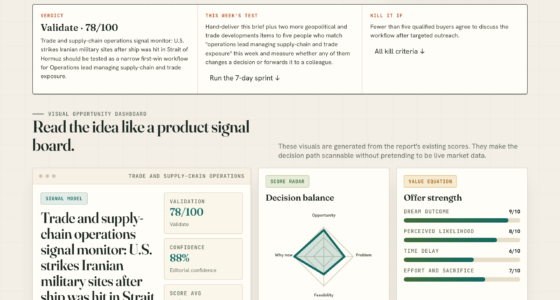

📊 Full opportunity report: Forezai · Polybot: When the AI Disagrees With the Odds on ThorstenMeyerAI.com — validation score, market gap, and execution plan.

Get the latest gadgets delivered free — and shop member deals
- Fast, free delivery on millions of items
- Access to Prime Big Deal Days deals on October 6–7
- Prime Video, Amazon Music and more included
TL;DR
Polybot is an experimental AI that compares its probability estimates with prediction market prices. It only trades when significant divergence occurs, aiming to assess when AI can reliably challenge market odds. The project emphasizes cautious, calibrated approaches over aggressive trading.
Polybot, an AI trading tool developed for the prediction market platform Polymarket, is experimenting with whether an AI can accurately form independent probability estimates that disagree with market prices and whether it should act on those differences. This project explores the limits of AI in financial prediction and the risks involved in automated trading based on disagreement with crowd-sourced odds, emphasizing that it remains a research prototype rather than a commercial system.
The core idea behind Polybot is to have an AI researcher analyze public information about a market question, generate its own probability estimate, and compare it to the market-implied price. When the discrepancy exceeds a certain threshold—accounting for trading fees, slippage, and model uncertainty—the bot considers executing a trade. Importantly, the system is designed to trade rarely and only on the strongest signals, prioritizing risk management over frequent trading.
Polybot records its reasoning behind each estimate, enabling post-trade analysis and calibration over time. The project explicitly states that it is an experimental tool, not a money-making system, emphasizing that market prices are dense information aggregators and that beating them consistently is extremely difficult. The developers caution that AI estimates are still just hypotheses, and confident predictions can be wrong, especially given the adversarial nature of markets and the costs associated with trading on thin edges.
Polybot — when the AI disagrees with the odds
A prediction market puts a price on the future. Polybot asks: can an AI’s own estimate diverge from that price for real — and should it ever act on the gap?
Not financial, investment, legal or tax advice; not a recommendation or solicitation to trade, invest or use any software. Forezai · Polybot is experimental software, developed privately and not publicly available, provided “as is” without warranty of accuracy or profitability. Trading and automated trading carry a substantial risk of loss including total loss of capital; past or backtested performance does not indicate future results. Prediction-market participation is restricted or prohibited in some jurisdictions (including for US persons) — you are solely responsible for compliance with applicable law. Consult a licensed professional before any financial decision. Produced with AI assistance under human editorial oversight; independent commentary, the author’s own views. Product and company names are trademarks of their respective owners; mention does not imply endorsement.
Implications for AI-Driven Market Analysis
Polybot’s experiment highlights the potential and limitations of AI in financial prediction markets. If successful, it could demonstrate that AI can, under certain conditions, identify mispricings worth acting upon. However, the project also underscores the importance of risk discipline and calibration, reminding users that even sophisticated models can be confidently wrong. This work contributes to understanding how AI might augment or challenge crowd-based predictions, with implications for finance, forecasting, and AI safety.
AI trading bot for prediction markets
As an affiliate, we earn on qualifying purchases.
As an affiliate, we earn on qualifying purchases.
Background of Prediction Markets and AI Testing
Prediction markets like Polymarket aggregate public opinions into a single price, representing a collective probability of future events. These markets are difficult to beat because their prices reflect extensive, money-weighted information. Prior efforts to develop AI systems that challenge market odds have generally struggled with calibration, costs, and adversarial responses. Polybot builds on this context by testing whether an AI can reliably identify when its independent estimate diverges meaningfully from market prices and whether it should act on such signals.
“Polybot is an experiment in understanding when an AI can meaningfully disagree with the crowd and whether it should act on that disagreement.”
— Thorsten Meyer, project lead
automated trading software for prediction markets
As an affiliate, we earn on qualifying purchases.
As an affiliate, we earn on qualifying purchases.
Uncertainties About AI Effectiveness and Market Impact
It is not yet clear whether Polybot’s divergence-based approach can produce consistent, profitable results over time. The system is experimental, and past backtests may not reflect live market conditions, where costs and market adaptations could negate any potential edge. Additionally, the extent to which AI can reliably identify mispricings without falling prey to overconfidence remains unproven.
As an affiliate, we earn on qualifying purchases.
Next Steps for Testing and Development
Developers plan to monitor Polybot’s performance over extended periods, focusing on calibration metrics and real-world trading outcomes. Further iterations may include refining thresholds, improving model transparency, and integrating more sophisticated risk controls. The project aims to contribute to broader research on AI’s role in financial markets and forecasting, with ongoing assessments of its practical viability.
prediction market analysis software
As an affiliate, we earn on qualifying purchases.
As an affiliate, we earn on qualifying purchases.
Key Questions
Can Polybot reliably beat prediction markets?
Currently, Polybot is an experimental system designed to test whether AI can identify meaningful divergences. Its effectiveness in beating markets is unproven and remains a subject of ongoing research.
Is Polybot suitable for live trading or investment?
No, Polybot is strictly a research prototype. It is not recommended for live trading, as it carries significant risks and is intended for experimental purposes only.
What are the main challenges for AI in prediction markets?
Challenges include calibration of estimates, costs like fees and slippage, adversarial responses from markets, and the difficulty of reliably identifying mispricings without overconfidence.
Will Polybot be commercialized or used in real trading?
There are no plans for commercialization; the project is open-source and aimed at understanding the theoretical and practical limits of AI in prediction markets.
Source: ThorstenMeyerAI.com
Fall Picks
fall essentials
As an affiliate, we earn on qualifying purchases.