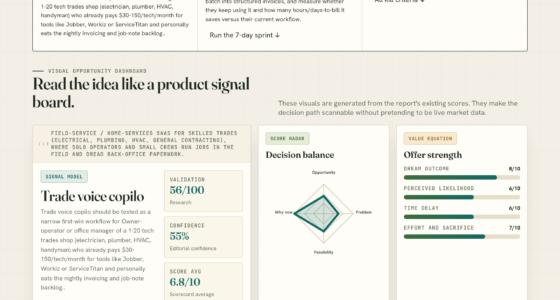
📊 Full opportunity report: Backyard Homes And Home Improvement: An ADU Guide on IdeaNavigator AI — validation score, market gap, and execution plan.

Get the latest gadgets delivered free — and shop member deals
- Fast, free delivery on millions of items
- Access to Prime Big Deal Days deals on October 6–7
- Prime Video, Amazon Music and more included
TL;DR

IdeaNavigator AI has outlined a proposed service that would give homeowners address-specific reports on whether a backyard accessory dwelling unit may fit their lot, what it could cost and what rent it might bring. The concept has not been shown to be operating: its suggested first step is a manual pilot that fulfills 25 paid reports in one California market.
IdeaNavigator AI has proposed a paid report service for homeowners considering a backyard accessory dwelling unit, or ADU, that would assess a property’s potential under local rules and estimate costs and rental income. The concept is at the proposal stage; no operating product, pilot results or customer demand figures were provided, so the immediate development is a plan to test whether homeowners will pay for these reports.
The proposed web service would let a homeowner enter a property address and buy a PDF feasibility report. For an initial market, the plan calls for using county parcel records, including lot boundaries, lot area and existing building footprints, alongside state ADU law and a manually curated set of local zoning rules. The report would estimate allowed ADU types and size, setbacks, lot coverage and buildable area.
It would also provide a construction cost range and projected rental income based on nearby rent comparisons. Those figures would be estimates: the proposal does not describe a site inspection, builder quote or guarantee that a local authority would approve a project. A button offering an introduction to a vetted builder would create a possible referral channel.
IdeaNavigator AI suggests charging homeowners roughly $25 to $75 per report, with other potential revenue from subscriptions or white-label and API access for builders and architects, plus referral fees from design-build firms or renovation lenders. These are proposed business models, not reported prices, contracts or revenue.
A Faster First Check for ADUs
A parcel-specific screening report is presented as a way for homeowners to gather information before commissioning detailed plans or arranging a builder visit. The proposal identifies an early-stage step in which homeowners review zoning rules, lot constraints and project economics before deciding whether to proceed. According to the proposal, a report of this kind would consolidate that information into a single document.
The proposal also states that the same screening could allow builders and lenders to sort inquiries by whether a property appears to meet basic constraints for further review. It does not provide data on how much time this would save or how participants in the industry currently handle such inquiries. The value of the reports would depend on the quality of local rules and parcel data, and on how uncertainty is communicated. A preliminary estimate would not substitute for official review, detailed design or a site assessment.
The concept is aimed at a market where housing supply is a continuing policy concern and ADUs are one source of additional homes. The proposal cites California permitting and production figures to explain its timing, but those figures do not establish demand for this particular service.
California’s ADU Policy Backdrop
California began statewide ADU law changes in 2016, and the proposal says the state has loosened rules repeatedly since. It points to Los Angeles County permitting more than 45,000 ADUs in 2023 and says ADUs made up roughly one in five new housing units produced in California. These figures are presented as market context; the proposal does not provide underlying datasets or definitions for the statewide share.
The suggested product would begin in one metro or county, such as a Los Angeles or Bay Area market, rather than attempt to interpret rules nationwide. Its builders would manually curate local zoning requirements and combine them with state law. That narrow launch reflects a practical challenge: requirements can differ among jurisdictions, while lot shape, existing structures and other site conditions affect what may fit.
IdeaNavigator AI argues that parcel data and language-model tools for parsing codes make address-level reports more practical now. The proposal does not describe a technical system already built or publish an accuracy assessment. It frames those capabilities as reasons to test the service, not as evidence that automated zoning interpretations are reliable.
Accuracy and Demand Remain Untested
No pilot findings are available. The proposal does not report how many homeowners have used or paid for a report, whether builders would pay for referred leads, or how often preliminary assessments would match official zoning reviews and site conditions. The estimated cost and rent ranges also lack a stated methodology in the proposal.
It is not yet clear which county would host a pilot, how frequently local rules and parcel records would be updated, or how the service would handle ambiguous codes and properties requiring exceptions or discretionary review. No launch date, operating company, named development team or product has been identified. Until a pilot supplies results, conversion, accuracy and revenue expectations remain unverified.
A 25-Report Concierge Pilot
The proposed next step is a manual concierge pilot in one ADU-friendly metro or county. A landing page would offer a fixed-price “instant backyard home feasibility + ROI report,” while the team researched the first 25 paid orders by hand. This would test whether local homeowners convert from advertising and community outreach into paying customers, and whether buyers request introductions to builders.
After those orders, the plan calls for approaching three to five local ADU builders to ask whether they would pay for qualified leads. The proposal sets out these validation measures but gives no schedule or results. Whether the service advances would depend on the pilot’s willingness-to-pay evidence, lead interest and ability to produce useful, locally grounded reports.
Source: IdeaNavigator AI
Key Questions
Is the ADU report service available now?
The proposal does not say that a service is operating. It describes a possible product and recommends testing it with a manual pilot.
What would a homeowner report include?
It is proposed to cover potential ADU types and size, setbacks, lot coverage, an estimated buildable area, a construction cost range and projected rent based on local comparisons.
How much might a report cost?
The suggested one-off price is roughly $25 to $75. That is a proposed range, not a confirmed price charged by an active service.
Would a report confirm that a property can receive approval?
No approval guarantee is described. The proposed report would be an initial assessment; official review, detailed design and site conditions could affect whether an ADU is allowed.
How would the proposal be tested?
IdeaNavigator AI recommends researching 25 paid orders by hand in one local market, measuring purchases and builder-introduction requests, then asking three to five builders whether they would pay for qualified leads.
Source: IdeaNavigator AI
Fall Picks
fall essentials
As an affiliate, we earn on qualifying purchases.