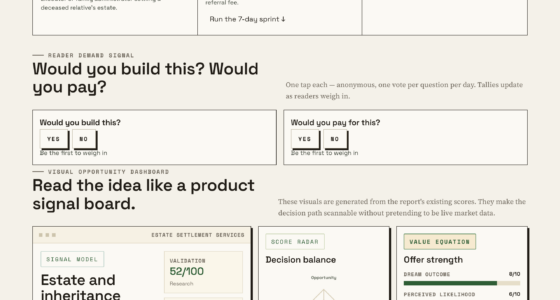
📊 Full opportunity report: Empty Trust Tracker on IdeaNavigator AI — validation score, market gap, and execution plan.

Get the latest gadgets delivered free — and shop member deals
- Fast, free delivery on millions of items
- Access to Prime Big Deal Days deals on October 6–7
- Prime Video, Amazon Music and more included
TL;DR
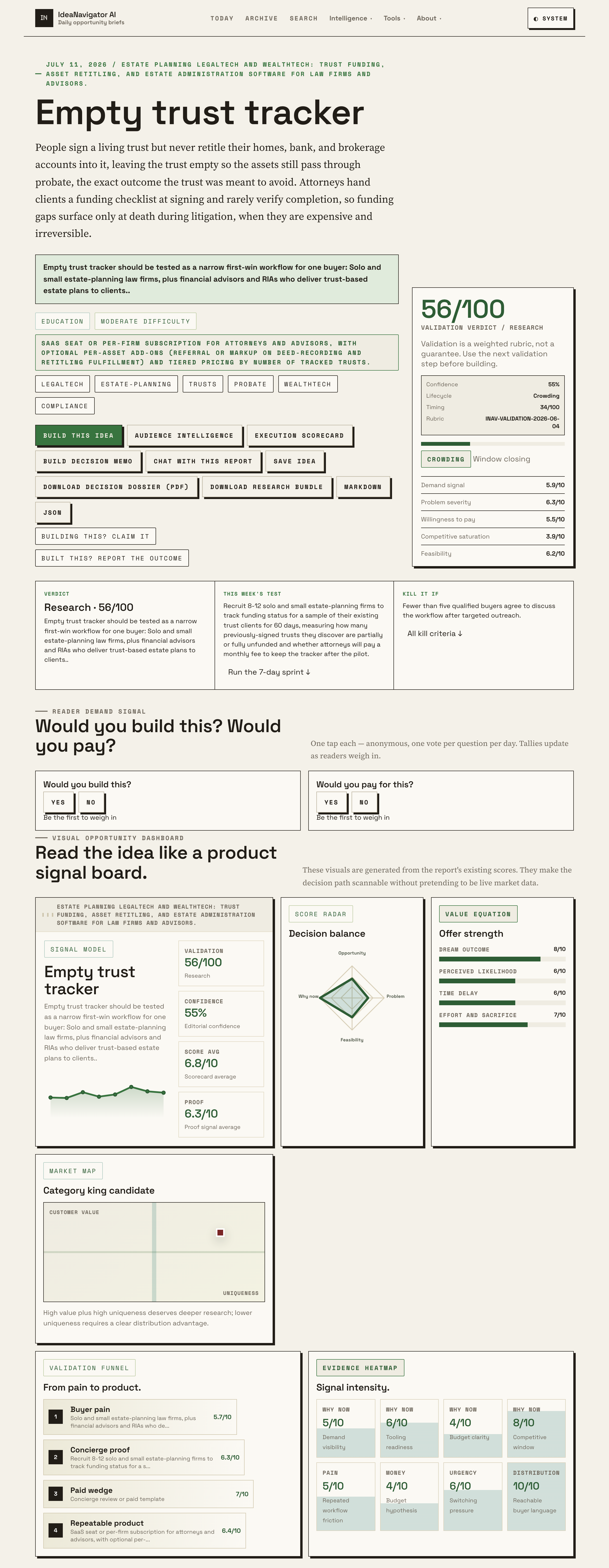
IdeaNavigator AI has outlined a proposed trust funding tracker for small law firms and financial advisers. The concept would let professionals monitor asset transfers, collect proof and remind clients, but no product launch, pilot results or customer commitments are reported.
IdeaNavigator AI has described a proposed trust funding tracker for solo and small estate-planning law firms, financial advisers and registered investment advisers. The concept targets a gap that can leave a signed living trust without the assets it was meant to hold, but the available details describe a product idea and validation plan, not a launched service.
In its published proposal, IdeaNavigator AI says the tool would let a firm create a checklist for each client’s trust and track assets such as real estate, bank and brokerage accounts, business interests and beneficiary designations. Each item could be marked pending, in progress or confirmed funded. Users could attach evidence, such as a recorded deed or a statement showing an account was retitled, and send clients automated reminders.
IdeaNavigator AI’s proposal says a firm dashboard would show the share of tracked assets marked funded across its clients’ trusts. The company says that view could help attorneys and advisers identify trusts with funding gaps while clients are alive. The proposal does not specify how the software would verify documents, connect to financial institutions or handle assets whose ownership cannot be confirmed through uploaded paperwork.
The proposed business model, as described by IdeaNavigator AI, is a subscription charged per firm or user, with pricing tiers based on the number of trusts tracked. Optional per-asset services could involve referrals or markups for deed recording and retitling. The proposal points to deed-funding services priced from $250 per deed as evidence of a paid market, but gives no revenue figures, customer research or pricing commitments for the tracker itself.
Funding Gaps After Signing
A living trust can only manage assets that have been transferred into it or otherwise arranged to benefit it. If a homeowner signs trust documents but leaves a house titled in their individual name, that property may still go through probate. The same general problem can arise with financial accounts, though the legal treatment depends on the asset, its ownership and any beneficiary designation.
IdeaNavigator AI’s proposal identifies an administrative handoff: clients may receive a checklist at signing, while firms may not routinely follow up on every item. A shared status record could make outstanding tasks easier to see and prompt clients to act. That potential value remains a product rationale, not a demonstrated result; the proposal provides no evidence that reminders increase funding rates or prevent disputes.
For small practices and advisers, IdeaNavigator AI says a per-trust dashboard could also make follow-up more systematic across a client book. Yet the tool would need to fit existing workflows and avoid giving users a false sense that a trust is fully funded simply because every checklist box is marked. The proposal does not explain how firms would assess whether a particular asset belongs in a trust or whether a transfer has been completed correctly.
The Proposed 60-Day Pilot
IdeaNavigator AI frames the tracker as a narrow first product for solo and small estate-planning firms, as well as financial advisers who deliver trust-based plans. In its proposal, the company says trust preparation software can produce documents, while the work of moving assets into a trust remains fragmented and often manual.
The material published by IdeaNavigator AI says that about 11% of Americans hold a trust, without providing a survey date, methodology or definition of “hold.” It also characterizes estate-planning adoption and digital tooling as increasing in 2026, but supplies no figures to quantify that trend. These points are part of the proposal’s market case and should not be read as independently verified measurements.
To test demand, IdeaNavigator AI recommends recruiting eight to 12 small firms to track funding status for a sample of existing trust clients over 60 days. The proposed pilot would measure how many previously signed trusts appear partly or wholly unfunded and whether participating attorneys would pay a monthly fee to continue using the tool. The proposal identifies no participating firms, pilot start date or findings.
Demand and Verification Unproven
IdeaNavigator AI’s published proposal includes no launch announcement, working product, named developer, customer, funding round or pilot outcome. It is therefore unclear whether the tracker is being built, how much it would cost or when firms could use it.
The proposal also leaves practical and legal questions open. It does not describe how uploaded deeds and account statements would be stored or protected, who would review them, or how the system would distinguish a completed transfer from an incomplete or legally unsuitable one. The consequences of an unfunded trust vary by asset and circumstances, so a status label alone cannot establish what happens at death.
The 11% estimate cited in IdeaNavigator AI’s material lacks a stated source or methodology, and the proposed pilot has no reported results. Whether firms will pay for ongoing tracking, whether clients will respond to reminders and whether the workflow saves enough staff time to justify a subscription remain unknown.
Pilot Results Would Test Demand
IdeaNavigator AI’s proposal names recruiting eight to 12 solo or small estate-planning firms for a 60-day trial using a sample of existing clients’ trusts as the next step. A useful report from that trial would say how firms defined a funding gap, how many trusts had assets still outstanding, how evidence was reviewed and whether clients completed transfers after reminders.
The other test is commercial: whether attorneys would keep paying a monthly fee after the trial. IdeaNavigator AI gives no timeline for recruitment or indication of whether the pilot will proceed. Until those details or results emerge, the tracker remains a market concept with a proposed validation plan, rather than a proven service.
Source: IdeaNavigator AI
Key Questions
Has the Empty Trust Tracker launched?
The details published by IdeaNavigator AI describe a proposed product and a potential pilot. They do not report a launch or identify a working service.
What would the tracker do?
According to IdeaNavigator AI’s proposal, it would let firms list assets associated with a client’s trust, track each item’s status, attach evidence and send reminders. A dashboard would summarize funding status across the firm’s tracked trusts.
What does an unfunded trust mean?
It generally refers to a trust that has been signed but does not hold some or all assets intended for it. The effect depends on the asset and its ownership arrangements; an asset outside the trust may still be subject to probate.
How would the idea be tested?
IdeaNavigator AI proposes that eight to 12 small firms track a sample of existing trust clients for 60 days. The test would assess funding gaps and whether attorneys would pay to continue, but no trial results are reported.
Source: IdeaNavigator AI
Fall Picks
fall essentials
As an affiliate, we earn on qualifying purchases.