📊 Full opportunity report: Factory VR Trainer on IdeaNavigator AI — validation score, market gap, and execution plan.

Get the latest gadgets delivered free with Prime
- Fast, free delivery on millions of items
- Prime Video, Amazon Music and more included
- Member-only deals all year
TL;DR
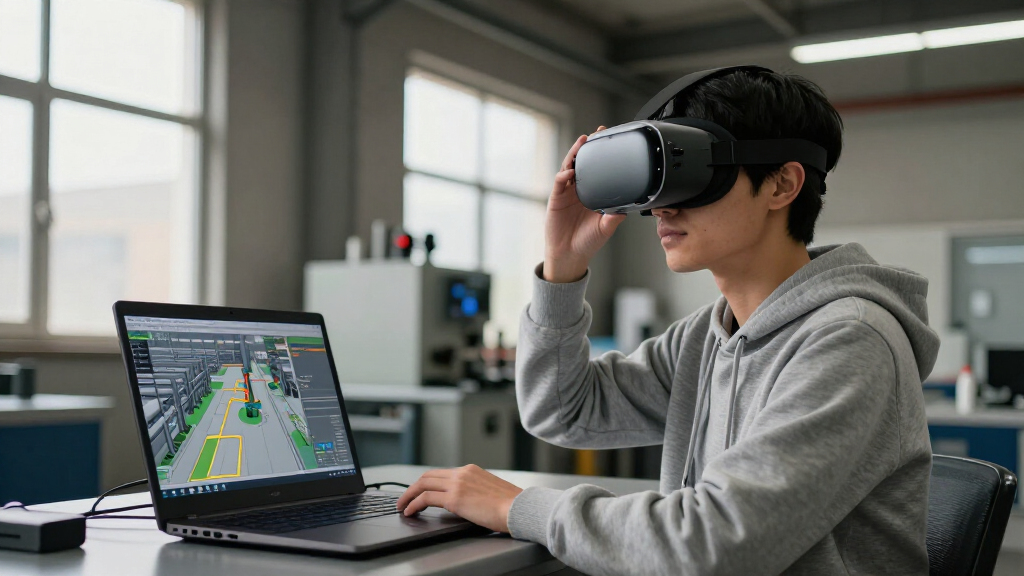
A new virtual reality training module is being piloted by manufacturers to improve onboarding and safety procedures. The initiative aims to address skills gaps and reduce safety incidents, utilizing standalone VR headsets and cloud tracking. Results from the pilot will determine wider adoption.
Manufacturers are launching a pilot program for a factory-specific VR training platform designed to improve onboarding efficiency and safety compliance. The initiative targets mid-to-large manufacturing plants facing labor shortages and skills gaps, aiming to deliver standardized, immersive training on hazardous procedures using standalone VR headsets. The pilot involves deploying a core module focused on safety procedures such as lockout/tagout, with tracking and assessment features to measure effectiveness.
The pilot program is testing a cloud-connected VR module library delivered via standalone headsets like Meta Quest, targeting high-risk procedures such as machinery safety and hazard recognition. The platform includes a dashboard for managers to monitor completion rates, scoring, and hazard detection accuracy per worker. The initial test involves shipping 5-10 headsets to a single plant, with the goal of comparing the VR training outcomes against traditional classroom methods in terms of time-to-competency and hazard-spotting scores.
The initiative is driven by the urgent need for rapid onboarding solutions, as the U.S. manufacturing sector faced approximately 409,000 unfilled positions in August 2025, with projections indicating a need for 3.8 million new workers by 2033. The decreasing hardware costs, driven by the availability of affordable standalone headsets, alongside the growth of immersive training markets at about 20% CAGR, make VR a feasible option for scalable workforce development.
The platform’s revenue model includes per-seat or per-headset SaaS subscriptions, custom scenario development, and optional hardware management services. The pilot’s success will be measured by improvements in training speed, hazard recognition accuracy, and supervisor assessments, with the intention to expand to additional procedures and plants if results are favorable.
Potential Impact on Manufacturing Safety and Efficiency
This VR training pilot could significantly transform manufacturing workforce development by providing standardized, immersive learning experiences that reduce onboarding time and improve safety outcomes. If successful, it could lead to widespread adoption across the industry, helping to mitigate the effects of labor shortages and skills gaps. The ability to track performance metrics digitally also offers manufacturers better insights into training effectiveness and compliance, potentially lowering incident rates and associated costs.
As an affiliate, we earn on qualifying purchases.
Growing Need for Innovative Workforce Training Solutions
The manufacturing sector faces a critical labor shortage, with over 400,000 unfilled positions in the U.S. alone as of August 2025, and an anticipated need for millions more workers over the next decade. Traditional training methods—classroom instruction and on-the-floor supervision—are increasingly inadequate due to safety risks, inconsistent quality, and slow onboarding processes. Advances in XR technology, especially affordable standalone headsets like Meta Quest and Pico, have lowered barriers to deploying immersive training at scale.
Previous efforts to incorporate VR into industrial training have shown promise, but widespread adoption has been limited by hardware costs, lack of tailored content, and integration challenges. The current pilot aims to test a focused, scalable approach by providing a core safety module with real-time tracking and assessment, offering a practical pathway toward broader industry implementation.
VR safety training modules for manufacturing
As an affiliate, we earn on qualifying purchases.
As an affiliate, we earn on qualifying purchases.
Uncertainties Around Pilot Outcomes and Scalability
It is not yet clear whether the VR training platform will deliver statistically significant improvements in onboarding speed and hazard recognition compared to existing methods. The pilot’s success depends on measurable outcomes such as faster ramp-up times and higher hazard-spotting accuracy, which are still being evaluated. Additionally, questions remain about long-term retention, cost-effectiveness at scale, and user acceptance across diverse manufacturing environments.
As an affiliate, we earn on qualifying purchases.
Next Steps in Pilot Evaluation and Industry Adoption
The pilot is expected to run for 60-90 days, during which data on training efficiency, safety performance, and user feedback will be collected. If results are positive, manufacturers plan to expand the VR program to additional procedures and plants, with potential for integrating more complex scenarios. Success could lead to broader industry adoption, supported by ongoing development of content libraries and hardware management services.
As an affiliate, we earn on qualifying purchases.
Key Questions
What safety procedures are included in the initial VR module?
The initial module focuses on high-risk procedures such as lockout/tagout and machinery hazard recognition.
How will the effectiveness of the VR training be measured?
Effectiveness will be assessed through metrics such as time-to-competency, hazard recognition scores, and supervisor evaluations, compared against traditional classroom training benchmarks.
What hardware is used for the VR training?
Standalone VR headsets like Meta Quest are used, which are cost-effective and easy to deploy at scale.
When will the results of the pilot be available?
The pilot is expected to conclude within 60-90 days, with initial results likely available shortly afterward.
Could this VR training replace traditional methods entirely?
While it may supplement or enhance existing training, full replacement will depend on demonstrated effectiveness and industry acceptance.
Source: IdeaNavigator AI
Evergreen bestsellers Picks
bestsellers
As an affiliate, we earn on qualifying purchases.