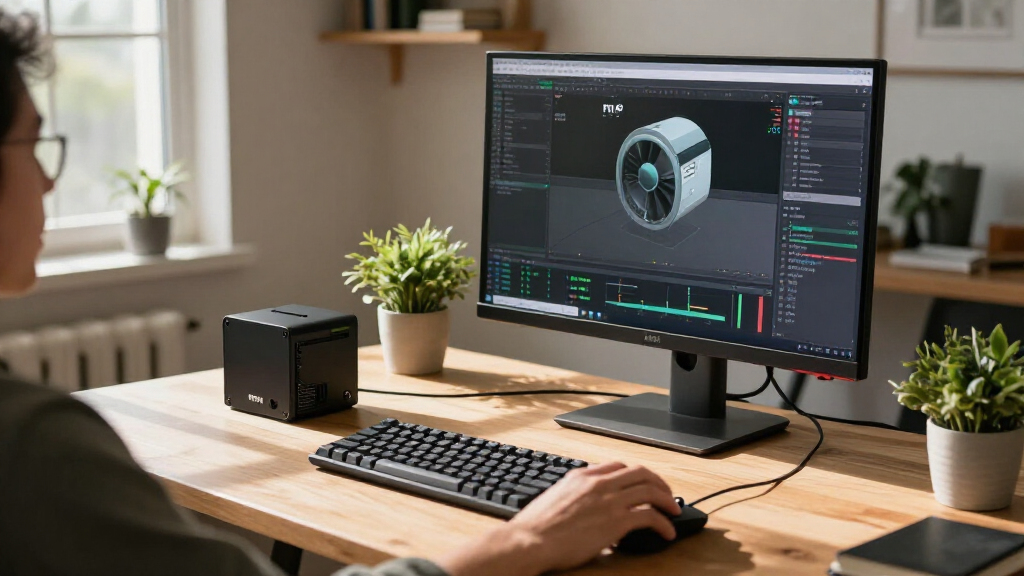

Among the best Nvidia RTX mini PCs in this roundup, I’d put the ROG NUC (2025) with RTX 5070 first for its strong gaming-class GPU and current-generation platform. The MINISFORUM G1 Pro with RTX 5060 is a more restrained gaming pick, while the Dell Pro Max Micro with RTX A400 better suits professional workflows than gaming. The main tradeoffs are graphics power, physical size, cooling demands, and whether you need a gaming GPU or a workstation-class one. Several Intel NUC 12 Extreme configurations share the same processor and case, so their GPU, memory, and operating system matter more than the repeated name. Read on for the full breakdown and buying advice.

Get the latest gadgets delivered free with Prime
- Fast, free delivery on millions of items
- Prime Video, Amazon Music and more included
- Member-only deals all year
Complete the kit



Key Takeaways
- The ROG NUC (2025) RTX 5070 is the clearest all-around gaming choice among the listed current-generation options, while the RTX 5090 Mobile ROG NUC is a far more specialized premium system.
- The MINISFORUM G1 Pro RTX 5060 offers a less extreme gaming configuration than the ROG NUC picks; its 32GB DDR5 and 1TB SSD are enough for many users, but storage needs may call for an upgrade.
- NUC 12 Extreme configurations vary most in GPU and memory, not their Core i7-12700 platform. The RTX 3060 Ti option is the strongest listed NUC 12 gaming configuration, while GTX 1660 Super versions are not RTX systems.
- The Dell Pro Max Micro’s RTX A400 serves a different purpose from gaming GPUs. It is the workstation-oriented pick here, so buyers should match its professional graphics focus to their applications.
- Some listed products do not meet the RTX requirement. The GTX 1050, GTX 1660 Super, and RTX A400 models should not be treated as interchangeable choices for RTX gaming.
| Intel NUC 12 Extreme Mini PC, Core i7-12700, 32GB DDR4 RAM, 2TB SSD, RTX 3060 12GB, Windows 11 Pro |  | Best Overall | Processor: Intel Core i7-12700, 12 cores (8P+4E), 20 threads, up to 4.9 GHz | Graphics: NVIDIA GeForce RTX 3060, 12GB GDDR6 | Memory: 32GB DDR4-3200; supports up to 64GB | VIEW LATEST PRICE | See Our Full Breakdown |
| Intel NUC 12 Extreme Mini PC, Core i7-12700, 32GB DDR4, 2TB SSD, GeForce GTX 1660 Super 6GB, Windows 10 Pro | | Best Legacy Nvidia Pick | Processor: Intel Core i7-12700, 12 cores, 20 threads, up to 4.9 GHz | Graphics: NVIDIA GeForce GTX 1660 Super, 6GB GDDR6 | Memory: 32GB DDR4-3200; supports up to 64GB | VIEW LATEST PRICE | See Our Full Breakdown |
| Intel NUC 12 Extreme Mini PC with Core i7-12700, 32GB RAM, 2TB SSD, and GeForce GTX 1660 Super | | Best Windows 11 Productivity Configuration | Processor: Intel Core i7-12700, 12 cores (8P+4E), 20 threads, up to 4.9 GHz | Graphics: NVIDIA GeForce GTX 1660 Super, 6GB GDDR6 | Memory: 32GB DDR4-3200; supports up to 64GB | VIEW LATEST PRICE | See Our Full Breakdown |
| Intel NUC 12 Extreme Mini PC, Core i7-12700, 64GB DDR4 RAM, 2TB SSD, GeForce RTX 3060, Windows 11 Pro | | Best for Memory-Heavy Workloads | Processor: Intel Core i7-12700, 12 cores (8P+4E), 20 threads, up to 4.9 GHz | Graphics: NVIDIA GeForce RTX 3060, 12GB GDDR6 | Memory: 64GB DDR4-3200 | VIEW LATEST PRICE | See Our Full Breakdown |
| MINISFORUM G1 Pro Mini PC with AMD Ryzen 9 8945HX, 32GB DDR5, 1TB SSD, and GeForce RTX 5060 |  | Best Compact Modern GPU Pick | Processor: AMD Ryzen 9 8945HX, 16 cores and 32 threads, up to 5.4 GHz | Graphics: NVIDIA GeForce RTX 5060, 8GB | Memory: 32GB DDR5-5200; expandable to 64GB | VIEW LATEST PRICE | See Our Full Breakdown |
| ROG NUC (2025) Gaming Mini PC, Intel Core Ultra 9 275HX, GeForce RTX 5070, 32GB DDR5 RAM, 2TB NVMe SSD |  | Best Premium Compact Gaming Pick | Processor: Intel Core Ultra 9 275HX | Graphics: NVIDIA GeForce RTX 5070 Mobile GPU | Memory: 32GB DDR5-6400; maximum 48GB | VIEW LATEST PRICE | See Our Full Breakdown |
| MINISFORUM G1 Pro Gaming Mini PC, Ryzen 9 8945HX, RTX 5060, 32GB DDR5, 1TB SSD |  | Best for Upgrades and Fast Networking | Processor: AMD Ryzen 9 8945HX, 16 cores / 32 threads, up to 5.4GHz | Graphics: NVIDIA GeForce RTX 5060, 8GB GDDR7, 145W | Memory: 32GB DDR5; upgradeable to 96GB | VIEW LATEST PRICE | See Our Full Breakdown |
| TOPGRO T1-MAX Mini Gaming PC with Intel Core i9-13900HX, GeForce RTX 4070, 32GB RAM, and 1TB SSD |  | Best for Windows Pro and Everyday Versatility | Processor: Intel Core i9-13900HX, 24 cores / 32 threads, up to 5.4GHz | Graphics: NVIDIA GeForce RTX 4070, 8GB GDDR6 | Memory: 32GB DDR4; listing states support for up to 96GB DDR5 expansion | VIEW LATEST PRICE | See Our Full Breakdown |
| Sinbun X800 Mini Gaming PC with Intel Core i7-8750H, GTX 1050, 16GB RAM, and 512GB NVMe SSD |  | Best Entry Point for Light 1080p Gaming | Processor: Intel Core i7-8750H, 6 cores / 12 threads, up to 4.1GHz | Graphics: NVIDIA GeForce GTX 1050, 3GB GDDR5 | Memory: 16GB dual-channel DDR4-2666; upgradeable to 64GB | VIEW LATEST PRICE | See Our Full Breakdown |
| Dell Pro Max Micro FCM2250 Mini Workstation, Intel Core Ultra 5 235, NVIDIA RTX A400, 32GB DDR5, 1TB SSD, Windows 11 Pro |  | Best for Professional Multi-Display Work | Model: FCM2250 | Processor: Intel Core Ultra 5 235 | Graphics: NVIDIA RTX A400, 4GB | VIEW LATEST PRICE | See Our Full Breakdown |
| Intel NUC11PHKi7C Phantom Canyon Mini PC, Core i7-1165G7, 32GB RAM, 1TB SSD, GeForce RTX 2060, Windows 11 Pro |  | Best Compact RTX Pick | Processor: Intel Core i7-1165G7, 11th generation | Discrete graphics: NVIDIA GeForce RTX 2060, 6GB GDDR6 | Memory: 32GB (2 × 16GB) DDR4-3200; expandable to 64GB | VIEW LATEST PRICE | See Our Full Breakdown |
| ROG NUC 16 Edition 20 Gaming Mini PC, Intel Core Ultra 9 290HX Plus, RTX 5090 Mobile GPU, 64GB DDR5, 2TB PCIe Gen5 SSD |  | Best Premium Performance | Processor: Intel Core Ultra 9 290HX Plus, 2.7 GHz | Graphics: NVIDIA GeForce RTX 5090 Mobile GPU | Memory: 64GB DDR5-6400; maximum 128GB | VIEW LATEST PRICE | See Our Full Breakdown |
| Intel NUC 12 Extreme Mini PC, Core i7-12700, 64GB DDR4 RAM, 2TB SSD, GeForce GTX 1660 Super, Windows 10 Pro | | Best for CPU-Heavy Workloads | Processor: Intel Core i7-12700, 12 cores, 20 threads, up to 4.9 GHz | Graphics: NVIDIA GeForce GTX 1660 Super, 6GB GDDR6 | Memory: 64GB DDR4-3200 | VIEW LATEST PRICE | See Our Full Breakdown |
| Intel NUC 12 Extreme Mini PC, Core i7-12700, RTX 3060 Ti, 64GB RAM, 2TB SSD, Windows 10 Pro | | Best Balanced RTX Desktop | Processor: Intel Core i7-12700, 12 cores, 20 threads, up to 4.9 GHz | Graphics: NVIDIA GeForce RTX 3060 Ti, 8GB GDDR6 | Memory: 64GB DDR4-3200 | VIEW LATEST PRICE | See Our Full Breakdown |
| Intel NUC 12 Extreme Mini PC, Core i7-12700, 64GB DDR4 RAM, 2TB SSD, GeForce GTX 1660 Super, Windows 11 Pro | | Best Windows 11 Pro GTX Option | Processor: Intel Core i7-12700, 12 cores, 20 threads, up to 4.9 GHz | Graphics: NVIDIA GeForce GTX 1660 Super, 6GB GDDR6 | Memory: 64GB DDR4-3200 | VIEW LATEST PRICE | See Our Full Breakdown |
| Nvidia RTX mini PC | Processor | Memory | Storage | Graphics |
|---|---|---|---|---|
| Intel NUC 12 Extreme Mini PC | Intel Core i7-12700, 12 cores (8P+4E), 20 threads, up to 4.9 GHz | 32GB DDR4-3200; supports up to 64GB | 2TB M.2 SSD; supports up to four M.2 SSDs | NVIDIA GeForce RTX 3060, 12GB GDDR6 |
| Intel NUC 12 Extreme Mini PC | Intel Core i7-12700, 12 cores, 20 threads, up to 4.9 GHz | 32GB DDR4-3200; supports up to 64GB | 2TB M.2 SSD | NVIDIA GeForce GTX 1660 Super, 6GB GDDR6 |
| Intel NUC 12 Extreme Mini PC w | Intel Core i7-12700, 12 cores (8P+4E), 20 threads, up to 4.9 GHz | 32GB DDR4-3200; supports up to 64GB | 2TB M.2 SSD; supports up to four M.2 SSDs | NVIDIA GeForce GTX 1660 Super, 6GB GDDR6 |
| Intel NUC 12 Extreme Mini PC | Intel Core i7-12700, 12 cores (8P+4E), 20 threads, up to 4.9 GHz | 64GB DDR4-3200 | 2TB SSD | NVIDIA GeForce RTX 3060, 12GB GDDR6 |
| MINISFORUM G1 Pro Mini PC with | AMD Ryzen 9 8945HX, 16 cores and 32 threads, up to 5.4 GHz | 32GB DDR5-5200; expandable to 64GB | 1TB M.2 2280 PCIe 4.0 SSD; second M.2 PCIe 4.0 slot | NVIDIA GeForce RTX 5060, 8GB |
| ROG NUC | Intel Core Ultra 9 275HX | 32GB DDR5-6400; maximum 48GB | 2TB NVMe SSD | NVIDIA GeForce RTX 5070 Mobile GPU |
| MINISFORUM G1 Pro Gaming Mini | AMD Ryzen 9 8945HX, 16 cores / 32 threads, up to 5.4GHz | 32GB DDR5; upgradeable to 96GB | 1TB SSD; dual M.2 slots, up to 8TB total | NVIDIA GeForce RTX 5060, 8GB GDDR7, 145W |
| TOPGRO T1-MAX Mini Gaming PC w | Intel Core i9-13900HX, 24 cores / 32 threads, up to 5.4GHz | 32GB DDR4; listing states support for up to 96GB DDR5 expansion | 1TB PCIe 4.0 NVMe SSD; supports up to 8TB SSD storage | NVIDIA GeForce RTX 4070, 8GB GDDR6 |
| Sinbun X800 Mini Gaming PC wit | Intel Core i7-8750H, 6 cores / 12 threads, up to 4.1GHz | 16GB dual-channel DDR4-2666; upgradeable to 64GB | 512GB M.2 NVMe SSD | NVIDIA GeForce GTX 1050, 3GB GDDR5 |
| Dell Pro Max Micro FCM2250 Min | Intel Core Ultra 5 235 | 32GB DDR5-4800; maximum 64GB | 1TB SSD | NVIDIA RTX A400, 4GB |
| Intel NUC11PHKi7C Phantom Cany | Intel Core i7-1165G7, 11th generation | 32GB (2 × 16GB) DDR4-3200; expandable to 64GB | 1TB PCIe 3.0 SSD | — |
| ROG NUC 16 Edition 20 Gaming M | Intel Core Ultra 9 290HX Plus, 2.7 GHz | 64GB DDR5-6400; maximum 128GB | 2TB PCIe Gen5 SSD | NVIDIA GeForce RTX 5090 Mobile GPU |
| Intel NUC 12 Extreme Mini PC | Intel Core i7-12700, 12 cores, 20 threads, up to 4.9 GHz | 64GB DDR4-3200 | 2TB M.2 SSD | NVIDIA GeForce GTX 1660 Super, 6GB GDDR6 |
| Intel NUC 12 Extreme Mini PC | Intel Core i7-12700, 12 cores, 20 threads, up to 4.9 GHz | 64GB DDR4-3200 | 2TB SSD | NVIDIA GeForce RTX 3060 Ti, 8GB GDDR6 |
| Intel NUC 12 Extreme Mini PC | Intel Core i7-12700, 12 cores, 20 threads, up to 4.9 GHz | 64GB DDR4-3200 | 2TB M.2 SSD | NVIDIA GeForce GTX 1660 Super, 6GB GDDR6 |
More Details on Our Top Picks
Intel NUC 12 Extreme Mini PC, Core i7-12700, 32GB DDR4 RAM, 2TB SSD, RTX 3060 12GB, Windows 11 Pro
I’d rank this NUC as the most balanced option here for buyers who want a discrete Nvidia GPU without sacrificing a capable everyday workstation. Its RTX 3060 with 12GB of VRAM gives it a meaningful graphics advantage over the two GTX 1660 Super NUCs in this group, while the Core i7-12700, 32GB RAM, and 2TB SSD make it ready for multitasking and sizeable projects. Thunderbolt 4, Wi-Fi 6E, 2.5Gb Ethernet, and room for additional M.2 drives add flexibility beyond the graphics card. The tradeoff is its roughly 14-inch-long chassis: it is compact beside a tower, but not a tiny palm-sized PC. The 64GB RTX 3060 variant is a better fit for unusually memory-heavy work, while this configuration is the more balanced pick for mixed gaming and productivity. Peripherals are not included, and the system is opened for upgrades.
Pros:- RTX 3060 provides 12GB of graphics memory, more than the 6GB GTX 1660 Super configurations in this roundup.
- 32GB RAM and a 2TB SSD offer a strong out-of-box balance for games and larger work files.
- Thunderbolt 4, Wi-Fi 6E, and 2.5Gb Ethernet provide flexible wired and wireless connectivity.
- Supports up to four M.2 SSDs and has an available PCIe x4 slot.
Cons:- The 14.06-inch-long chassis is larger than many buyers expect from a mini PC.
- Monitor, keyboard, and mouse are not included.
- The factory seal is opened for hardware and software upgrades.
Best for: Buyers who want an RTX-equipped compact desktop for gaming, creative applications, and general workstation tasks, with 32GB RAM and ample starting storage.
Not ideal for: Shoppers who need the smallest possible mini PC or want a fully unopened, ready-to-use bundle with monitor and peripherals.
- Processor:Intel Core i7-12700, 12 cores (8P+4E), 20 threads, up to 4.9 GHz
- Graphics:NVIDIA GeForce RTX 3060, 12GB GDDR6
- Memory:32GB DDR4-3200; supports up to 64GB
- Storage:2TB M.2 SSD; supports up to four M.2 SSDs
- Operating system:Windows 11 Pro
- Networking:Wi-Fi 6E, Bluetooth 5, and 2.5Gb Ethernet
- Ports:2 front USB-A; rear 2 Thunderbolt 4 USB-C, 6 USB-A, HDMI 2.0, mini DisplayPort, and RJ45
- Power supply:650W internal, 80+ Gold
- Dimensions:14.06 × 7.44 × 4.72 inches
Our verdict“Choose this NUC for the strongest balance of RTX 3060 graphics, memory, storage, and connectivity without stepping up to the 64GB configuration.”
Intel NUC 12 Extreme Mini PC, Core i7-12700, 32GB DDR4, 2TB SSD, GeForce GTX 1660 Super 6GB, Windows 10 Pro
This NUC makes the most sense for buyers whose software or existing setup calls for Windows 10 Pro and who want dedicated Nvidia graphics in the same expandable chassis as the RTX 3060 models. The Core i7-12700, 32GB RAM, and 2TB SSD provide a capable base for everyday productivity, while Thunderbolt 4 and Wi-Fi 6E keep the connection options current. Its main compromise is clear: the GTX 1660 Super has 6GB of VRAM and lacks the RTX graphics feature set of the RTX 3060 NUC. That makes this a less fitting choice for buyers prioritizing newer graphics capabilities or more demanding GPU workloads. Compared with the Windows 11 GTX 1660 Super version in this lineup, this model is principally distinguished by its operating system, so buyers should choose based on compatibility needs rather than expecting a graphics upgrade.
Pros:- Core i7-12700 and 32GB RAM support a broad range of multitasking and productivity work.
- 2TB SSD provides substantial included storage.
- Thunderbolt 4, Wi-Fi 6E, and 2.5Gb Ethernet offer varied connectivity.
- 650W 80+ Gold power supply and expandable NUC 12 Extreme platform.
Cons:- GTX 1660 Super has 6GB of VRAM and does not provide the RTX graphics features of the RTX 3060 options.
- Ships with Windows 10 Pro rather than Windows 11 Pro.
- Monitor, keyboard, and mouse are not included, and the factory box is opened for upgrades.
Best for: Buyers who specifically need Windows 10 Pro, want a dedicated Nvidia GPU, and value the NUC 12 Extreme’s connectivity and storage expansion.
Not ideal for: Gamers or creators seeking RTX-specific features, more graphics memory, or a newer graphics platform; the RTX 3060 NUC is a better match.
- Processor:Intel Core i7-12700, 12 cores, 20 threads, up to 4.9 GHz
- Graphics:NVIDIA GeForce GTX 1660 Super, 6GB GDDR6
- Memory:32GB DDR4-3200; supports up to 64GB
- Storage:2TB M.2 SSD
- Operating system:Windows 10 Pro
- Networking:Wi-Fi 6E, Bluetooth 5, and Intel 2.5Gb Ethernet
- Ports:2 front USB-A; rear 2 Thunderbolt 4 USB-C, 6 USB-A, HDMI 2.0, mini DisplayPort, and RJ45
- Power supply:650W, 80+ Gold
- Dimensions:14.06 × 7.44 × 4.72 inches
Our verdict“Pick this configuration if Windows 10 Pro compatibility matters more than having RTX-class graphics.”
Intel NUC 12 Extreme Mini PC with Core i7-12700, 32GB RAM, 2TB SSD, and GeForce GTX 1660 Super
This configuration is a practical fit for buyers who want the NUC 12 Extreme’s strong processor and storage but do not need an RTX-class graphics card. It pairs the Core i7-12700 with 32GB RAM and a 2TB SSD, making everyday multitasking and CPU-heavy tasks a stronger selling point than graphics performance. It also ships with Windows 11 Pro, Wi-Fi 6E, Thunderbolt 4, and support for additional M.2 drives. Compared with the otherwise similar Windows 10 GTX 1660 Super model, this one is the better fit for buyers who prefer Windows 11; neither offers the RTX 3060’s 12GB graphics memory or RTX feature set. The GTX card also occupies the PCIe x16 slot, limiting that expansion path. As with the other customized NUCs, peripherals are absent and the box is opened for upgrades.
Pros:- Core i7-12700 with 12 cores and 20 threads suits demanding multitasking.
- 32GB RAM and a 2TB SSD are included.
- Windows 11 Pro, Wi-Fi 6E, Thunderbolt 4, and 2.5Gb Ethernet.
- Supports up to four M.2 SSDs and includes an available PCIe x4 slot.
Cons:- GTX 1660 Super has 6GB GDDR6 and lacks RTX graphics capabilities.
- The graphics card occupies the PCIe x16 slot.
- Monitor, keyboard, and mouse are not included; the factory box is opened for upgrades.
Best for: Windows 11 Pro users who prioritize processor performance, a large included SSD, and NUC 12 Extreme connectivity over newer GPU features.
Not ideal for: Buyers focused on modern RTX gaming or GPU-intensive creative work; the RTX 3060 NUC configurations offer a stronger graphics fit.
- Processor:Intel Core i7-12700, 12 cores (8P+4E), 20 threads, up to 4.9 GHz
- Graphics:NVIDIA GeForce GTX 1660 Super, 6GB GDDR6
- Memory:32GB DDR4-3200; supports up to 64GB
- Storage:2TB M.2 SSD; supports up to four M.2 SSDs
- Operating system:Windows 11 Pro
- Networking:Wi-Fi 6E, Bluetooth 5, and 2.5Gb Ethernet
- Ports:2 front USB-A; rear 2 Thunderbolt 4 USB-C, 6 USB-A, HDMI 2.0, mini DisplayPort, and RJ45
- Power supply:650W internal, 80+ Gold
- Dimensions:14.06 × 7.44 × 4.72 inches
Our verdict“Choose this Windows 11 model for a CPU- and storage-focused NUC, but favor an RTX 3060 configuration if graphics performance is the priority.”
Intel NUC 12 Extreme Mini PC, Core i7-12700, 64GB DDR4 RAM, 2TB SSD, GeForce RTX 3060, Windows 11 Pro
For buyers whose applications benefit from extra system memory, this is the NUC 12 Extreme configuration I’d place ahead of the 32GB RTX 3060 model. It keeps the same Core i7-12700 and RTX 3060 with 12GB GDDR6, but doubles the memory to 64GB DDR4 while retaining a 2TB SSD. That can help when juggling large creative projects, virtual machines, or numerous demanding applications; it does not make the graphics card itself faster than the 32GB RTX 3060 version. Both also offer Wi-Fi 6E, Thunderbolt 4, and a 650W 80+ Gold supply. The cost of this added headroom is less appeal for ordinary gaming or lighter workloads, where the 32GB model already provides a substantial base. The chassis is still sizable for a mini PC, and peripherals are not included.
Pros:- 64GB DDR4 memory supports larger multitasking and memory-intensive projects.
- RTX 3060 includes 12GB GDDR6 graphics memory.
- 2TB SSD and support for up to four M.2 drives provide storage capacity and expansion.
- Wi-Fi 6E, Thunderbolt 4, 2.5Gb Ethernet, and a 650W 80+ Gold power supply.
Cons:- The RTX 3060 is the same graphics option as the 32GB model, so the extra RAM does not improve GPU capability.
- The 14-inch-long chassis is relatively large for a mini PC.
- Peripherals are not included, and the system is opened for hardware and software upgrades.
Best for: Creators, developers, and workstation users who need 64GB of system memory alongside an RTX 3060 in a compact desktop.
Not ideal for: Buyers with routine gaming or office workloads who would not use more than 32GB RAM, or anyone seeking a very small PC.
- Processor:Intel Core i7-12700, 12 cores (8P+4E), 20 threads, up to 4.9 GHz
- Graphics:NVIDIA GeForce RTX 3060, 12GB GDDR6
- Memory:64GB DDR4-3200
- Storage:2TB SSD
- Operating system:Windows 11 Pro
- Networking:Wi-Fi 6E, Bluetooth 5, and Intel 2.5Gb Ethernet
- Ports:2 front USB-A; rear 2 Thunderbolt 4 USB-C, 6 USB-A, HDMI 2.0, mini DisplayPort, and RJ45
- Power supply:650W internal, 80+ Gold
- Dimensions:14.06 × 7.44 × 4.72 inches
Our verdict“Choose this version over the 32GB RTX 3060 NUC when your workload can use the additional memory, not simply for gaming.”
MINISFORUM G1 Pro Mini PC with AMD Ryzen 9 8945HX, 32GB DDR5, 1TB SSD, and GeForce RTX 5060
The G1 Pro stands apart from the NUC 12 Extreme options by pairing a newer-generation GeForce RTX 5060 with a high-core-count AMD processor in a mini PC built around multiple display connections. Its Ryzen 9 8945HX, 32GB DDR5, and Wi-Fi 7 make it a modern choice for gaming, creative workloads, and fast networking, while five video outputs allow up to four displays. Compared with the RTX 3060 NUC, this model offers newer listed graphics and DDR5 memory, but its 8GB of GPU memory is less than the NUC’s 12GB. It also starts with a 1TB SSD rather than 2TB, though a second M.2 slot provides a straightforward storage path. The listed three USB ports may feel limiting beside the NUC’s extensive port selection, and the supplied power adapter is specified for US outlets.
Pros:- GeForce RTX 5060 graphics with ray tracing and DLSS support.
- Ryzen 9 8945HX and 32GB DDR5-5200 provide a modern processing and memory platform.
- Five video outputs support up to four displays.
- Wi-Fi 7, Bluetooth 5.4, 5G RJ45 Ethernet, and a second M.2 slot.
Cons:- The listed 8GB of graphics memory is less than the RTX 3060 NUC’s 12GB.
- Includes a 1TB SSD, half the listed capacity of the NUC configurations.
- Only three USB ports are listed, and the included power adapter is specified for US outlets.
Best for: Buyers seeking a newer RTX mini PC with DDR5, Wi-Fi 7, and support for a multi-monitor desk setup.
Not ideal for: Users who need many USB connections, more than 1TB of included storage, or a graphics card with more than 8GB of listed VRAM.
- Processor:AMD Ryzen 9 8945HX, 16 cores and 32 threads, up to 5.4 GHz
- Graphics:NVIDIA GeForce RTX 5060, 8GB
- Memory:32GB DDR5-5200; expandable to 64GB
- Storage:1TB M.2 2280 PCIe 4.0 SSD; second M.2 PCIe 4.0 slot
- Video outputs:2 HDMI and 3 DisplayPort; supports up to four displays
- Networking:Wi-Fi 7, Bluetooth 5.4, and 5G RJ45 Ethernet
- Maximum display resolution:3840 × 2160
- USB ports:3 listed
- Included accessories:HDMI cable, US power adapter, and manual
Our verdict“Pick the G1 Pro for newer RTX graphics, DDR5, and multi-display flexibility, but choose an RTX 3060 NUC for more VRAM and included storage.”
ROG NUC (2025) Gaming Mini PC, Intel Core Ultra 9 275HX, GeForce RTX 5070, 32GB DDR5 RAM, 2TB NVMe SSD
The ROG NUC (2025) is the premium choice here for buyers who want a current-generation GeForce GPU in a compact chassis. Its RTX 5070 Mobile GPU, Core Ultra 9 processor, and 2TB SSD make it better equipped for demanding gaming and large local libraries than the older GTX 1050 in the Sinbun X800. The 3L enclosure is paired with triple-fan cooling and dual vapor chambers, while accessible memory and storage give owners room to upgrade. It also stands apart from the Dell Pro Max Micro: this is built around gaming graphics, whereas Dell’s RTX A400 favors professional workflows and multi-display setups. The tradeoffs are a 48GB memory ceiling and a substantial 330-watt power draw, so it is compact in footprint, not especially modest in power use.
Pros:- RTX 5070 Mobile graphics and Core Ultra 9 processing suit demanding gaming workloads.
- 2TB NVMe SSD offers more included storage than the 1TB drives in the MINISFORUM G1 Pro and TOPGRO T1-MAX.
- Triple-fan cooling and dual vapor chambers support a high-performance system in a 3L chassis.
- Accessible memory and storage, Thunderbolt 4, and support for up to five 4K displays add flexibility.
Cons:- Maximum memory of 48GB limits expansion compared with the MINISFORUM G1 Pro’s 96GB ceiling.
- 330-watt power consumption is high for a compact PC.
Best for: Gaming-focused buyers who want an RTX 5070 system, a 2TB drive, and upgrade access in a compact 3L chassis.
Not ideal for: Buyers who need more than 48GB of memory or want a low-power mini PC for light everyday work.
- Processor:Intel Core Ultra 9 275HX
- Graphics:NVIDIA GeForce RTX 5070 Mobile GPU
- Memory:32GB DDR5-6400; maximum 48GB
- Storage:2TB NVMe SSD
- Chassis volume:3L
- Display support:Up to five 4K displays
- Connectivity:Thunderbolt 4, Wi-Fi 7, Ethernet, HDMI, DisplayPort, Bluetooth, USB 3.2 Gen 2
- Cooling:Triple-fan cooling with dual vapor chamber
- Power consumption:330 watts
Our verdict“Choose the ROG NUC if you want a premium, compact gaming system with an RTX 5070 and 2TB of storage, and can accept its power draw and memory limit.”
MINISFORUM G1 Pro Gaming Mini PC, Ryzen 9 8945HX, RTX 5060, 32GB DDR5, 1TB SSD
The MINISFORUM G1 Pro is a strong fit for buyers who want GeForce RTX gaming performance but also plan to expand memory and storage over time. Its RTX 5060 with 8GB GDDR7 places it below the ROG NUC’s RTX 5070 in this lineup, but the G1 Pro counters with memory expansion up to 96GB and two M.2 slots supporting up to 8TB total. That makes it more adaptable for large projects or a growing game library than the TOPGRO T1-MAX, whose supplied configuration also starts at 1TB. Wi-Fi 7 and 5GbE are useful for fast network transfers, while the many video connectors suit multi-screen desks. The 3.8L chassis and 350W power supply are not especially restrained, and the five listed outputs should not be confused with its stated quad-4K display support.
Pros:- RTX 5060 graphics with 8GB GDDR7 provides dedicated GeForce GPU capability.
- Memory can be upgraded to 96GB, and dual M.2 slots support up to 8TB of storage.
- Wi-Fi 7 and 5GbE Ethernet support fast wireless and wired connections.
- Multiple HDMI and DisplayPort connectors support a quad-4K display arrangement.
Cons:- The 3.8L chassis and 350W power supply make it larger and power-hungry for a mini PC.
- Five listed video outputs do not mean five displays can run at once; stated support is for four.
Best for: Gamers and power users who want an RTX 5060 mini PC with substantial memory, storage, and wired-networking upgrade headroom.
Not ideal for: Buyers seeking the smallest or lowest-power system, or those who need a clearly specified five-display setup.
- Processor:AMD Ryzen 9 8945HX, 16 cores / 32 threads, up to 5.4GHz
- Graphics:NVIDIA GeForce RTX 5060, 8GB GDDR7, 145W
- Memory:32GB DDR5; upgradeable to 96GB
- Storage:1TB SSD; dual M.2 slots, up to 8TB total
- Networking:Wi-Fi 7 and 5GbE Ethernet
- Display support:Quad 4K output
- Cooling:Glacier cooling system with five copper heat pipes and dual-side exhaust
- Chassis volume:3.8L
- Power supply:350W
Our verdict“Pick the G1 Pro if upgrade capacity and fast networking matter more than the ROG NUC’s stronger RTX 5070 graphics or a smaller footprint.”
TOPGRO T1-MAX Mini Gaming PC with Intel Core i9-13900HX, GeForce RTX 4070, 32GB RAM, and 1TB SSD
The TOPGRO T1-MAX pairs a 24-core Core i9-13900HX with an RTX 4070 and 8GB of GDDR6, giving it a distinct middle ground between the newer RTX 5060 systems and the workstation-oriented Dell Pro Max Micro. Windows 11 Pro, 2.5G Ethernet, and dual-4K output make it a reasonable choice for someone splitting time between gaming and desktop productivity. Its 1TB PCIe 4.0 SSD is less generous than the ROG NUC’s 2TB drive, though the stated storage expansion support offers room to grow. One point needs careful attention: the supplied memory is 32GB DDR4, while the listing describes DDR5 expansion support, so buyers should confirm the upgrade path before planning a memory replacement. The one-touch full-speed fan control is convenient, but may favor quick manual intervention over quiet operation.
Pros:- RTX 4070 dedicated graphics and a 24-core processor provide a capable gaming and productivity combination.
- Windows 11 Pro and 2.5G Ethernet suit work-oriented desktop setups.
- Dual 4K at 60Hz display support and separate microphone and headphone jacks aid desk use.
- Storage supports expansion up to 8TB, according to the supplied specifications.
Cons:- The included 32GB is DDR4, while the stated expansion support refers to DDR5, creating uncertainty for upgrades.
- The 1TB SSD provides less included space than the ROG NUC’s 2TB drive.
- Full-speed fan operation is manually triggered, and the supplied details do not specify a broader cooling profile.
Best for: Buyers who want a Windows 11 Pro mini PC for mixed gaming and productivity, with an RTX 4070 and 2.5G Ethernet.
Not ideal for: Buyers who want current-generation RTX 50-series graphics, consistent memory specifications, or a multi-display setup beyond two 4K screens.
- Processor:Intel Core i9-13900HX, 24 cores / 32 threads, up to 5.4GHz
- Graphics:NVIDIA GeForce RTX 4070, 8GB GDDR6
- Memory:32GB DDR4; listing states support for up to 96GB DDR5 expansion
- Storage:1TB PCIe 4.0 NVMe SSD; supports up to 8TB SSD storage
- Operating system:Windows 11 Pro
- Display support:Dual 4K at 60Hz via HDMI 2.0 and DisplayPort 1.4
- Networking:Wi-Fi 6E, Bluetooth 5.3, 2.5G Ethernet
- Cooling control:One-touch full-speed fan control
- Power consumption:230 watts
Our verdict“Choose the TOPGRO T1-MAX for a Windows Pro desktop with RTX 4070 graphics and 2.5G Ethernet, but verify its memory upgrade details first.”
Sinbun X800 Mini Gaming PC with Intel Core i7-8750H, GTX 1050, 16GB RAM, and 512GB NVMe SSD
The Sinbun X800 is the entry-level pick in this batch, but its GTX 1050 with 3GB of GDDR5 is a clear step down from the RTX 4070 in the TOPGRO T1-MAX and the RTX 5060 in the MINISFORUM G1 Pro. That gap makes the X800 a better match for light 1080p gaming, office tasks, and older games than demanding current releases. Its 16GB of memory can be expanded to 64GB, and a 2.5-inch SATA bay lets owners add storage beyond the included 512GB SSD. Wi-Fi 6E and support for three displays are useful outside gaming, but they do not change its limited graphics headroom. Buyers should also plan for separate keyboard and mouse purchases and an additional drive if they need more storage.
Pros:- Dedicated GTX 1050 graphics can handle light 1080p gaming and everyday display tasks.
- Memory is upgradeable to 64GB.
- A 2.5-inch SATA bay supports an additional drive up to 4TB.
- Wi-Fi 6E, Bluetooth 5.2, and support for up to three displays add useful connectivity.
Cons:- The GTX 1050 is substantially less capable than the RTX 4070 in the TOPGRO T1-MAX and is not intended for demanding AAA games.
- The included 512GB SSD may be limiting, and the additional SATA drive is not included.
- Keyboard and mouse are not included.
Best for: Budget-conscious buyers who mainly handle office tasks and want occasional light 1080p gaming on a compact Windows 11 Pro PC.
Not ideal for: Gamers seeking demanding AAA performance, modern RTX features, or strong graphics headroom for future releases.
- Processor:Intel Core i7-8750H, 6 cores / 12 threads, up to 4.1GHz
- Graphics:NVIDIA GeForce GTX 1050, 3GB GDDR5
- Memory:16GB dual-channel DDR4-2666; upgradeable to 64GB
- Storage:512GB M.2 NVMe SSD
- Additional storage:7mm 2.5-inch SATA slot; supports up to 4TB, drive not included
- Operating system:Windows 11 Pro
- Display support:Up to three displays via two HDMI 2.0 ports and USB Type-C
- Wireless:Wi-Fi 6E and Bluetooth 5.2
- Cooling:Twin turbo smart fans and copper heat spreader; listed below 38 dB
Our verdict“Choose the Sinbun X800 for light gaming and everyday work on a limited graphics budget, not for modern high-demand games.”
Dell Pro Max Micro FCM2250 Mini Workstation, Intel Core Ultra 5 235, NVIDIA RTX A400, 32GB DDR5, 1TB SSD, Windows 11 Pro
The Dell Pro Max Micro FCM2250 is the workstation alternative in a roundup otherwise centered on GeForce gaming GPUs. Its NVIDIA RTX A400 with 4GB is aimed at professional and technical workloads, and Dell lists support for up to four 4K displays at 120Hz or four 5K displays at 60Hz. That makes it better suited to a multi-screen office or compatible professional applications than the gaming-focused ROG NUC, whose RTX 5070 is the stronger fit for gaming. The included 32GB DDR5 and 1TB SSD provide a practical starting point, with memory expandable to 64GB. The main limitation is connectivity: there is no Wi-Fi or Bluetooth, so a wired Ethernet connection or separate adapters are needed. The memory and SSD were upgraded after resealing, with separate warranty terms for those components.
Pros:- RTX A400 supports up to four 4K displays at 120Hz or four 5K displays at 60Hz.
- 32GB DDR5 memory and a 1TB SSD suit multitasking and local project files.
- Windows 11 Pro and ISV-certified professional application compatibility target workstation use.
- Memory can be expanded to 64GB.
Cons:- No built-in Wi-Fi or Bluetooth; network access requires Ethernet or an added adapter.
- RTX A400 is a professional graphics option, not a GeForce gaming GPU like the ROG NUC’s RTX 5070.
- The memory and SSD were upgraded after the computer was resealed and have warranty coverage separate from the remaining components.
Best for: Technical and creative professionals who need a compact Windows 11 Pro workstation with certified application compatibility and several high-resolution displays.
Not ideal for: GeForce gaming buyers or anyone who relies on built-in Wi-Fi and Bluetooth rather than wired networking or adapters.
- Model:FCM2250
- Processor:Intel Core Ultra 5 235
- Graphics:NVIDIA RTX A400, 4GB
- Memory:32GB DDR5-4800; maximum 64GB
- Storage:1TB SSD
- Operating system:Windows 11 Pro 64-bit
- Display support:Up to four 4K displays at 120Hz or four 5K displays at 60Hz
- Wireless connectivity:No Wi-Fi or Bluetooth
- Ports:Two USB-C, six USB-A, RJ-45 Ethernet, universal audio port, and graphics outputs
Our verdict“Pick the Dell Pro Max Micro for professional multi-display work and certified applications, but skip it if you want a GeForce gaming mini PC or wireless networking built in.”
Intel NUC11PHKi7C Phantom Canyon Mini PC, Core i7-1165G7, 32GB RAM, 1TB SSD, GeForce RTX 2060, Windows 11 Pro
The Phantom Canyon is the most compact option here with genuine RTX graphics: its 8 × 5.5 × 1.6-inch chassis pairs a GeForce RTX 2060 with a Core i7-1165G7. That makes it a better fit for a small desk or multi-display workspace than the much larger Intel NUC 12 Extreme models, though its older GPU and four-core processor offer less headroom for demanding games and creative workloads. The included 32GB RAM and 1TB SSD make it ready for everyday use, while Thunderbolt 4, 2.5Gb Ethernet, and an SDXC slot add flexibility. Its RTX 2060 gives it a stronger case for this roundup than the GTX 1660 Super NUCs, but buyers should note that the product details conflict on memory and storage figures.
Pros:- Compact 8 × 5.5 × 1.6-inch chassis with discrete RTX 2060 graphics
- Includes 32GB dual-channel DDR4 and a 1TB PCIe 3.0 SSD
- Supports up to four displays and up to 8K on one display
- Thunderbolt 4, 2.5Gbps Ethernet, and SDXC card reader
Cons:- Older RTX 2060 and four-core processor provide less performance headroom than the newer, larger NUC 12 Extreme options
- Product details conflict on memory and storage figures
- Additional 2.5-inch storage drive is not included
Best for: Buyers who need an unusually small Windows mini PC with RTX graphics, a ready-to-use memory and SSD configuration, and support for several displays.
Not ideal for: Gamers seeking newer RTX performance or buyers who need clear, consistent configuration details before purchasing.
- Processor:Intel Core i7-1165G7, 11th generation
- Discrete graphics:NVIDIA GeForce RTX 2060, 6GB GDDR6
- Memory:32GB (2 × 16GB) DDR4-3200; expandable to 64GB
- Storage:1TB PCIe 3.0 SSD
- Operating system:Windows 11 Pro
- Dimensions:8 × 5.5 × 1.6 inches
- Display support:Up to four displays; one display up to 8K
- Networking:Intel i225-LM 2.5Gbps Ethernet
- Ports:2 Thunderbolt 4, 6 USB 3.1, HDMI 2.0a, Mini DisplayPort 1.4, RJ45, 2 audio jacks, SDXC
Our verdict“Choose the Phantom Canyon if a genuinely small RTX system matters more than newer graphics performance or upgrade clarity.”
ROG NUC 16 Edition 20 Gaming Mini PC, Intel Core Ultra 9 290HX Plus, RTX 5090 Mobile GPU, 64GB DDR5, 2TB PCIe Gen5 SSD
The ROG NUC 16 Edition 20 is the performance-first choice in this batch, pairing an RTX 5090 Mobile GPU with a Core Ultra 9 290HX Plus, 64GB DDR5, and a 2TB PCIe Gen5 SSD. It is a different class of system from the Intel NUC 12 Extreme with RTX 3060 Ti: the ROG has a far more advanced listed GPU and newer memory and storage, while the older NUC is the less demanding choice for buyers who do not need flagship-tier hardware. Triple fans and dual vapor chambers are built to manage heat, and the case can stand vertically or lie horizontally. The tradeoff is size and power: at 13.1 pounds and a listed 380 watts, this is not the easiest mini PC to move or treat like a low-power desktop.
Pros:- RTX 5090 Mobile GPU paired with a Core Ultra 9 290HX Plus processor
- 64GB DDR5 memory and a 2TB PCIe Gen5 SSD
- Triple-fan cooling with dual vapor chambers
- Can be positioned vertically or horizontally
Cons:- Listed power consumption of 380 watts is high for a mini PC
- At 13.1 pounds, it is heavier than the other compact systems in this batch
- Larger and more demanding than the RTX 3060 Ti Intel NUC 12 Extreme
Best for: Enthusiast gamers and creative professionals who want the strongest listed mobile RTX graphics in this group, plus substantial memory and fast storage.
Not ideal for: Buyers prioritizing low power use, easy portability, or a particularly small and lightweight desktop.
- Processor:Intel Core Ultra 9 290HX Plus, 2.7 GHz
- Graphics:NVIDIA GeForce RTX 5090 Mobile GPU
- Memory:64GB DDR5-6400; maximum 128GB
- Storage:2TB PCIe Gen5 SSD
- Operating system:Windows 11 Home
- Cooling:Triple-fan system with dual vapor chambers
- Wireless:Wi-Fi 7 and Bluetooth
- Dimensions and weight:10.16 × 7.48 × 14.57 inches; 13.1 pounds
- Power consumption:380 watts
Our verdict“Pick the ROG NUC 16 if you want the highest-end listed RTX configuration here and can accommodate its weight and power needs.”
Intel NUC 12 Extreme Mini PC, Core i7-12700, 64GB DDR4 RAM, 2TB SSD, GeForce GTX 1660 Super, Windows 10 Pro
This Intel NUC 12 Extreme prioritizes processor capacity, memory, and storage over newer RTX graphics. Its 12-core Core i7-12700, 64GB of DDR4, and 2TB SSD make it a strong fit for multitasking and CPU-heavy work, but its GTX 1660 Super is not an RTX GPU. That distinction matters in a roundup focused on Nvidia RTX mini PCs: compared with the RTX 3060 Ti version of the same NUC, this model gives up RTX features and graphics headroom while retaining the same broad platform and ample system memory. Windows 10 Pro is another point of difference from the Windows 11 Phantom Canyon. The larger 14-inch-class chassis and opened factory box for upgrades also make it less suited to buyers seeking a sealed, truly tiny system.
Pros:- 12-core, 20-thread Core i7-12700 processor
- 64GB DDR4 memory and a 2TB M.2 SSD
- Wi-Fi 6E, 2.5Gb Ethernet, and Thunderbolt 4 connectivity
- 650W 80+ Gold power supply
Cons:- GTX 1660 Super is not an RTX GPU, unlike the RTX 3060 Ti version in this batch
- Monitor, keyboard, and mouse are not included
- Factory box is opened for hardware and software upgrades
Best for: Multitaskers and CPU-focused users who want a NUC 12 Extreme platform with generous memory and storage and do not require RTX graphics.
Not ideal for: Buyers specifically seeking an Nvidia RTX GPU, newer graphics features, or a small, self-contained setup with peripherals included.
- Processor:Intel Core i7-12700, 12 cores, 20 threads, up to 4.9 GHz
- Graphics:NVIDIA GeForce GTX 1660 Super, 6GB GDDR6
- Memory:64GB DDR4-3200
- Storage:2TB M.2 SSD
- Operating system:Windows 10 Pro
- Wireless:Wi-Fi 6E and Bluetooth 5
- Networking:2.5Gb Ethernet
- Power supply:650W 80+ Gold
- Dimensions:14.06 × 7.44 × 4.72 inches
Our verdict“Choose this NUC for its CPU, memory, and storage configuration, but skip it if RTX graphics are a requirement.”
Intel NUC 12 Extreme Mini PC, Core i7-12700, RTX 3060 Ti, 64GB RAM, 2TB SSD, Windows 10 Pro
The RTX 3060 Ti NUC 12 Extreme is the clearest all-around fit for buyers who want a desktop-class Nvidia RTX GPU alongside a capable processor. Its Core i7-12700, 64GB RAM, and 2TB SSD are a substantial base for gaming and demanding multitasking, while Wi-Fi 6E, 2.5Gb Ethernet, and Thunderbolt 4 keep the system adaptable. Compared with the ROG NUC 16’s RTX 5090 Mobile GPU, this NUC is a less extreme choice; compared with the GTX 1660 Super NUCs in this batch, it has the distinct advantage of actual RTX graphics. The costs of that balance are physical: its 14.06-inch length is not pocket-sized, and the listing says the factory box is opened for upgrades. A monitor and input devices are also absent.
Pros:- GeForce RTX 3060 Ti with 8GB GDDR6
- 12-core Core i7-12700 processor
- 64GB DDR4 memory and a 2TB SSD
- Wi-Fi 6E, 2.5Gb Ethernet, and Thunderbolt 4
Cons:- Larger than compact systems such as the Phantom Canyon
- Monitor, keyboard, and mouse are not included
- Factory box is opened for hardware and software upgrades
Best for: Gamers and creators who want an RTX-equipped NUC with ample memory and storage without stepping up to the ROG NUC 16 configuration.
Not ideal for: Buyers who need a genuinely tiny mini PC, a current-generation flagship GPU, or a complete setup with monitor and peripherals.
- Processor:Intel Core i7-12700, 12 cores, 20 threads, up to 4.9 GHz
- Graphics:NVIDIA GeForce RTX 3060 Ti, 8GB GDDR6
- Memory:64GB DDR4-3200
- Storage:2TB SSD
- Operating system:Windows 10 Pro
- Wireless:Wi-Fi 6E and Bluetooth 5
- Networking:2.5Gb Ethernet
- Power supply:650W 80+ Gold
- Dimensions:14.06 × 7.44 × 4.72 inches
Our verdict“Choose this NUC for a balanced RTX desktop configuration with ample memory and storage, provided its larger chassis suits your space.”
Intel NUC 12 Extreme Mini PC, Core i7-12700, 64GB DDR4 RAM, 2TB SSD, GeForce GTX 1660 Super, Windows 11 Pro
This version of the Intel NUC 12 Extreme suits buyers who value Windows 11 Pro and a well-equipped general-purpose system more than RTX-specific graphics. It pairs the Core i7-12700 with 64GB DDR4 and a 2TB SSD, and its Thunderbolt 4, Wi-Fi 6E, and 2.5Gb Ethernet provide a broad set of connections. The GTX 1660 Super, however, is not an RTX GPU; the RTX 3060 Ti NUC is the better match for this roundup’s graphics focus, while this model’s Windows 11 Pro installation differentiates it from the otherwise similar Windows 10 Pro GTX 1660 Super option. Its substantial chassis also sits far from the pocket-sized meaning of “mini,” and buyers must supply their own monitor, keyboard, and mouse. The factory seal is opened for configuration work.
Pros:- Core i7-12700 with 12 cores and 20 threads
- 64GB DDR4 memory and a 2TB M.2 SSD
- Windows 11 Pro, Wi-Fi 6E, and Bluetooth 5
- Thunderbolt 4 and 2.5Gb Ethernet
Cons:- GTX 1660 Super is not an RTX GPU, unlike the RTX 3060 Ti NUC
- Monitor, keyboard, and mouse are not included
- Factory seal is opened for hardware and software upgrades
Best for: Windows 11 Pro users who want a high-memory NUC 12 Extreme for general computing and are comfortable with GTX rather than RTX graphics.
Not ideal for: RTX-focused gamers and creators, or buyers who expect a small system with the monitor and peripherals included.
- Processor:Intel Core i7-12700, 12 cores, 20 threads, up to 4.9 GHz
- Graphics:NVIDIA GeForce GTX 1660 Super, 6GB GDDR6
- Memory:64GB DDR4-3200
- Storage:2TB M.2 SSD
- Operating system:Windows 11 Pro
- Wireless:Wi-Fi 6E and Bluetooth 5
- Networking:2.5Gb Ethernet
- Power supply:650W 80+ Gold
- Dimensions:14.06 × 7.44 × 4.72 inches
Our verdict“Pick this model for Windows 11 Pro and generous system resources, not for RTX-specific graphics performance.”
How We Picked
I ranked these systems around the needs implied by Nvidia RTX mini PCs: graphics capability, processor and memory pairing, storage, and how well each configuration fits gaming or professional work. I gave greater weight to modern RTX gaming GPUs and complete, capable configurations, while treating workstation graphics as a separate use case rather than assuming every Nvidia GPU serves the same buyer. Size also matters: a compact label alone does not tell you how much space a system needs for airflow, cables, and upgrades.
That ranking puts the ROG NUC (2025) RTX 5070 ahead as a balanced current-generation gaming option, with the RTX 5060 MINISFORUM systems below it for buyers who do not need the same GPU tier. The RTX 5090 Mobile ROG NUC earns the premium spot for buyers seeking the highest listed graphics tier, not the broadest value. Among the older NUC 12 Extreme systems, I favor the RTX 3060 Ti configuration over RTX 3060 versions and place GTX 1660 Super models lower because they lack RTX features. I also account for operating system, memory, and configuration differences, and separate the Dell workstation from gaming-first picks.
| Nvidia RTX mini PC | Operating system |
|---|---|
| Intel NUC 12 Extreme Mini PC | Windows 11 Pro |
| Intel NUC 12 Extreme Mini PC | Windows 10 Pro |
| Intel NUC 12 Extreme Mini PC w | Windows 11 Pro |
| Intel NUC 12 Extreme Mini PC | Windows 11 Pro |
| MINISFORUM G1 Pro Mini PC with | — |
| ROG NUC | — |
| MINISFORUM G1 Pro Gaming Mini | — |
| TOPGRO T1-MAX Mini Gaming PC w | Windows 11 Pro |
| Sinbun X800 Mini Gaming PC wit | Windows 11 Pro |
| Dell Pro Max Micro FCM2250 Min | Windows 11 Pro 64-bit |
| Intel NUC11PHKi7C Phantom Cany | Windows 11 Pro |
| ROG NUC 16 Edition 20 Gaming M | Windows 11 Home |
| Intel NUC 12 Extreme Mini PC | Windows 10 Pro |
| Intel NUC 12 Extreme Mini PC | Windows 10 Pro |
| Intel NUC 12 Extreme Mini PC | Windows 11 Pro |
Factors to Consider When Choosing Best Nvidia RTX Mini PCs
Choosing among these systems takes more than comparing GPU names. I’d first decide whether the PC is for gaming, professional graphics work, or a mix, then check the exact configuration and physical setup before buying.
Match the GPU to the work, not just its name
An RTX gaming GPU and an RTX workstation GPU can target different software and workloads, even when both carry Nvidia branding. For games, prioritize a GeForce RTX model and check the graphics tier against the resolution and detail level you intend to use. For design, visualization, or other professional applications, confirm that the specific software supports and benefits from the workstation-class graphics in a system such as the Dell. Avoid assuming that a workstation card will deliver the same gaming results as a GeForce card, or that a gaming GPU is the right choice for a certified professional workflow. The GTX 1660 Super and GTX 1050 options are Nvidia graphics cards, but they are not RTX GPUs. If ray tracing or RTX-specific features are part of your reason for buying, those GTX systems miss that requirement.
Check the exact GPU and configuration
Mini PC product names often cover several configurations, and this roundup includes repeated NUC 12 Extreme listings with different graphics cards, memory amounts, and Windows versions. Confirm the full specification list on the exact item you plan to order rather than relying on a shared product title or image. A GTX 1660 Super configuration is not equivalent to an RTX 3060 version, and an RTX 3060 Ti model is a separate step within this set. Compare memory and SSD capacity as well: 32GB and 64GB can suit different workloads, while a 1TB drive may fill faster than a 2TB drive with large games or media projects. This check also catches operating-system differences, which can affect setup if you need a particular Windows version or plan to install your own system.
Treat cooling and desk space as part of performance
A compact PC can save desk space, but its high-performance components still need room to shed heat. Before choosing a powerful configuration, check the unit’s dimensions, ventilation layout, and the manufacturer’s stated cooling and power requirements. Leave space around vents instead of placing the chassis inside a tight cabinet or directly against a wall. Noise under sustained gaming or rendering loads can matter more than noise during everyday browsing, so look for independent measurements if quiet operation is a priority. A larger mini-tower-style system may be a better fit than the smallest chassis if it offers the GPU tier and sustained performance you need. The real footprint includes the power adapter or supply, display cables, and room for airflow.
Plan upgrades around the parts that matter
Memory and storage are the first areas I’d check for upgrade flexibility, since they can affect how long a system stays comfortable to use. Don’t assume a mini PC accepts standard desktop parts: memory type, slot count, drive format, and access to the interior vary by model. Verify those details in the manufacturer documentation before treating a lower-capacity configuration as an easy upgrade. A 1TB SSD may be adequate for a focused game library or office work, but large games and project files can make 2TB more practical. Also check whether the GPU is replaceable; in many compact systems, it is not. If the graphics card cannot be changed, choose its performance tier with the system’s full expected lifespan in mind.
Decide when a premium GPU is worth the tradeoff
Paying for a higher GPU tier makes sense when your games, creative workload, or planned display setup can use the extra graphics capability. It is harder to justify if you mostly run everyday applications, play less demanding games, or would rather direct the budget toward more storage and memory. The RTX 5090 Mobile ROG NUC is the most specialized premium gaming option in this list, while the RTX 5070 ROG NUC is a more balanced choice for buyers who want a modern GeForce system without selecting the highest listed tier. Compare the whole configuration rather than the GPU alone: processor, RAM, SSD capacity, cooling, and connectivity all shape the experience. If you do not need RTX gaming, the Dell’s workstation focus may be a better match than paying for a more powerful GeForce GPU.
Separate current RTX systems from older Nvidia options
The list spans newer GeForce RTX systems, older RTX 2060 and RTX 3060 platforms, and GTX models that do not offer RTX branding. That range can make a familiar product family seem more current or capable than its GPU actually is. Check the GPU generation and full model number, then compare them with the applications and games you plan to run. Older systems may still fit buyers with modest performance needs, but the age of the processor, memory platform, and operating system can also affect long-term usefulness. A Windows 10 configuration deserves extra scrutiny if you require an actively supported operating system for your setup. For a new RTX-focused purchase, do not select a GTX configuration simply because its listing shares a name with an RTX variant.
Frequently Asked Questions
Which of these mini PCs is the strongest fit for gaming with RTX features?
I’d start with the ROG NUC (2025) with RTX 5070 for a current-generation gaming-focused configuration. The RTX 5090 Mobile ROG NUC sits higher as a premium choice, but its specification makes more sense for buyers who specifically want the highest listed GPU tier. The MINISFORUM G1 Pro RTX 5060 is a more restrained alternative. Check the exact display resolution and games you plan to run, since the best fit depends on the performance you need rather than the GPU name alone. Skip the GTX 1660 Super and GTX 1050 models if RTX features are a requirement.
Can I choose a GTX 1660 Super NUC if I want an Nvidia RTX mini PC?
No: the GTX 1660 Super is not an RTX model, so it does not satisfy a requirement for an Nvidia RTX GPU. The same applies to the GTX 1050 configuration. Those systems may still suit buyers seeking a different level of graphics capability, but their shared NUC branding should not be mistaken for RTX support. Within the NUC 12 Extreme options here, look at the RTX 3060 or RTX 3060 Ti configurations instead. Verify the GPU in the complete listing before ordering, since several configurations use nearly identical product names.
Should I choose the RTX 3060 Ti NUC 12 Extreme over the newer RTX 5060 options?
I would not decide from the GPU number alone, since the RTX 3060 Ti NUC and RTX 5060 systems belong to different configurations and platforms. Compare independent performance data for the exact GPUs and the games or applications you use, then factor in the Core i7-12700 versus Ryzen 9 8945HX platform, memory, storage, and cooling. The MINISFORUM systems list DDR5, while the NUC 12 Extreme listings use DDR4; that difference may matter for particular workloads but does not settle the GPU comparison by itself. The NUC option also appears with 64GB RAM and a 2TB SSD, while the listed G1 Pro configuration has 32GB and 1TB. Choose based on the full system and verified performance results, not a single spec.
Is the Dell Pro Max Micro a good alternative to a GeForce RTX mini PC?
It can be a good alternative if your priority is a compact workstation for professional applications rather than a gaming-first PC. Its RTX A400 is a workstation-class graphics option, so buyers should check software compatibility and workload support instead of treating it like a GeForce gaming card. For gaming with RTX features, the ROG NUC or MINISFORUM GeForce RTX systems are a closer match. The Dell’s Core Ultra 5 235, 32GB DDR5, and 1TB SSD form a different balance from the higher-powered gaming configurations. Confirm your applications’ GPU requirements before choosing it.
What should I verify before ordering one of the Intel NUC 12 Extreme listings?
Check the exact GPU first: the listings include RTX 3060, RTX 3060 Ti, and GTX 1660 Super versions, which are not equivalent. Then verify RAM capacity, SSD size, and Windows version, since the configurations vary even when the Core i7-12700 and chassis name match. Look for the seller’s precise model identifier and confirm that the listing describes the same parts shown in the configuration selector. If you plan to upgrade, check memory and storage compatibility in the manufacturer documentation rather than assuming standard desktop components fit. Finally, review current operating-system support and update plans if the listing includes Windows 10.
Conclusion
For most buyers seeking a compact gaming system, I recommend the ROG NUC (2025) with RTX 5070 as the best overall choice in this lineup. The MINISFORUM G1 Pro RTX 5060 is my best value-style pick for a less extreme GeForce configuration, while the ROG NUC 16 Edition with RTX 5090 Mobile is the best premium option for buyers who specifically want the highest listed gaming GPU tier. For beginners, I’d favor a clearly specified RTX 5060 or RTX 5070 system over the lookalike NUC listings, which require careful checking of GPU, memory, and Windows version. For professional graphics workflows, the Dell Pro Max Micro with RTX A400 is the specific-use recommendation; for a lower-demand Nvidia system, the GTX models may fit, but they are not RTX PCs. Choose by the work you need done, then verify the exact configuration before placing an order.