
📊 Full opportunity report: The Rise Of Muse Glimmer: Meta’s Open-Source Solution For Advanced AI Development on ThorstenMeyerAI.com — validation score, market gap, and execution plan.

Get the latest gadgets delivered free — and shop member deals
- Fast, free delivery on millions of items
- Access to Prime Big Deal Days deals on October 6–7
- Prime Video, Amazon Music and more included
TL;DR
Meta has released Muse Glimmer, a 30-billion-parameter multimodal AI model licensed under Apache 2.0, designed for local deployment in AI agents. Hugging Face announced quick support across multiple frameworks, but performance and hardware requirements remain unverified.
Meta has officially released Muse Glimmer, a 30-billion-parameter multimodal AI model licensed under Apache 2.0, designed for local deployment in AI applications involving text, images, and video. This move aims to provide developers with an open-source foundation for building private, customizable AI agents, marking a significant step in democratizing advanced multimodal AI technology.
The Muse Glimmer model was distilled from Meta’s larger Muse model, aiming to balance performance with practical deployment considerations. It features a dense architecture combining a 28-billion-parameter text decoder with a 2-billion-parameter vision encoder based on Meta’s Perception Encoder design. The model supports processing still images and video, with a focus on applications such as coding, document analysis, and personal assistants.
Hugging Face has announced immediate support for Muse Glimmer across several inference frameworks, including Transformers, llama.cpp, vLLM, and Inference Endpoints. This support allows developers to deploy the model on available Nvidia, AMD, or Intel hardware accelerators. The release emphasizes local operation, enabling sensitive workloads to stay on private hardware and potentially reducing recurring inference costs, though hardware demands remain high for the full 30-billion-parameter size. For more context, see the original analysis on Muse Glimmer’s capabilities.
Potential Impact on AI Development and Privacy
The release of Muse Glimmer introduces a powerful open-source multimodal model that could accelerate local AI agent development, especially for organizations prioritizing data privacy and control. Its Apache 2.0 license allows broad commercial use and customization, fostering competition and innovation in the open AI ecosystem. However, the model’s real-world performance, hardware requirements, and safety remain to be independently verified, which will influence its adoption and impact.
As an affiliate, we earn on qualifying purchases.
Background on Meta’s Multimodal AI Initiatives
Meta has been active in developing multimodal AI models, with the original Muse model serving as a foundation for visual and spatial tasks. The company previously introduced the Perception Encoder for visual processing, which is integrated into Glimmer. Prior to this release, most large multimodal models were proprietary, limiting access for broader developer communities. The move to open source aligns with Meta’s broader strategy to foster innovation through accessible AI tools.
The release of Muse Glimmer follows industry trends toward local deployment options, driven by concerns over data privacy, security, and cost. The model’s size and architecture reflect ongoing efforts to balance performance with practical hardware constraints, though detailed benchmarks are still awaited.
“Muse Glimmer is Meta’s new multimodal model, especially designed for local agentic use cases.”
— Hugging Face
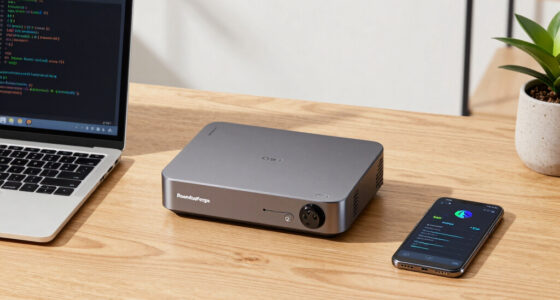
high-performance AI inference hardware
As an affiliate, we earn on qualifying purchases.
As an affiliate, we earn on qualifying purchases.
Performance and Hardware Compatibility Still Unverified
Independent benchmarks evaluating Muse Glimmer’s accuracy, speed, and resource consumption are not yet available. The practical performance on various hardware setups, especially for video processing and long-term tasks, remains uncertain. Additionally, safety, reliability, and robustness during autonomous or multi-step tasks have not been publicly tested or validated.
multimodal AI model deployment hardware
As an affiliate, we earn on qualifying purchases.
As an affiliate, we earn on qualifying purchases.
Community Testing and Benchmarking Will Shape Adoption
Developers and researchers are expected to begin testing Muse Glimmer across different hardware platforms and inference frameworks, publishing performance metrics in the coming months. Independent safety and reliability evaluations will also emerge, guiding potential users on deployment suitability. Hardware compression and optimization efforts may influence how broadly the model can be utilized in consumer-grade devices.
As an affiliate, we earn on qualifying purchases.
Key Questions
What is Muse Glimmer?
Muse Glimmer is a 30-billion-parameter multimodal AI model released by Meta, capable of processing text, images, and videos for local AI applications.
Is Muse Glimmer open source?
Yes, it is licensed under Apache 2.0, allowing use, modification, and commercial deployment with few restrictions.
How does Muse Glimmer compare to other models?
Independent performance data is not yet available, so comparisons with proprietary or other open models are pending. Its practical utility will depend on hardware efficiency and accuracy results from community testing.
What are the main benefits of local deployment?
Local deployment reduces reliance on external servers, enhances data privacy, and can lower recurring inference costs, though hardware demands may be high.
When will more performance data be available?
Performance benchmarks and independent evaluations are expected to emerge as developers test the model across different setups in the coming months.
Source: ThorstenMeyerAI.com
Fall Picks
fall essentials
As an affiliate, we earn on qualifying purchases.