
📊 Full opportunity report: Task-based Social Media Workspace For Creators And Agencies on IdeaNavigator AI — validation score, market gap, and execution plan.

Get the latest gadgets delivered free with Prime
- Fast, free delivery on millions of items
- Prime Video, Amazon Music and more included
- Member-only deals all year
TL;DR
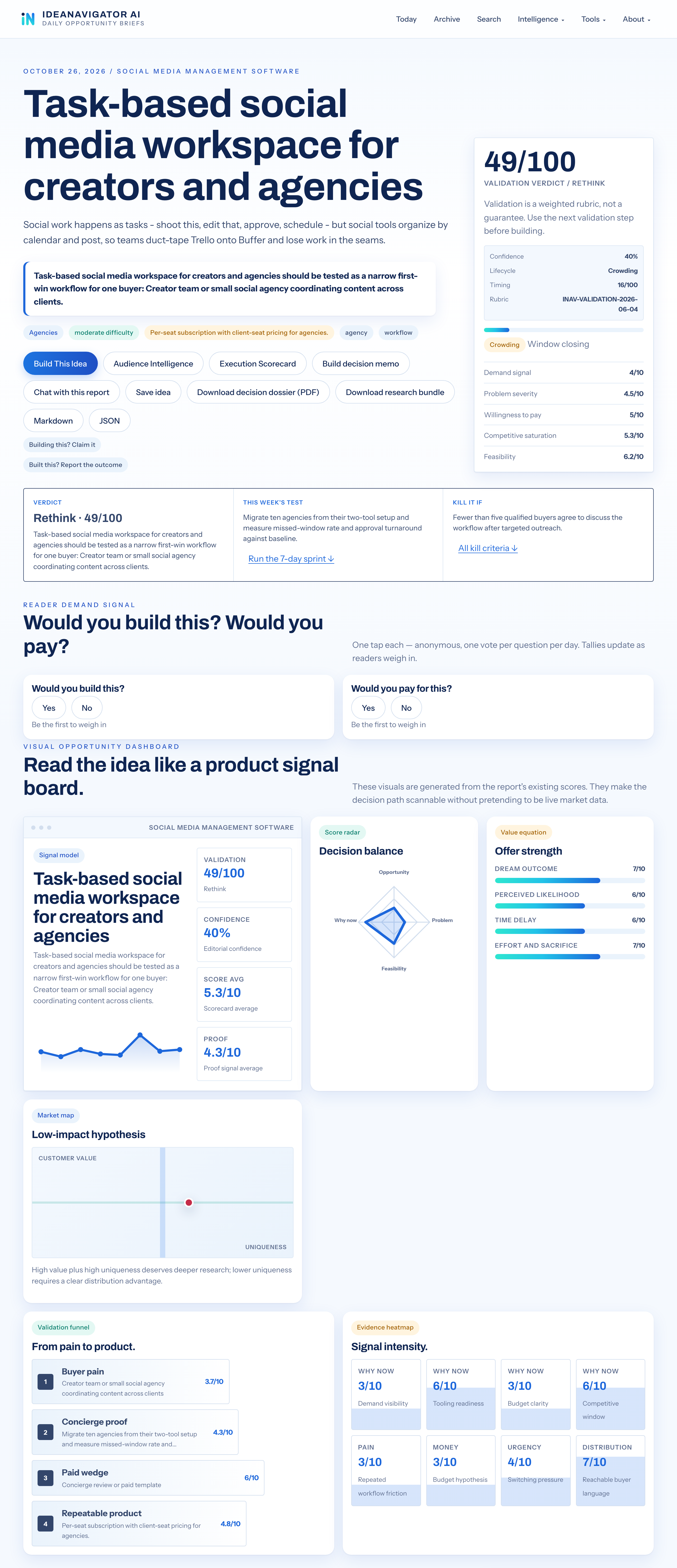
IdeaNavigator AI has outlined a product concept for creator teams and small social agencies: manage each post as a task from brief through approval and scheduling. The proposal is not a launched product; its suggested test is to move 10 agencies from separate tools and compare missed publishing windows and approval turnaround with their baseline.
IdeaNavigator AI has proposed a task-based social media workspace for creator teams and small agencies, combining content production, client approvals and scheduling in one workflow. The concept addresses teams that currently split post planning and execution across social scheduling tools and general project-management software, but it has not been presented as a launched or tested product. These details come from the product concept published by IdeaNavigator AI.
In its published concept, IdeaNavigator AI proposes treating each social post as a task, moving it through stages such as brief, asset creation, editing, approval and scheduling. The suggested minimum viable product would also include client-facing approval links and asset versioning, with scheduling triggered once a post is approved. The proposed flow runs from an initial idea to publication in one system.
IdeaNavigator AI identifies a creator team or small social agency coordinating content for multiple clients as the target customer. The concept describes a gap between the task-based nature of social production and software organized mainly around calendars and posts. It suggests teams may bridge that gap by pairing a scheduling tool with a separate task-management product, leaving work spread across systems.
The concept proposes a per-seat subscription, with pricing for agency client seats. For validation, IdeaNavigator AI recommends migrating 10 agencies from their existing two-tool setups and comparing missed publishing windows and approval turnaround with each agency’s baseline. The concept provides no results from such a trial, pricing figures or product availability.
For agencies and creator teams, a post can pass through several people and stages before it is ready to publish. When briefs, files, feedback and scheduling live in separate tools, teams may need to track status manually and repeat information between systems. IdeaNavigator AI’s concept proposes a workspace built around the post as a task, which could make handoffs and outstanding approvals easier to see if the workflow works in practice.
The concept’s practical value would depend on whether it improves measurable outcomes rather than simply replacing one interface with another. IdeaNavigator AI suggests measuring missed publishing windows and approval turnaround, focusing on delivery and client review. Results from agency pilots could help establish whether bringing those steps together saves time or reduces delays; the published material reports no such evidence.
Agency-specific client seats also point to a commercial question: whether customers will pay for access that lets clients review and approve work without managing the whole production system. IdeaNavigator AI proposes this pricing approach but provides no evidence of customer demand, willingness to pay or the costs of supporting client access.
social media content planning and scheduling software for agencies
As an affiliate, we earn on qualifying purchases.
As an affiliate, we earn on qualifying purchases.
From Calendars to Production Tasks
In its product concept, IdeaNavigator AI contrasts social media management software that helps teams plan or schedule posts with general project-management tools that handle assignments and progress tracking across many kinds of work. The concept rests on the view that social production combines both needs: posts require briefs, creative assets, edits, client feedback and a publishing time.
The proposed product would connect those stages rather than leave teams to coordinate them across separate services. IdeaNavigator AI describes a narrower focus than a broad social platform: the initial customer is a small agency or creator team working across clients, and the initial workflow is the path from idea to scheduled post. The published material does not name existing vendors or establish how widely teams use the two-tool arrangement.
project management software for social media content approval workflows
As an affiliate, we earn on qualifying purchases.
As an affiliate, we earn on qualifying purchases.
Product Status and Pilot Results
No product launch, working prototype or customer adoption is confirmed in IdeaNavigator AI’s published concept. The material describes what an MVP could include, not features that users can currently access. It also does not identify a company building the product, provide a release timetable or specify subscription prices.
IdeaNavigator AI presents the agency test as a proposed plan, not a reported study: the concept gives no agency names, baseline figures or results. It is unclear how the missed-window rate would be defined, what time period the comparison would cover, or how differences in client workload would be accounted for. Until a pilot is conducted and its method and findings are reported, claims about improved turnaround or fewer missed posts remain unverified.
client proofing and approval software for creative agencies
As an affiliate, we earn on qualifying purchases.
As an affiliate, we earn on qualifying purchases.
Testing With Ten Agencies
IdeaNavigator AI’s proposed next step is to migrate 10 agencies from their current two-tool workflow into a test of the combined workspace. The suggested evaluation would compare missed publishing windows and approval turnaround against each agency’s existing baseline. Those results could indicate whether the central workflow addresses the coordination problem described in the concept.
IdeaNavigator AI has specified no pilot start date or follow-up announcement. A useful update would report the test duration, how the measures were calculated, agency participation and whether teams continued using the product after the trial. Until then, the idea remains a product opportunity and validation proposal, rather than evidence of a new service in market.
Source: IdeaNavigator AI
social media asset management and version control software
As an affiliate, we earn on qualifying purchases.
As an affiliate, we earn on qualifying purchases.
Key Questions
Has the task-based social media workspace launched?
No launch is confirmed. IdeaNavigator AI’s published material describes a product concept and a possible MVP, not a service currently available to customers.
Who is the proposed workspace for?
IdeaNavigator AI says the concept is aimed at creator teams and small social agencies coordinating content across clients.
What would the MVP include?
According to IdeaNavigator AI’s concept, proposed features include post tasks with stages for briefing, assets, editing, approval and scheduling, along with client approval links, asset versioning and scheduling after approval.
How would the concept be tested?
IdeaNavigator AI proposes moving 10 agencies from two-tool workflows and comparing missed publishing windows and approval turnaround with their baselines. The concept reports no test results.
How might the product make money?
IdeaNavigator AI proposes a per-seat subscription, with client-seat pricing for agencies. The concept provides no actual prices or evidence of customer willingness to pay.
Source: IdeaNavigator AI
Halloween Picks
halloween
As an affiliate, we earn on qualifying purchases.