
TL;DR

Get the latest gadgets delivered free — and shop member deals
- Fast, free delivery on millions of items
- Access to Prime Big Deal Days deals on October 6–7
- Prime Video, Amazon Music and more included
An XDA Developers writer reports that after about six months using a Crucial T710 PCIe 5.0 SSD, game load times felt no different from those on a 2019 Corsair MP600 PCIe 4.0 drive. The account is a personal comparison, not a controlled benchmark; it suggests gaming buyers may get more value from extra capacity than from paying for Gen 5 speeds they may not notice.
An XDA Developers writer says game loading felt no faster on a Crucial T710 PCIe 5.0 SSD than on a Corsair MP600 PCIe 4.0 drive used since 2019, despite the newer model’s much higher advertised sequential-read speed. The account is a personal, informal comparison rather than a controlled test, but it highlights why gamers may see less benefit from a high-end Gen 5 drive than benchmark figures suggest.
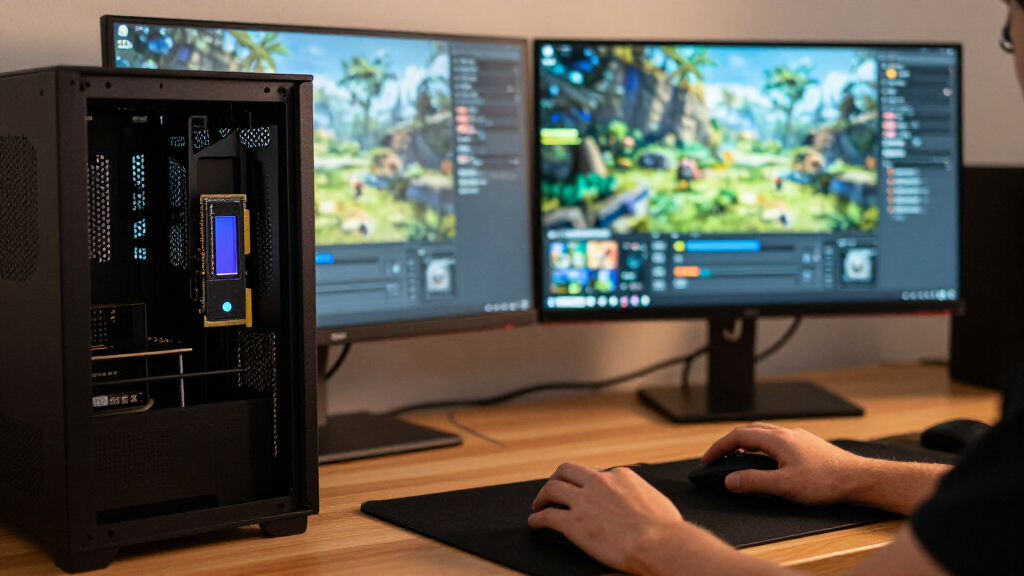
The writer bought the Crucial T710 while upgrading to an AM5 system earlier in 2026. The drive advertises sequential read speeds of up to 14,900 MB/s, which the writer says is about three times the speed of the older Corsair MP600. After using the T710 for about half a year, the writer reports no noticeable change in game loading, including loading saves and fast travel in open-world games.
The comparison reflects the writer’s experience across games, not timed results collected under a published testing method. XDA’s account does not provide specific load-time measurements, a game-by-game results table, or details about whether hardware and software conditions were held constant. The claim is therefore that the difference was not perceptible to the writer, not that the two drives have identical performance in every game or setup.
The writer argues that the advertised throughput figures are based on sequential reads, while many games use smaller, more random storage requests and do not sustain the queue depths needed to reach a drive’s maximum throughput. Loading also involves work by the CPU, memory, graphics hardware and game engine; shader compilation or online services can add other delays. The account says these factors can limit how much a faster SSD changes the time a player waits.
Why Gen 5 May Not Help Gaming
For someone choosing parts for a gaming PC, the practical question is not whether a PCIe 5.0 drive posts a higher number in a storage benchmark. It is whether that extra speed makes games load faster enough to justify its price. In the writer’s experience, the move from a capable Gen 4 NVMe drive to Gen 5 did not produce a noticeable gaming benefit.
The account points to a possible alternative use for a gaming budget: buying more storage capacity. The writer notes that some large games exceed 100GB and suggests putting roughly $100 that might go toward a faster drive toward additional capacity instead. That is a personal purchasing recommendation, not a price comparison across all current SSD models; prices and value vary by product and market.
The conclusion is limited to gaming and to the writer’s setup. The same writer says Gen 5 performance could be useful for workloads such as running multiple virtual machines, where heavier input/output demands may matter. Faster drives may also become more useful as software changes. The report does not establish that Gen 5 SSDs offer no benefit for other tasks.
As an affiliate, we earn on qualifying purchases.
From Benchmarks to Game Loads
The writer’s comparison followed an AM5 system upgrade and a move from the 2019 Corsair MP600 to a PCIe 5.0-compatible platform and Crucial T710. The choice was partly driven by having an X870E motherboard that supports Gen 5 SSDs. The writer says the newer drive’s benchmark performance looked impressive, but everyday gaming did not reflect a similarly obvious improvement.
The account also discusses Microsoft DirectStorage, a technology designed to streamline storage input and output and support GPU-based asset decompression. The writer says adoption has been slow and reports no noticeable loading improvement in the DirectStorage-supported games Marvel’s Spider-Man 2 and Ratchet & Clank: Rift Apart when played on the T710. The piece argues that DirectStorage can work with PCIe 3.0 NVMe storage, so its existence does not by itself show that games currently require Gen 5 speeds.
This is a user report and an interpretation of one upgrade, not an independent technical study of SSD performance across games. Its useful distinction is between maximum sequential transfer speeds shown in benchmarks and the broader process of loading a playable game scene.
“When gaming, I just don’t see the difference at all, no matter what title I play.”
— XDA Developers writer
As an affiliate, we earn on qualifying purchases.
Limits of the SSD Comparison
The report does not include controlled timing data, hardware test specifications beyond the named drives and platform, or a list of every game tested. It is not clear how much any individual loading time changed, whether differences were measured with a stopwatch, or how performance might vary with other processors, games, operating-system settings or storage configurations.
It also does not establish that PCIe 5.0 SSDs will remain unnecessary for gaming. The writer expects storage demands and software support to evolve, while acknowledging that the potential future value of faster drives is not yet apparent in the games discussed. The claim about relative prices, including the suggested $100 difference, may not apply to current offers or other drive capacities.
As an affiliate, we earn on qualifying purchases.
What Buyers Should Compare
For a gaming-focused purchase, readers can compare the price and capacity of suitable Gen 4 and Gen 5 drives alongside their stated performance, warranty and compatibility. The XDA report offers no new benchmark release or formal follow-up test; its next useful step would be a controlled comparison with repeatable, game-specific load-time measurements across multiple systems.
Until more such testing or games that make heavier use of storage throughput change the picture, the writer’s advice is to avoid paying a premium for Gen 5 solely on the assumption that it will make current games load noticeably faster. Buyers with professional or other demanding storage workloads may have different needs.
As an affiliate, we earn on qualifying purchases.
Key Questions
Did the PCIe 5.0 SSD make games load faster?
The XDA writer reports no noticeable difference in game loading compared with the older PCIe 4.0 drive. The account does not include controlled timing results proving that loading times were identical.
Which drives were compared?
The writer moved from a Corsair MP600 PCIe 4.0 NVMe SSD, bought in 2019, to a Crucial T710 PCIe 5.0 SSD during an AM5 upgrade in 2026.
Why might higher SSD benchmark speeds not reduce game loading?
Games may not use storage in the same way as sequential-read benchmarks. Loading can also depend on CPU processing, memory, game-engine work, shader compilation and online services, so storage is only one possible bottleneck.
Does the report show that PCIe 5.0 SSDs are never useful?
No. The writer’s observation is about gaming on one setup. The article says heavier workloads, including running multiple virtual machines, may benefit from faster storage, and future games could use storage differently.
What does the writer recommend for a gaming PC?
The writer recommends considering a Gen 4 NVMe drive and spending any savings on additional capacity, particularly because some games take up more than 100GB. That is a personal recommendation, not a universal pricing rule.
Source: XDA Developers
Fall Picks
fall essentials
As an affiliate, we earn on qualifying purchases.