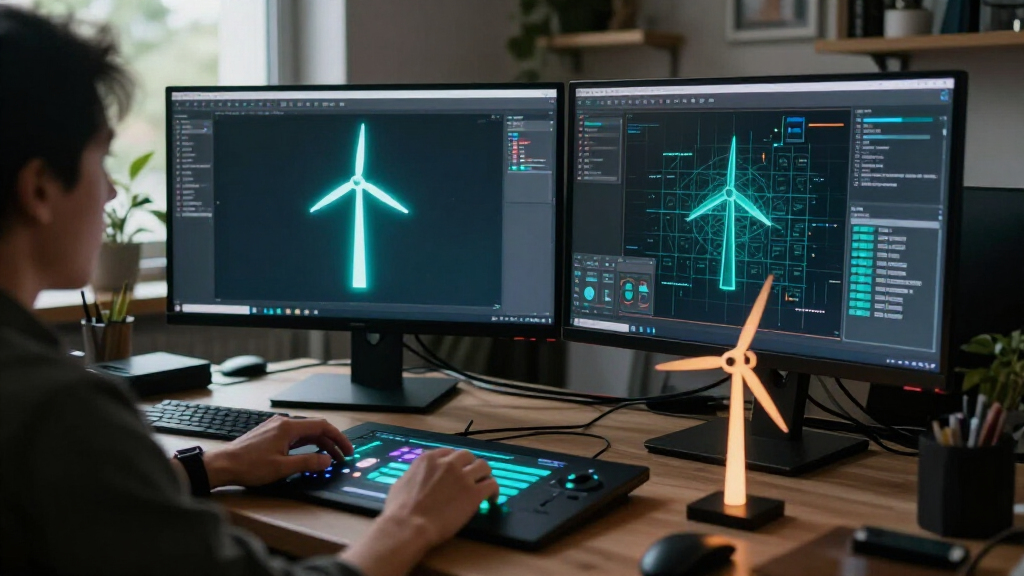

🔍 Read the full analysis: How “TURBINE — WERK 9” Uses SVG Motion To Explore AI on ThorstenMeyerAI.com

Get the latest gadgets delivered free — and shop member deals
- Fast, free delivery on millions of items
- Access to Prime Big Deal Days deals on October 6–7
- Prime Video, Amazon Music and more included
TL;DR
TURBINE — WERK 9 is an interactive web project that uses a scroll-driven SVG rotor to give the page a mechanical, spatial feel. Its presentation connects the interaction to AI and automation, but the available project description does not specify an AI system, its role, or technical implementation.
TURBINE — WERK 9 uses a scroll-driven SVG rotor to turn movement through a web page into an industrial-themed interaction, according to the original project feature on ThorstenMeyerAI.com. The project is framed as a way to explore AI and automation, though its description focuses on browser interaction and does not explain whether an AI system powers any part of the experience.
The project is presented as an interactive field guide, rather than a conventional brochure. As visitors scroll, a rotor drawn with SVG vector paths moves in response, linking the act of progressing through the page to the mechanics suggested by its industrial setting. The description says the interaction is intended to make the web page feel like a space users can explore.
Its stated ingredients are a browser, carefully constructed vector artwork and a familiar input: scrolling. The page’s visual system and rotor motion are described as central to the experience. ThorstenMeyerAI.com says a fuller design teardown discusses how the team shaped the movement, organized the visuals and translated a physical-feeling environment into a browser experience.
The project is available to view through a live-room link, while the feature points readers to a longer case study. No technical specifications, code details, accessibility information or performance measurements are included in the supplied description. Nor does it name a specific AI model, tool or automated system behind the design.
Interactive Field Guide · Web Motion
How “TURBINE — WERK 9” Uses SVG Motion To Explore AI
A scroll-driven rotor turns page progress into an industrial-feeling interaction. The project is presented in the context of AI and automation, while the available description documents browser-based motion rather than a specific AI system.
“What if a web page behaved less like a brochure and more like a machine you could walk around?”
Project description · ThorstenMeyerAI.com01 / The interaction
Scroll Becomes Part of the Machine
The described mechanism connects movement through the page with the industrial setting. The result is framed as a space to explore, rather than a conventional brochure.
Visitor scrolls
Page progress is the stated control for the experience.
SVG paths respond
A vector-drawn rotor is identified as the central visual element.
Motion suggests machinery
The interaction lends the page a mechanical, spatial feel.
Explore the field guide
Scrolling becomes part of how visitors move through the environment.
02 / What the description tells us
A Browser Interaction, Clearly Framed
The project’s presentation connects its subject to AI and automation. Its documented ingredients are more specific about web design.
Scroll-driven motion
Scrolling is described as the input that animates the rotor as visitors progress through the page.
SVG illustration
Scalable Vector Graphics provide the rotor artwork. The exact animation code and motion mapping are not supplied.
Spatial visual concept
The field-guide framing aims to make the page feel like an environment users can explore.
Known from the feature
Browser interaction, vector artwork, scroll input, a rotor, and an industrial visual atmosphere.
Still open
Whether AI was used or powers any part of the experience; accessibility, device behavior, and performance details.
03 / Reading the AI connection
Theme Is Not Evidence of an AI System
The available account places TURBINE — WERK 9 alongside AI and automation, but does not establish an AI-powered function.
Browser-based SVG motion
The described interaction uses scrolling to animate a vector rotor. This is the clearest technical claim in the supplied feature.
AI involvement
No model, tool, AI-generated asset, automated decision, or AI-driven behavior is identified.
Everyday performance
No user testing, performance measurements, accessibility details, or cross-device evaluation is provided.
04 / Questions to carry forward
What the Teardown Could Clarify
ThorstenMeyerAI.com points readers to a live room and a longer design teardown about motion, visual organization, and translating physical space into a browser.
How does the rotor move?
The feature says it responds to scrolling, but does not explain whether motion maps directly to scroll position or how the animation is implemented.
Does AI power the experience?
The available description does not say whether AI contributed to the design or operates any part of the live experience.
How does it work across devices?
Mobile behavior, reduced-motion support, keyboard access, screen-reader experience, and performance are not documented.
Where can readers learn more?
Visit the live room and consult the linked case study for the fuller account of the rotor, visual system, and browser environment.
Takeaway
A Mechanical Metaphor Driven by Scrolling
The supported conclusion is focused: TURBINE — WERK 9 uses a scroll-responsive SVG rotor to make an interactive field guide feel more like a place. Its direct relationship to AI remains unanswered.
Scroll Becomes Part of the Machine
The project illustrates how a familiar browser gesture can carry meaning beyond navigation. In TURBINE — WERK 9, scrolling is described as the input that animates a mechanical visual element, making the visitor’s progress through the page appear connected to the industrial environment. That approach can make a digital presentation feel more like an object or place without requiring a new input device.
For readers interested in AI and automation, the distinction between the project’s framing and its documented mechanism matters. The description presents the work in that broader area of interest, but the confirmed interaction is a scroll-responsive SVG animation. Without details about AI involvement, the project is best understood from the available information as an example of interactive web design, not as evidence of an AI-powered interface.
The concept also points to a design trade-off: motion can help establish atmosphere and guide attention, but the description does not report how the experience works for people who reduce motion, use assistive technology or browse on different devices. Those details would help readers judge how the visual idea performs in everyday use.
SVG animation tools for web development
As an affiliate, we earn on qualifying purchases.
As an affiliate, we earn on qualifying purchases.
A Field Guide in the Browser
The project’s stated premise is to make a web page behave less like a static promotional document and more like a machine visitors can move around. Its field-guide framing gives the scrolling experience a purpose: users progress through an arranged visual environment while the rotor provides a recurring mechanical cue.
SVG, or Scalable Vector Graphics, is a format for vector illustrations that can be displayed and animated in a browser. In this project, the description specifically identifies SVG paths as the basis of the rotor and scrolling as its control. It does not disclose the animation code, the rotor’s precise behavior, or whether other inputs or interactive elements are present.
ThorstenMeyerAI.com presents the work through a short project overview and points to a longer design teardown. The available description does not give a publication date, identify individual designers, or provide a development timeline. Those omissions limit what can be said about how the project was made or how it has changed over time.
““What if a web page behaved less like a brochure and more like a machine you could walk around?””
— ThorstenMeyerAI.com project description
scroll-driven SVG interactive components
As an affiliate, we earn on qualifying purchases.
As an affiliate, we earn on qualifying purchases.
AI Role and Technical Details
The available description does not establish whether AI was used to design, generate or operate any part of TURBINE — WERK 9. It also does not identify a model, provide an AI-related function or explain what the project contributes to automation beyond its thematic framing. Claims about AI-powered behavior would go beyond the information provided.
Other open questions include the specific animation technique, whether rotor movement is synchronized directly to scroll position, and how the page handles mobile screens, reduced-motion preferences and keyboard or screen-reader access. The description offers no user testing, performance data or independent evaluation. It is also unclear when the project launched and whether the live version is the same one discussed in the design teardown.
As an affiliate, we earn on qualifying purchases.
The Teardown Holds More Detail
The next available step for readers is to view the live room and consult the linked design teardown. ThorstenMeyerAI.com says the longer case study covers the rotor’s motion, the visual system and the translation of a physical-feeling space into a browser experience. The information provided here does not give a release schedule for further updates or promise additional technical documentation.
Until those details are available, the confirmed takeaway remains narrow: TURBINE — WERK 9 uses scrolling to animate an SVG rotor within an interactive field guide. Whether AI plays a direct role, and how the experience performs across devices and accessibility settings, remains unanswered.
Source: ThorstenMeyerAI.com
browser-based SVG animation software
As an affiliate, we earn on qualifying purchases.
As an affiliate, we earn on qualifying purchases.
Key Questions
What is TURBINE — WERK 9?
It is an interactive web experience framed as a field guide to an industrial-feeling environment. Its described central feature is a rotor animated in response to scrolling.
How does the rotor move?
The project description says a scroll-driven SVG makes the rotor move as visitors progress through the page. It does not provide implementation details or explain the precise relationship between scroll position and motion.
Does the project use artificial intelligence?
The available description does not say whether an AI system was used in the design or powers the experience. It presents the work in connection with AI and automation, but documents a browser-based SVG interaction.
Where can readers find more information?
ThorstenMeyerAI.com links to a live room and a longer design teardown. The feature says the teardown covers the rotor’s movement, visual organization and the effort to translate a physical-feeling space into a browser experience.
Source: ThorstenMeyerAI.com
Halloween Picks
halloween
As an affiliate, we earn on qualifying purchases.