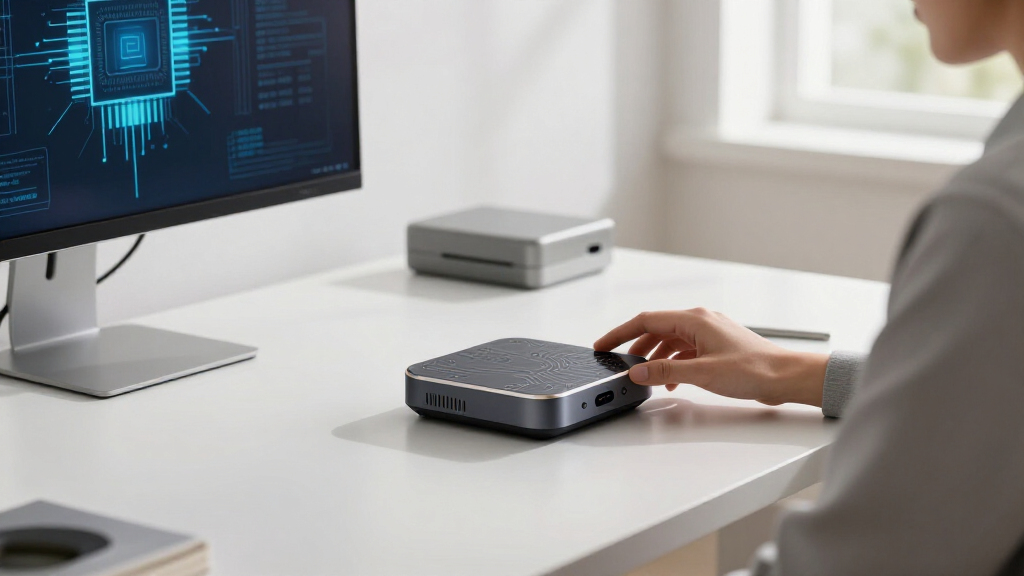

📊 Full opportunity report: Designed Before The Thing It Runs: The Future Of AI Hardware on ThorstenMeyerAI.com — validation score, market gap, and execution plan.

Get the latest gadgets delivered free — and shop member deals
- Fast, free delivery on millions of items
- Access to Prime Big Deal Days deals on October 6–7
- Prime Video, Amazon Music and more included
TL;DR
AI hardware is shifting from general-purpose chips to purpose-built designs optimized for inference workloads. This transition hinges on thermal efficiency, advanced memory interconnects, and workload-specific specialization, marking a fundamental change in AI infrastructure.
AI hardware is undergoing a significant transformation, moving away from legacy GPUs designed prior to the development of transformer models and inference workloads. Industry experts indicate that future hardware will be purpose-built, optimized specifically for inference, which currently accounts for a substantial portion of AI compute demands. This transition is driven by the need for higher throughput, improved thermal management, and hardware architectures tailored for specific workloads.
Most existing AI chips, primarily GPUs, were conceived before the advent of transformer architectures and the current focus on inference. These chips have been adapted over multiple generations to accommodate evolving workloads, but this approach is reaching its limitations. The main challenge is that current hardware is not optimized for inference tasks, which involve serving models to large numbers of users and agents simultaneously.
Industry sources, including Thorsten Meyer, note that the main performance constraints are related to thermal management, memory interconnect latency, and lack of workload-specific design. The next generation of AI chips aims to focus on low-voltage operation to enhance thermal efficiency, advanced memory interconnects to reduce latency, and architectures tailored for inference tasks. These innovations are intended to improve throughput, reduce power consumption, and support scalable deployment.
Almost every chip serving AI today was architected for a world that no longer exists — training-dominant, general-purpose, conceived before the transformer became the only architecture that mattered. The next decade rebuilds silicon around inference at civilizational scale.
Strip away the hype and the gains in purpose-built inference silicon come from exactly three places. Each tells you where the roadmap goes.
Prefill and decode have opposite hardware appetites. Running both on one undifferentiated chip satisfies neither. The answer is disaggregation — a pipeline of specialized chips, each doing the part it was born for.
Today we make tokens the way the Renaissance made screws — one at a time, by hand, on general-purpose machines. The endpoint is fab-like: cost per token falls as the facility grows.
Capital believes the workload is specializing. But the physics bet and the adoption bet are not the same bet.
- Merchant inference ASICs arriving with working silicon, $1B+ in contracts, gigawatt-scale roadmaps
- Groq’s inference tech absorbed into NVIDIA (~$20B)
- Cerebras public at large valuations; custom-chip shipments projected to outgrow GPUs
- Architecture lock-in: a transformer ASIC is obsolete the day a post-transformer design wins. The GPU’s inefficiency is its insurance.
- No independent benchmarks yet — the numbers are vendor-claimed.
- NVIDIA’s moat is software. A proprietary toolchain asks customers to abandon what they know.
If token production becomes a majority of output, and national capacity is measured in agents per gigawatt, the token supply chain becomes the most strategic chokepoint on Earth.
This is the strongest argument I know for the local-first, open-weight posture: keep meaningful capability distributed — models you can run yourself, on hardware you own, close enough to the frontier to matter. Scale pulls one way; sovereignty and resilience pull the other. Both futures get built at once.
It’s who owns the factories when it does, and whether the answer is “many.”
Implications of Rebuilding AI Hardware from the Ground Up
This development is noteworthy because current AI infrastructure is approaching physical and economic limitations. The creation of purpose-built hardware could lead to gains in efficiency, facilitating more sustainable scaling of AI services as inference workloads grow. Additionally, it may influence industry dynamics by favoring companies that develop specialized chips, potentially affecting cost, performance, and deployment strategies.
Furthermore, this evolution suggests a move toward hardware architectures that are more closely aligned with specific workload requirements, which could shape the future landscape of AI hardware development, chip design, and data center infrastructure. The overarching goal is to establish a more efficient and scalable AI ecosystem that considers environmental impact.
As an affiliate, we earn on qualifying purchases.
Background of AI Hardware and the Shift to Inference
Historically, AI chips have been based on general-purpose GPUs designed for graphics processing and later adapted for AI tasks. These chips were optimized for training large models, but their architecture was not specifically designed for inference, which now constitutes a significant portion of AI compute. As inference workloads have expanded rapidly—serving billions of users and agents—the limitations of this approach have become apparent.
Recent industry discussions, including insights from Thorsten Meyer, suggest that the hardware ecosystem is approaching physical and economic constraints. Challenges related to heat dissipation, memory bandwidth, and inter-chip communication are prompting a reassessment of hardware design principles, with a focus on low-voltage operation, memory pooling, and workload-specific architectures.
"Most existing AI chips were conceived before the rise of transformer models and the dominance of inference workloads. The next wave of hardware will be purpose-built from the transistor up."
— Thorsten Meyer
purpose-built AI inference processors
As an affiliate, we earn on qualifying purchases.
As an affiliate, we earn on qualifying purchases.
Uncertainties in the Transition to Purpose-Built AI Chips
The timeline for industry-wide adoption of specialized AI hardware remains uncertain. While prototypes and early deployments are anticipated within the next 12 to 24 months, factors such as technological advancements in memory interconnects and thermal management, as well as market dynamics and regulatory considerations, could influence the pace of transition.
As an affiliate, we earn on qualifying purchases.
Next Steps in AI Hardware Innovation and Adoption
Industry stakeholders are expected to continue developing and testing specialized AI chips, with prototypes and pilot projects likely to emerge within the next 12 to 24 months. The extent and speed of adoption will depend on technological progress, cost considerations, and market demand. Monitoring these developments will help gauge how quickly hardware architectures can evolve to meet inference-centric AI requirements.
advanced memory interconnects for AI
As an affiliate, we earn on qualifying purchases.
As an affiliate, we earn on qualifying purchases.
Key Questions
Why are current GPUs insufficient for future AI workloads?
Current GPUs are designed for general-purpose computing and were developed before the rise of inference workloads. They face limitations related to thermal management, memory latency, and lack of workload-specific optimizations, which can restrict scalability and efficiency for large-scale inference tasks.
What are the main technical innovations driving new AI hardware?
Key innovations include low-voltage operation to enhance thermal efficiency, advanced memory interconnects to reduce latency, and specialized architectures optimized for inference, such as memory pooling and workload-specific designs.
When can we expect to see these new hardware architectures in production?
Industry sources suggest that prototypes and initial implementations could be available within 12 to 24 months, with broader deployment contingent upon technological advancements and market conditions.
How will this shift impact AI service providers and consumers?
Purpose-built hardware has the potential to improve the scalability, energy efficiency, and cost-effectiveness of AI inference services, which may influence pricing and accessibility for end users.
Source: ThorstenMeyerAI.com
Fall Picks
fall essentials
As an affiliate, we earn on qualifying purchases.