
TL;DR

Get the latest gadgets delivered free with Prime
- Fast, free delivery on millions of items
- Prime Video, Amazon Music and more included
- Member-only deals all year
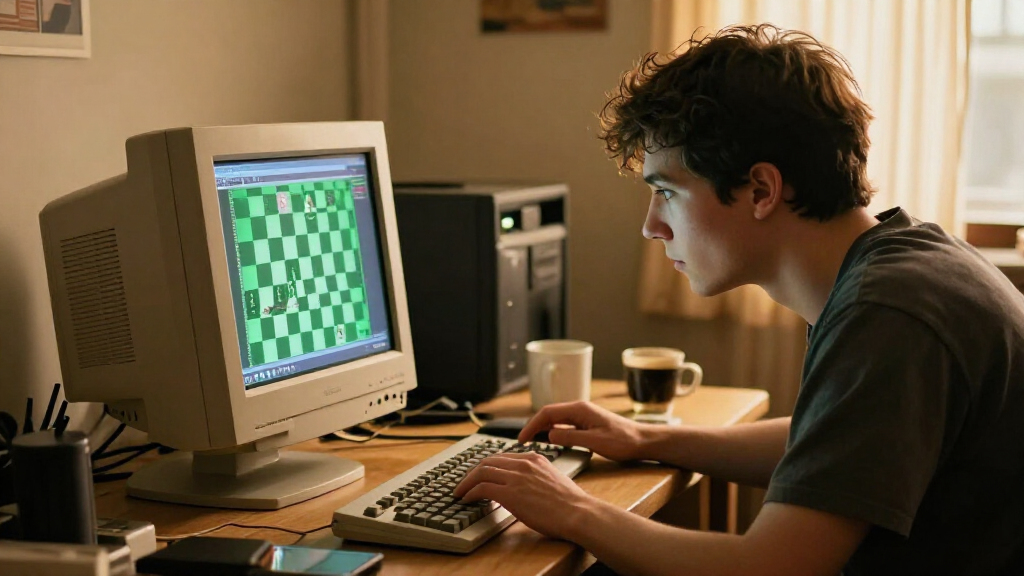
A 2026 report describes tests of a modern Stockfish engine adapted to a 200 MHz Pentium Pro, estimating its rating at 3,180 Elo at 30 seconds per move. The author argues that software advances could have made a 1996-era computer strong enough to beat Garry Kasparov, but the reported tests do not establish how it would have performed in a real match against him.
A 2026 report says a modern Stockfish engine adapted to a 200 MHz Pentium Pro reached an estimated 3,180 Elo at 30 seconds per move, lending support to the argument that a 1996 desktop could have run software capable of challenging Garry Kasparov. The result is an engine-rating estimate from the author’s tests—not a match against Kasparov—and the report’s central finding is that better chess programming can outweigh faster hardware.
The report’s author tested a 32-bit port of Stockfish on a Pentium Pro system with 64 MB of RAM, then adjusted the engine to suit the older processor. The tuned version was rated at 2,846 Elo at one second per move, 3,109 at 10 seconds and 3,180 at 30 seconds. Those estimates include uncertainty ranges, and the report presents them as results of its own testing rather than ratings from a match against a human champion.
As a comparison, a more direct port of Stockfish—before the described tuning—was estimated at 2,496 Elo at one second per move and 2,940 at 10 seconds. The author also tested 1996 engine Crafty 11.13. It scored an estimated 1,999 Elo on the Pentium Pro at one second per move and 2,383 at 10 seconds. Running that older program on a modern Ryzen 7 raised its one-second estimate to 2,614 Elo.
The report’s second comparison added newer search and evaluation techniques to Crafty. On the Pentium Pro, that revised engine was estimated at 2,718 Elo at one second per move and 2,974 at 10 seconds. In a 100-game engine match, the tuned modern engine on the Pentium Pro scored 78 wins, 17 draws and five losses against 1996 Crafty running on modern hardware. That contest compared engines, not either engine with Kasparov.
How Software Changed the Hardware Equation
The experiment addresses a familiar question raised by the history of computer chess: whether Deep Blue’s specialized hardware was necessary to beat the world champion, or whether stronger software could have done the job on an ordinary period computer. The author estimates that 720 of a 1,335-Elo gain between the cited historical and modern engine strengths came from programming improvements rather than hardware. That estimate frames the report’s case, though it depends on the author’s chosen engines, test settings and rating comparisons.
For readers, the distinction matters because raw processing speed is only one part of an engine’s strength. The report says newer search methods and evaluation systems can make better use of a limited processor, improving move selection even when the machine cannot examine as many positions. Its results suggest that the software gap between 1996 and modern chess engines is large enough to change how we think about the role of Deep Blue’s custom processors.
But an estimated rating should not be treated as a recorded outcome. Chess ratings summarize expected performance across games under particular conditions; they do not establish that a machine would beat a specific opponent in a particular event. A historical claim that the Pentium engine would have beaten Kasparov is therefore an inference from the reported tests, not a result demonstrated by them.
Products Worth Considering

Bose S1 Pro+ All-in-One PA Speaker

Apple AirPods Pro 3 Wireless Earbuds with Active Noise Cancellation

Anker SOLIX C1000 Gen 2 Portable Power Station
As an affiliate, we earn on qualifying purchases.
Deep Blue’s 1996 Match and the Test
On Feb. 10, 1996, IBM’s Deep Blue became the first computer program to defeat reigning world champion Garry Kasparov in an individual chess game. Kasparov won that six-game match. Deep Blue later won their 1997 rematch, 3.5–2.5, according to the source report.
The report describes the upgraded Deep Blue as using 30 IBM P2SC processors running at about 120 MHz, alongside 480 custom chess co-processors. It says the system could analyze more than 200 million positions per second. The Pentium Pro experiment instead asks what could be achieved with broadly available hardware if later engine techniques were applied to it.
The tested desktop used a 200 MHz Intel Pentium Pro and 64 MB of memory. The author’s work involved adapting Stockfish for a 32-bit processor and the machine’s memory limit, then tuning the program for that hardware. The report also describes tests of Crafty, a competitive engine from the 1990s whose source code is available. These are retrospective computer-versus-computer tests, not a reconstruction of the conditions of the 1996 championship match.
No Kasparov Match Tested the Claim
The report does not show a game between Kasparov and the Pentium Pro engine, nor does it establish how that engine would have performed in the specific conditions of the 1996 match. Its Elo figures are estimates from engine testing; the source material does not provide enough detail here to independently assess every testing choice, rating pool or uncertainty calculation.
The claim that the engine would have beaten Kasparov is consequently stronger than the direct evidence. The report compares engine ratings and records a 100-game result against Crafty, but that is not the same as a head-to-head result against Kasparov. The exact expected outcome would depend on factors including time controls, match format, opening preparation and the engine’s reliability on the old system. The supplied material does not settle those questions.
Further Tests Could Narrow the Gap
The report’s immediate contribution is a set of retrospective tests and an argument about how chess software improved. The source material does not identify a planned Kasparov-versus-Pentium match or a scheduled follow-up. Further independent testing could help evaluate the rating estimates, including repeated matches under specified time controls and comparisons with documented human-player ratings.
Until such evidence is available, the measured result is best stated narrowly: the author reports that a tuned modern engine ran strongly on a Pentium Pro and beat a 1996 engine in a 100-game test, despite the latter running on modern hardware. Whether it would have defeated Kasparov in 1996 remains a plausible but unverified counterfactual.
Key Questions
Did the Pentium Pro engine play Garry Kasparov?
No. The report describes engine ratings and a 100-game match against 1996 Crafty. It does not report a match against Kasparov.
How strong was the tuned engine on the old computer?
The author estimated it at 2,846 Elo at one second per move, 3,109 at 10 seconds and 3,180 at 30 seconds. These are reported estimates, not results from games against Kasparov.
What did the 100-game match show?
The tuned Stockfish port on the Pentium Pro scored 78 wins, 17 draws and five losses against 1996 Crafty running on a modern Ryzen 7, according to the report.
Does the report prove a Pentium would have beaten Kasparov in 1996?
No. It supports the argument that modern engine methods can perform strongly on older hardware, but the claim about Kasparov is an inference. No direct match or equivalent historical test is reported.
Source: nicholas.carlini.com