
TL;DR
SpaceX said on November 12 that it plans AI computing projects near Brownsville, Texas, and in Cochise County, Arizona, with more than $74 billion in combined planned investment. The proposals describe different power and cooling arrangements, but local approvals are pending and several details, including the Texas facility’s water use, remain unknown.
SpaceX said November 12 it is advancing plans for two large AI computing sites in Starbase, Texas, and Cochise County, Arizona, describing them as more than $74 billion in planned investment. Both proposals face local proceedings scheduled for December 9, and their scale could affect regional electricity infrastructure, water planning, public finances and employment.

Get the latest gadgets delivered free with Prime
- Fast, free delivery on millions of items
- Prime Video, Amazon Music and more included
- Member-only deals all year
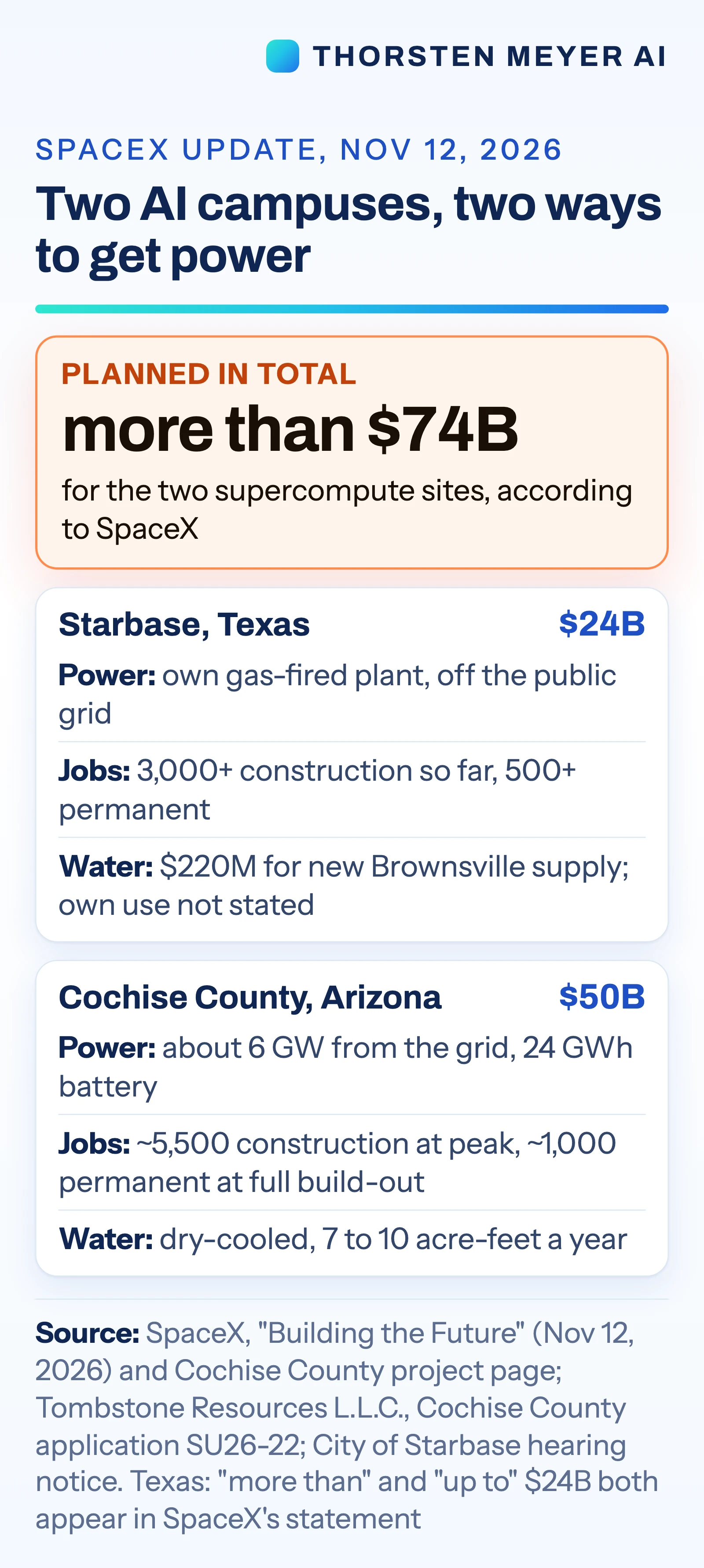
In Texas, SpaceX says it plans to invest more than $24 billion in computing infrastructure in the Rio Grande Valley. A Starbase city notice describes an approximately 444-acre site between Boca Chica Boulevard and the Port of Brownsville, with an initial-phase capital investment of about $24 billion and possible later expansion. The city describes the project as a gas-fired power plant and super-compute facility. SpaceX says the site will generate its own electricity rather than draw from the public grid; the city notice does not specify the plant’s capacity.
SpaceX says the Texas project is intended to train AI systems and support work in areas including medical research, emergency response and advanced manufacturing. The company reports more than 3,000 construction jobs so far and expects over 500 permanent jobs once the facility is operating. Those are company figures and projections. SpaceX also says it has committed $220 million for water and wastewater infrastructure in Brownsville and Cameron County, including $40 million it says it has already provided. The company says those projects could add about 20 million gallons per day from sources independent of the Rio Grande. It has not stated how much water the computing site itself would use.
In Arizona, SpaceX describes a roughly $50 billion campus on about 747 acres near Cochise. The county application, filed by Tombstone Resources L.L.C., proposes up to nine single-story computing buildings, each about 493,000 square feet, built in four phases. The application lists a first phase of about 1,500 megawatts and a full build-out of approximately 6 gigawatts, alongside a 24-gigawatt-hour battery system. It proposes grid power delivered through Sulphur Springs Valley Electric Cooperative and Arizona Electric Power Cooperative to a utility-owned substation. The plans describe dry cooling without cooling towers, and backup natural-gas generators for outages and testing.
Power, Water and Local Commitments
The proposals put AI computing infrastructure before two communities with different power arrangements. SpaceX says the Texas facility would make its own electricity, while the Arizona campus would take power from the grid. Arizona’s proposed full capacity is large enough that the project’s electricity arrangements and the local utility network will be central to how it proceeds.
Water and employment are also local concerns. SpaceX has described regional water infrastructure spending and says the Arizona site would use dry cooling, but the Texas facility’s own water demand has not been disclosed. The company’s employment figures give residents a sense of its stated expectations, though projected permanent jobs are not a guarantee of eventual hiring. Local decisions will shape whether these plans can move forward and what conditions may apply.
Products Worth Considering

DJI Osmo Mobile 8 Phone Gimbal with Mic Mini Transmitter, Infinity Black

Jackery Explorer 1000 v2 Portable Power Station

Jackery Solar Generator 1000 v2 with Two 100W Solar Panels, 1024Wh LiFePO4 Battery
As an affiliate, we earn on qualifying purchases.
From Orbital Plans to Ground Sites
When SpaceX announced its acquisition of xAI on February 2, 2026, it argued that demand for electricity to run AI could not be met on Earth without hardship to communities and the environment, and pointed to data centers in orbit. The November announcement describes two substantial terrestrial projects. SpaceX says the Texas site could also help develop and test technologies for future space-based computing.
The projects are at different stages of public documentation. The Starbase city notice describes the Texas site and a gas-fired power plant. In Arizona, the county application identifies Tombstone Resources L.L.C. as the applicant; the county documents cited in the source material do not name SpaceX. SpaceX’s project page and Tombstone Resources’ town hall statement link the plans to the company. The Arizona proposal’s scale and utility connection are described in the application, while SpaceX’s broader investment figure comes from the company.
SpaceX’s announcement put the two projects’ planned investment at more than $74 billion combined. That is a company-stated plan, not a report of spending already completed. The projects also differ in the information available: public figures for the Arizona campus include proposed capacity and cooling design, while key operating details for Texas have not been specified in the city notice.
““Together, they represent more than $74 billion in planned American investment.””
— SpaceX
Unanswered Questions Before Approval
Several details remain unresolved. The Texas city notice gives no generating capacity for the planned gas-fired plant, and SpaceX has not disclosed the computing facility’s own water use. A local news outlet, The 956 Report, reported details from an air registration filed with the Texas Commission on Environmental Quality, including proposed turbine configurations and an emissions cap. Those reported figures are not specified in the city notice.
The size of any Texas property tax abatement is also not stated in the supplied material. In Arizona, SpaceX has promised lower power bills for local cooperative members, but it remains unclear whether the utility arrangement behind those cuts will receive the required regulatory approval. The source material does not establish that either project has received all local approvals, that construction will follow the proposed schedules, or that the announced investment and job estimates will be realized.
December Hearings Set the Course
On December 9, 2026, the Cochise County Planning and Zoning Commission is scheduled to hold a hearing on the Arizona proposal. The Starbase City Commission is scheduled to consider a property tax abatement connected to the Texas project. Those proceedings will provide an opportunity for local officials to review the proposals and for more information about conditions, infrastructure and public impacts to enter the record. The material available here does not specify the final decisions or a construction timetable.
Key Questions
How much investment has SpaceX announced?
SpaceX says the two projects represent more than $74 billion in planned investment: more than $24 billion for Texas and roughly $50 billion for Arizona. These are announced plans, not confirmed completed spending.
How will the two sites get electricity?
SpaceX says the Texas facility will generate its own electricity at a gas-fired plant. The Arizona application describes grid power delivered through local cooperatives to a utility-owned substation, with backup natural-gas generators.
What is known about water use?
SpaceX says it is funding regional water and wastewater infrastructure in Texas and says the Arizona campus would use dry cooling without cooling towers. The Texas facility’s own water use has not been disclosed in the supplied material.
How many jobs could the projects create?
SpaceX reports more than 3,000 construction jobs so far in Texas and expects more than 500 permanent jobs once that facility operates. Those figures are company statements; the source material does not provide comparable Arizona job estimates.
When will local officials consider the proposals?
The Cochise County Planning and Zoning Commission is scheduled to hold an Arizona project hearing on December 9, 2026. The Starbase City Commission is scheduled that day to consider a property tax abatement for the Texas project.
Source: Thorsten Meyer AI