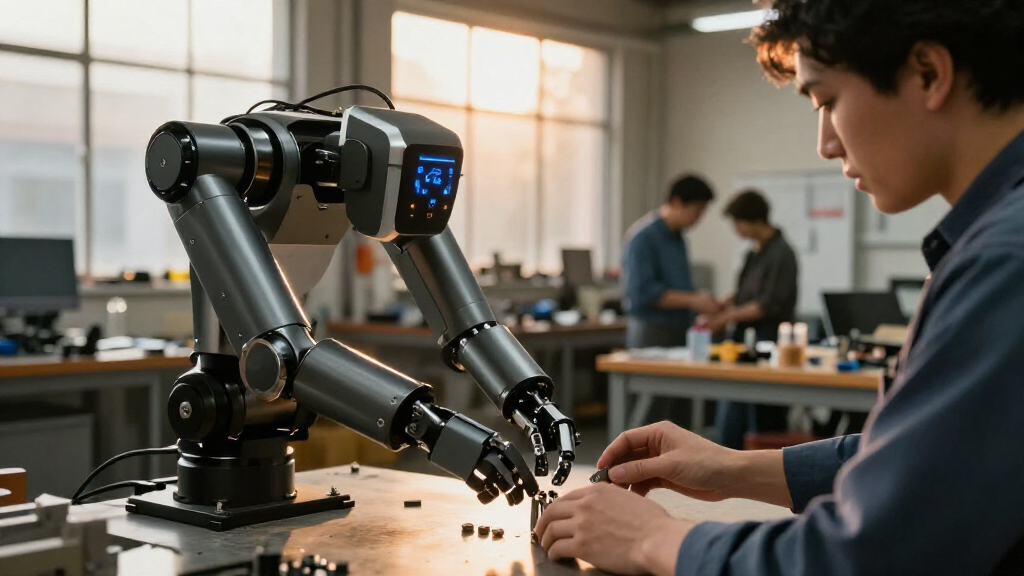

🔍 Read the full analysis: Meta Reportedly Built A Humanoid Robot Called Max In Three Months. Who Does The Housework When Robots Arrive? on ThorstenMeyerAI.com

Get the latest gadgets delivered free with Prime
- Fast, free delivery on millions of items
- Prime Video, Amazon Music and more included
- Member-only deals all year
TL;DR
The Information reported on Oct. 31 that Meta and Chinese robotics company Fourier built a humanoid prototype, Max, in about three months. Meta has not publicly announced the robot, and the reported goal is household assistance in the future—not a product currently available for sale.
Meta and Shanghai-based robot maker Fourier reportedly built a humanoid prototype called Max in about three months, according to a report published by The Information on Oct. 31. Meta has not announced the robot, and the available reporting describes it as an internal research project aimed at exploring future household assistance—not a robot that is already carrying out chores in homes.
The report describes Max as a roughly five-foot-tall, 106-pound prototype with a screen that can display facial expressions, speakers and five-fingered hands designed to handle small objects. It reportedly uses Nvidia’s Jetson Thor robotics computer. These specifications have been repeated by outlets including Engadget, The Next Web and Investing.com, which cited The Information. Reuters said it could not immediately verify the report.
According to those accounts, Meta employees saw Max at an internal robotics summit in late August. A follow-up model, Max 2, has reportedly been in development since September. The reported changes include a redesigned torso, improved hands, a projector and additional sensors intended to help the robot manage stairs. Meta has not released specifications, images, a launch schedule or a public demonstration confirming those details.
The Information reported that Meta characterized its work with Fourier as internal research and experimentation and said it had no plans to sell the units. The report also links the project to Meta’s interest in applying its AI systems to physical robots, potentially including household tasks. That is a reported long-term direction, not evidence that Max can perform a reliable set of domestic chores today.
Infographic 01 · Meta’s humanoid, on paper
Max: a humanoid built in about three months
What multiple outlets reported from The Information’s story, and what is not confirmed.
What the report says Max is
From The Information (31 Oct 2026), as carried by Engadget, The Next Web and Investing.com
- Built by Meta with Fourier, a Shanghai robot maker
- Runs on Nvidia Jetson Thor, a computer for robots
- A screen that shows facial expressions, built-in speakers
- Five-fingered hands designed for small objects
- Shown to some Meta staff at an internal summit in late August
- Max 2: new torso, better hands, a projector, sensors for stairs
What you should not take from the headlines
- No Meta announcement. Reuters “could not immediately verify the report.”
- Not for sale. Meta told The Information the work is internal research, with no plans to sell units.
- No chores shown. “Can do household chores” is a goal, not a reported demonstration.
- Dropped: “lifts bottles and toys” and a Muse quote, found only on aggregator sites.
Jetson Thor, per Nvidia: up to 2,070 FP4 teraflops of AI compute, 128 GB memory, 130-watt power envelope; developer kit from $3,499 at launch in August 2025. Meta was named an early adopter.
Sources: The Information (paywalled), reported by Engadget, The Next Web, Investing.com and Reuters, all 31 Oct 2026 · Nvidia, 25 Aug 2025.
Powered by Thorsten Meyer AI
Why Household Robots Matter
The report matters because it places Meta’s AI ambitions in a physical machine, while underscoring the gap between a prototype and a useful home product. A robot that can reliably perform a few household tasks could affect how people manage daily work, but the current information does not establish that Max can do so. The distinction is important: descriptions of a robot intended to help in homes have been shortened in some headlines to claims that it already “can do household chores.” The source material supports the former, not the latter.
The work such machines might eventually address is substantial. The International Labour Organization estimates that people perform 16.4 billion hours of unpaid care work each day, with women doing about three-quarters of it. The ILO also counts 80 million people in paid domestic work worldwide, 83% of them in informal employment. Those figures describe a broad social and economic landscape; they do not show that robots can replace this work, or that any benefits would be shared evenly.
For consumers, the more immediate questions are practical: whether a home robot can operate safely around people, handle varied objects and rooms, and do enough useful work to justify its cost. Other companies’ announcements and demonstrations show activity in the field, but they do not settle those questions for Max. No public price, availability date or performance test has been reported for Meta’s prototype.
Products Worth Considering

DJI Osmo Mobile 8 Standard Combo Gimbal Stabilizer for Phone

Logitech MX Mechanical Wireless Illuminated Keyboard, Tactile Quiet, Graphite

Samsung 27-Inch Odyssey QD-OLED G8 4K 240Hz Gaming Monitor
As an affiliate, we earn on qualifying purchases.
Meta’s Robotics Partnership
The reported three-month development period does not mean the companies designed every component from scratch in that time. Fourier already makes humanoid robots. In August 2025, the Shanghai company introduced its GR-3 care-oriented robot, which it described as intended for settings such as nursing homes and rehabilitation centres. The partnership reportedly combined Fourier’s robotics experience and manufacturing capacity with Meta’s interest in AI systems and consumer hardware.
The reported use of Nvidia’s Jetson Thor also places Max within a wider move toward onboard computing for robots. Nvidia made the platform generally available in August 2025 and markets it for robotics workloads. That hardware can support local processing, but a powerful computer alone does not establish that a robot can safely interpret instructions, move through an unfamiliar home or complete chores consistently.
Other companies are pursuing home humanoids, though their claims should be treated as company-reported results. 1X sells its NEO home robot for $20,000, according to the source material; it reportedly uses remote human “experts” for tasks it does not know. Figure has said its robot completed entire chores in 56% of trials across 30 homes it had not previously encountered. That is Figure’s own reported result, not an independent assessment and not a direct comparison with Max.
“The work with Fourier is for internal research and experimentation, and Meta has no plans to sell the units.”
— Meta, as quoted in The Information
What Has Not Been Verified
Meta has not publicly confirmed Max’s existence or specifications in the material available for this report. The Information’s original article is behind a paywall, and the details here come from secondary reports citing it. Reuters said it could not immediately verify the account. There is no public demonstration or independent testing establishing what Max can do, how reliably it can do it, or how it behaves in an occupied home.
It is also unclear what “built in three months” covers: the development of this particular prototype, the work on its software and hardware integration, or a wider project that may have relied on existing Fourier designs. The reported Max 2 features and development schedule have not been confirmed by Meta or Fourier through a public announcement. Nor is there a disclosed price, consumer release plan or date for a product launch. The available reporting does not establish that Max has completed household chores outside a controlled demonstration.
The Next Public Milestones
The next useful evidence would be a direct statement or demonstration from Meta or Fourier confirming the robot’s design, capabilities and development status. Until then, the reported work on Max 2 remains a secondhand account, and no consumer release is announced. Any future assessment will depend on more than a list of components: testing in real homes would be needed to show which tasks the robot can complete, how often it needs human help and what safeguards are in place.
For now, readers should treat Max as a reported prototype and Meta’s household-robot ambitions as research, not as a near-term replacement for domestic work. The development timeline, technical performance and commercial plans remain open questions.
Key Questions
Has Meta officially announced the Max robot?
No. The report is attributed to The Information, with other outlets repeating details from it. The supplied material says Meta has not publicly announced Max.
Can Max currently do household chores?
That has not been established. The reporting describes Max as a prototype intended to support household tasks in the future; it does not provide verified evidence that the robot currently completes chores in homes.
Who reportedly built Max?
Meta and Fourier, a robotics company based in Shanghai, reportedly worked together on the prototype. The Information’s account says the project took about three months.
What are Max’s reported specifications?
Reports describe a robot about five feet tall and 106 pounds, with a facial-expression display, speakers, five-fingered hands and Nvidia’s Jetson Thor computer. Meta has not independently confirmed those specifications.
When could a Meta home robot go on sale?
No release date or sales plan has been announced. According to the report, Meta said its work with Fourier is for internal research and experimentation and that it has no plans to sell the units.
Source: ThorstenMeyerAI.com