

TL;DR
Six European game worker unions are reported to have backed a manifesto urging employers to avoid generative AI, prevent its use from being imposed on workers, and label any unavoidable use. The text also calls for player support of games made without genAI and rules requiring consent and fair compensation for work used in training data. The unions’ reach and the manifesto’s effect on studio policies remain unclear.
The document, titled “On Generative AI Usage in the Games Industry,” addresses four groups: workers, employers, players and regulators. It tells workers to avoid genAI services where possible, organise and negotiate company agreements. Employers are urged to avoid the tools entirely, ensure no worker is required to use them, and label any unavoidable use precisely. The manifesto says workers should decide when, where and how genAI is used.

Get the latest gadgets delivered free with Prime
- Fast, free delivery on millions of items
- Prime Video, Amazon Music and more included
- Member-only deals all year
The demands cover tools used in finished games, including art, sound, code and dialogue, as well as behind-the-scenes work such as concept art, reference materials and pre-translation. That scope means the manifesto’s position would apply even when AI-generated material does not appear in the released game. The text also asks regulators to bar the use of people’s work in training datasets without consent and fair compensation, and says workers should be able to withdraw their work.
The IWGB page says its branch members wrote the manifesto in collaboration with members of Game Workers Unite Ireland, Spain’s CSVI and FIOM-CGIL’s Milan Work Council. Rock Paper Shotgun and Kotaku also identify France’s STJV and Germany’s GDRT as participants, bringing the reported total to six unions. The manifesto argues that genAI harms workers and games; these are the unions’ claims, not findings established by the document itself.
Rules for AI in Game Development
The demands go beyond asking studios to credit AI-generated content. They seek limits on genAI throughout production and a say for workers in whether and how their employers use it. That could affect workplace agreements, production workflows and disclosure, including uses that players may never see.
The appeal to regulators connects game development to wider disputes over training data, consent and payment. The manifesto describes some training data as stolen, but the legality of using particular material remains contested. Its call for rules reflects the unions’ position; it does not establish what current law requires across Europe.
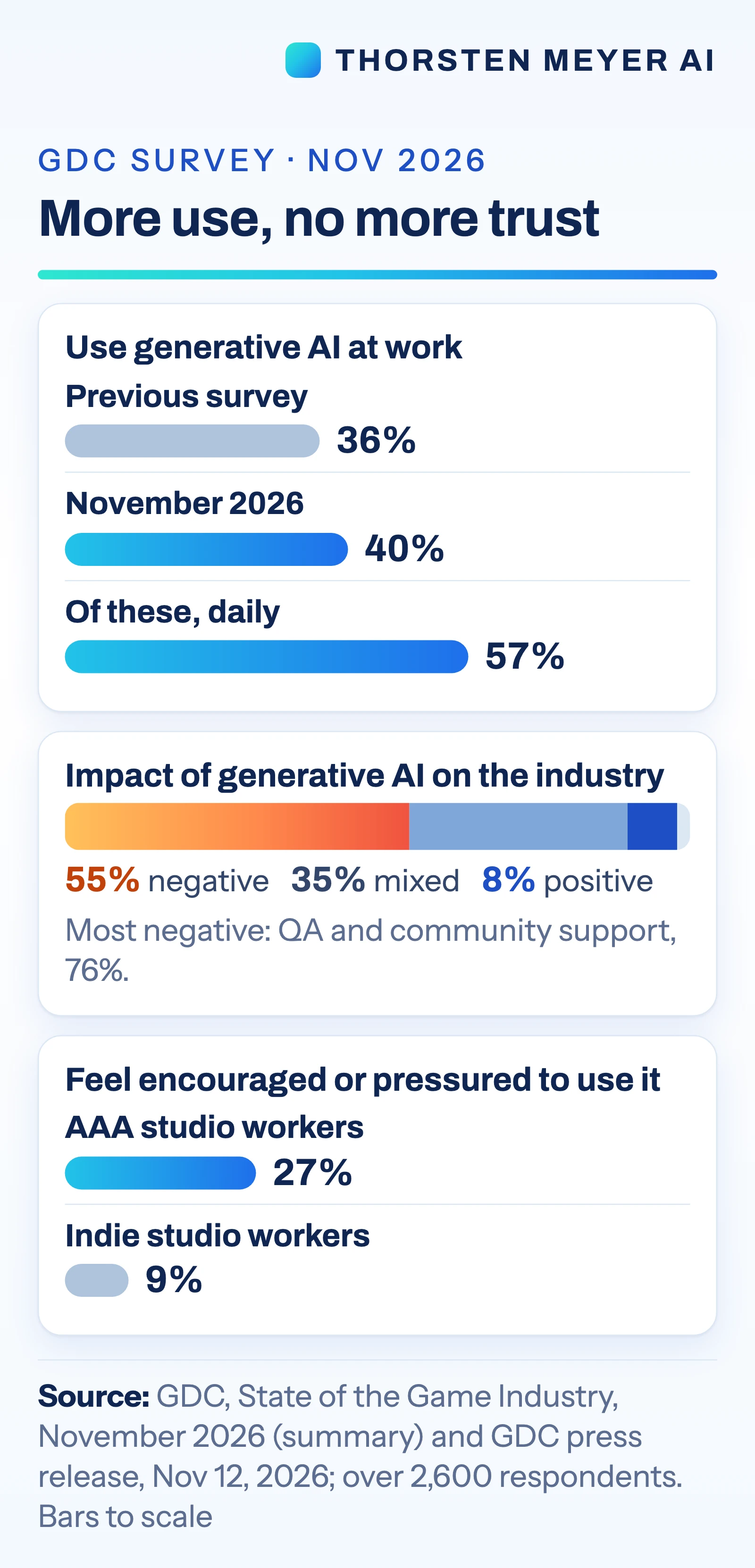
The timing places the statement amid wider concern about jobs and AI in games. The 2026 Game Developers Conference survey, published Nov. 12, found 40% of respondents used genAI at work, up from 36% in the previous survey, while 55% said the technology was having a negative impact on the industry. Those figures indicate workers’ reported use and views; they do not show that AI caused job losses.
Products Worth Considering

Apple Watch SE 3 GPS + Cellular 40mm Smartwatch

Bose TV Speaker (2nd Gen) Compact Soundbar with Bluetooth and HDMI Connectivity

Bose QuietComfort True Wireless Earbuds with Active Noise Cancellation, Bluetooth 5.3, USB-C Charging, and IPX4 Water Resistance
As an affiliate, we earn on qualifying purchases.
A Debate Already Underway
The manifesto appeared days after the GDC survey and amid other public signals of resistance and adoption. A group of Independent Games Festival jurors said they would not vote for games using genAI “in any capacity,” according to the source material. The studio behind Big Walk, meanwhile, disclosed that large language models touched “well under 0.1%” of its code. That is the studio’s description of its own project, not an industry-wide measure.
Industry representatives have described potential benefits. Video Games Europe, a trade body for the European video game sector, wrote in 2024 that genAI was widely expected to take development “to the next level” and argued against AI labels in games. Xbox CEO Asha Sharma wrote on Nov. 12 that a small team would be able to build worlds that previously required hundreds of developers, though she did not name AI in that statement.
The manifesto sets out five areas of concern: working conditions, relations between employers and staff, appropriation of work, discrimination and hidden costs. It argues that genAI may replace jobs, weaken junior hiring and shift blame for errors onto employees. Those points are the unions’ assessment; the supplied material does not independently establish the scale or causes of these effects.
““Avoid the use of generative AI entirely”.”
— European game worker unions, in “On Generative AI Usage in the Games Industry”
Reach and Studio Response Unknown
The source material does not state how many workers the unions represent, whether any studio will change its policies in response, or whether game companies have agreed to the proposed workplace protections. It reports no public response from a studio or trade body to the manifesto as of publication.
The relationship between genAI and recent layoffs is also unresolved. The GDC survey found that 34% of respondents had been laid off in the previous two years, but that figure does not identify AI as a cause. The manifesto’s claims about job replacement, junior roles, bias and working conditions remain the unions’ arguments rather than independently verified findings in the material available.
It is also unclear how the demands would be implemented across different studios and jurisdictions, particularly the proposed consent, compensation and withdrawal rules for training data. The manifesto does not itself create binding legal requirements.
Whether Studios Adopt the Demands
The next indication of the manifesto’s effect will be whether unions raise its proposals in company negotiations and whether studios publish policies on genAI use, worker requirements and disclosure. The text urges workers to organise and negotiate agreements, but the source material identifies no announced negotiations or studio commitments.
Regulatory action on training data would depend on decisions by lawmakers and courts. No specific next vote, hearing or legal milestone is identified in the available material, so the timing of any policy change remains uncertain.
Key Questions
What are the unions asking game studios to do?
They urge employers to avoid genAI entirely, ensure no worker is required to use it, and precisely label any use they consider unavoidable.
Does the manifesto cover AI used behind the scenes?
Yes. It includes tools used for early concept art, reference materials and pre-translations, as well as material that could appear in a finished game.
Which unions are associated with the manifesto?
The IWGB Game Workers page names its own branch members and collaborators from Game Workers Unite Ireland, Spain’s CSVI and FIOM-CGIL’s Milan Work Council. Rock Paper Shotgun and Kotaku also list France’s STJV and Germany’s GDRT.
Does the GDC survey show that AI caused game industry layoffs?
No. The survey reported that 34% of respondents had been laid off in the previous two years, but the cited figures do not identify genAI as the cause.
Have studios agreed to follow the manifesto?
No studio commitment is identified in the source material, which also reports no public response from a studio or trade body by the time of writing.
Source: Thorsten Meyer AI