

TL;DR
Apache released HTTP Server 2.4.71 on November 11 to fix CVE-2026-119618, a critical flaw in mod_http2 that Apache says can lead to remote code execution. The issue affects specified Apache and standalone mod_h2 versions when HTTP/2 is enabled; exploitation reports remain conflicting, so administrators should check their configuration and vendor patch status.
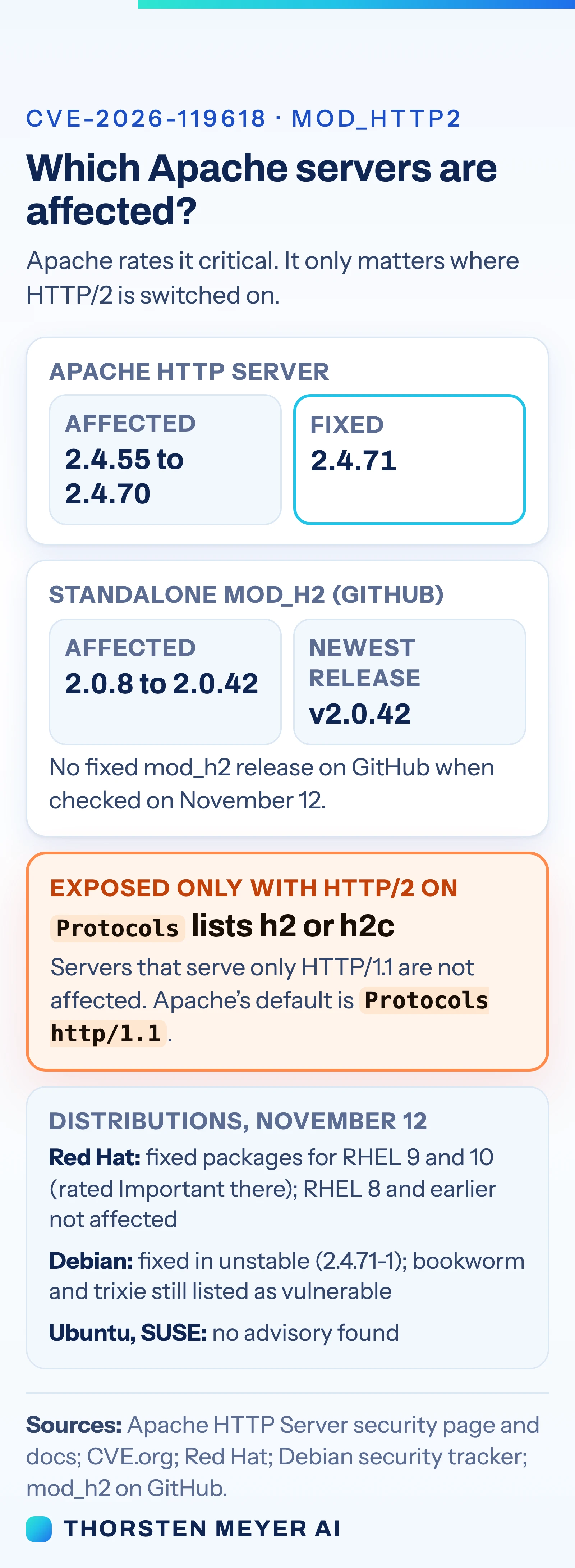
The Apache HTTP Server project released version 2.4.71 on November 11 to fix CVE-2026-119618, a critical flaw in its mod_http2 module that Apache says can lead to remote code execution. The stated affected versions are Apache HTTP Server 2.4.55 through 2.4.70 and standalone mod_h2 2.0.8 through 2.0.42; exposure depends on HTTP/2 being enabled.

Get the latest gadgets delivered free with Prime
- Fast, free delivery on millions of items
- Prime Video, Amazon Music and more included
- Member-only deals all year
Apache describes the issue as a shared-resource synchronization flaw in the assign_headers() function, with a title referring to heap corruption and remote code execution. Red Hat explains that one thread may modify memory belonging to another, corrupting the server’s internal memory. Red Hat says a remote attacker able to reach an affected server could execute arbitrary commands without authentication. It assigns the vulnerability a CVSS 3.1 score of 9.8; the source material said NVD had not published its own score as of November 12.
HTTP/2 must be enabled for the described exposure. Red Hat says servers using h2 or h2c through Apache’s Protocols directive are affected, while servers serving only HTTP/1.1 are not. Apache documentation lists HTTP/1.1 alone as the default, but administrators should inspect their actual configuration. Apache’s upstream fix is version 2.4.71, and Red Hat shipped fixed packages on November 11.
Distribution status varied on November 12. Red Hat rated the issue critical overall but important for RHEL 9 and 10, citing separate allocators for HTTP/2 streams that increase exploitation complexity; fixed packages were available for those releases. RHEL 8 and earlier were listed as unaffected. Red Hat JBoss Core Services and Red Hat Hardened Images remained listed as affected. Debian listed bookworm and trixie as vulnerable, with fixed version 2.4.71-1 available only in unstable, or sid. The source report found no published Ubuntu or SUSE advisory at that time.
Exposure Depends on HTTP/2
The flaw matters because Apache is widely used to serve web traffic, and Red Hat says exploitation could allow unauthenticated command execution on a reachable affected server. The reported scope is limited by both software version and configuration: an installation within the affected range is not necessarily exposed if it serves only HTTP/1.1.
Wiz reported that 64% of cloud environments in its data had resources vulnerable to the CVE and that 51% had publicly exposed instances. Wiz cautioned that its figures did not account for configuration. They describe its customer data, not a count of confirmed exploitable servers, and should not be read as a measure of all cloud deployments.
Patch availability also depends on how Apache is installed. Administrators using distribution packages need to follow their vendor’s advisory and package updates; the upstream version number alone may not describe the status of a vendor-maintained build.
Products Worth Considering

Bose Smart Ultra Dolby Atmos Soundbar with Voice Control, HDMI eARC, Black

DJI Osmo 360 Road Cycling First-Person Combo Action Camera

Samsung 27-Inch Odyssey G5 QHD Gaming Monitor (G50F)
As an affiliate, we earn on qualifying purchases.
Reports and Patch Timeline
Apache credited the discovery to Anthropic’s OSS Scanner and two researchers from Google Cloud Vulnerability Research. Apache’s account says Anthropic’s report arrived on October 26 and Google Cloud’s report on November 3. The CVE.org record says the identifier was reserved on October 30.
The upstream fix followed on November 11, 16 days after the first report date stated in the source material. Red Hat also shipped fixed packages that day. The timeline shows when reports and fixes were recorded; it does not establish when the flaw first became exploitable or whether attackers knew about it before disclosure.
““Concurrent Execution using Shared Resource with Improper Synchronization vulnerability in Apache HTTP Server’s mod_http2 in assign_headers() can lead to RCE.””
— Apache HTTP Server project
Exploit Status Remains Unsettled
Sources give different accounts of exploit availability. Wiz said on November 11 that it knew of no available exploit and no in-the-wild exploitation. Red Hat said public research had demonstrated a reliable exploit against a default-configured server with HTTP/2 enabled, but the supplied material does not identify the researchers or say whether their work was published. It also reports no public exploit code linked from the advisories.
The source report said the CVE was not in CISA’s Known Exploited Vulnerabilities catalog when checked on November 12. The catalog version cited was released before the CVE became public, so its omission does not establish that exploitation has not occurred. The actual number of exposed servers is also unknown: Wiz’s environment figures did not account for configuration. Vendor status can change after the November 12 check, and no Ubuntu or SUSE advisory was found in the material at that time.
Check Configuration and Vendor Fixes
Administrators should confirm whether their Apache installation falls within the affected versions and whether h2 or h2c is enabled. They should then check their operating system or package vendor’s current advisory and apply the supported fixed package. For upstream installations, Apache identifies 2.4.71 as the fixed release.
Distribution advisories and exploitation reports may change after the November 12 status check. The source material does not provide a date for further vendor updates or a named next milestone, so administrators should monitor their suppliers’ notices and CISA’s catalog for new information.
Key Questions
Which Apache versions are listed as affected?
Apache lists HTTP Server 2.4.55 through 2.4.70 and standalone mod_h2 versions 2.0.8 through 2.0.42. Apache HTTP Server 2.4.71 is the upstream fixed release.
Does a server need HTTP/2 enabled to be affected?
According to Red Hat, the issue affects servers with HTTP/2 enabled through the Protocols directive, including h2 or h2c. Servers serving only HTTP/1.1 are not affected, so check the running configuration rather than assuming from defaults.
Is CVE-2026-119618 being exploited?
The available statements conflict. Wiz reported no exploit availability or in-the-wild reports as of November 11, while Red Hat said public research had demonstrated a reliable exploit. The supplied material does not resolve the discrepancy.
Are Debian stable systems patched?
As of the November 12 check described in the source material, Debian listed bookworm and trixie as vulnerable. Fixed package 2.4.71-1 had reached Debian unstable, sid; check Debian’s current advisory for later updates.
Source: Thorsten Meyer AI