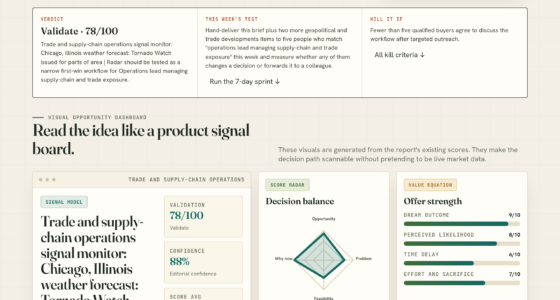
📊 Full opportunity report: Small-order Sourcing Platform For Independent Retailers on IdeaNavigator AI — validation score, market gap, and execution plan.

Get the latest gadgets delivered free — and shop member deals
- Fast, free delivery on millions of items
- Access to Prime Big Deal Days deals on October 6–7
- Prime Video, Amazon Music and more included
TL;DR
A proposal for a small-order wholesale sourcing platform would help independent retailers test products without meeting conventional distributor minimums. Its suggested first step is a manual pilot involving 20 brands and 50 shops, with conversion to standard reorders measured within a quarter; no launch or pilot results are reported.
IdeaNavigator AI has proposed a small-order sourcing platform that would let independent retailers test new products in quantities as small as five units, avoiding distributor minimums that can make trial orders difficult. The idea remains a proposal: no platform launch, participating businesses or pilot results are reported, and the suggested next step is to broker trial orders manually between 20 brands and 50 shops.
In its proposal, IdeaNavigator AI describes a marketplace with a dedicated lane for trial-size wholesale orders. Brands would set micro-minimums, while consolidated fulfillment would combine smaller orders to make shipping economics workable. Retailers could choose five-unit assortments, track how those products sell, and move to a standard wholesale relationship if a trial performs well. These are features described in the proposal, not confirmed services currently available to retailers.
IdeaNavigator AI suggests a limited validation test: arrange orders manually for 20 brands and 50 independent shops, then measure how many trial purchases turn into standard reorders within one quarter. The proposal does not report that this test has begun or provide outcomes, costs, or a target conversion rate. It also does not specify how sell-through data would be gathered or shared.
The proposal’s suggested revenue model combines a take rate on orders with subscriptions for brand-facing analytics on trial performance. It identifies independent retail wholesale as the target market, but gives no pricing, transaction-fee level, subscription terms or financial projections. Those details would need to be tested alongside retailer demand and fulfillment costs.
Why Smaller Trial Orders Matter
For an independent shop, a large opening order can tie up cash and shelf space before the owner knows whether customers will buy a product. A five-unit test could lower that initial commitment and give retailers a way to experiment with a broader selection. If the model works, it may make product discovery less dependent on annual trade-show visits and existing distributor catalogs, as IdeaNavigator AI argues in its proposal.
The benefit depends on more than a low minimum. Shipping, handling and order consolidation must not erase the savings of buying fewer units, and retailers need a practical way to judge whether a product sold well enough to reorder. Brands, meanwhile, would need to see enough useful information from small trials to justify accepting lower-volume orders. The proposed pilot matters because it could test these commercial conditions before a dedicated platform is built.
The stakes are therefore practical rather than established: the concept could reduce barriers to trying inventory, but its value to retailers and brands has not yet been demonstrated. Measuring trial-to-reorder conversion would offer an initial signal of demand, though IdeaNavigator AI’s outline does not define what rate would make the business viable.
As an affiliate, we earn on qualifying purchases.
The Gap Between Minimums and Trials
IdeaNavigator AI’s proposal describes a specific purchasing problem: independent retailers may want to test unfamiliar products but face distributor case minimums or opening orders sized for larger chains. When the minimum purchase is too large for a cautious trial, a shop may stick with familiar inventory instead. The outline presents limited product discovery as a consequence, but supplies no survey data or sales figures to quantify how common the problem is.
The proposal also points to Faire as evidence that a wholesale marketplace model has been established, while arguing that very small trial orders remain an underserved edge. That comparison is part of the proposal’s rationale; it does not establish that existing marketplaces cannot support small orders or that retailers would switch to a new service. The suggested distinction is the combination of micro-minimums, consolidated shipping and a path from test purchase to regular wholesale ordering.
As an affiliate, we earn on qualifying purchases.
Demand, Costs and Pilot Status
No operating platform or completed pilot is reported in IdeaNavigator AI’s proposal. It remains unclear whether IdeaNavigator AI or another party plans to build the marketplace, when a test might start, or whether the proposed 20 brands and 50 shops have been recruited. The proposal includes no retailer or brand interviews, signed commitments, trial orders or performance figures.
Several business questions are also open. The outline does not say how consolidated fulfillment would work across brands, who would bear shipping and handling costs, how returns or unsold stock would be managed, or what transaction and analytics fees might apply. It does not specify the methods or data standards for tracking sell-through. Until a pilot produces evidence, claims that five-unit orders can be shipped economically or lead to lasting wholesale relationships remain untested.
independent retailer product testing kits
As an affiliate, we earn on qualifying purchases.
As an affiliate, we earn on qualifying purchases.
Testing the Wholesale Trial Model
IdeaNavigator AI describes the next step as a manual brokerage test, rather than an immediate technology launch: arrange trial orders between 20 brands and 50 independent shops, then check within a quarter how many retailers place standard reorders. A useful assessment would also need to account for shipping costs, order completion, retailer feedback and the quality of sell-through information, although those measures are not set out in the proposal.
No pilot timetable or public decision point has been announced. If the test proceeds, its results could help establish whether retailers want smaller initial orders and whether brands can fulfill them without making the economics unworkable. Until then, the platform is a proposed business concept, not a confirmed new service.
Source: IdeaNavigator AI proposal
As an affiliate, we earn on qualifying purchases.
Key Questions
Has the small-order sourcing platform launched?
No launch is reported. IdeaNavigator AI describes the platform as a proposal, and its suggested first test would broker orders manually.
How small could a retailer’s trial order be?
IdeaNavigator AI’s proposal describes five-unit assortments as a possible trial size. It does not confirm that any retailer can currently place such an order through a service.
How would the proposed platform make money?
The proposal suggests combining a fee on orders with subscriptions for brand analytics on trial performance. No rates or pricing terms are provided.
What would the proposed pilot measure?
As outlined by IdeaNavigator AI, it would track whether trial orders arranged between 20 brands and 50 shops convert into standard wholesale reorders within one quarter. No pilot results or conversion target have been reported.
Source: IdeaNavigator AI
Halloween Picks
halloween
As an affiliate, we earn on qualifying purchases.