
📊 Full opportunity report: See What May Be Ready To Automate With A Workflow Review on IdeaNavigator AI — validation score, market gap, and execution plan.

Get the latest gadgets delivered free with Prime
- Fast, free delivery on millions of items
- Prime Video, Amazon Music and more included
- Member-only deals all year
TL;DR
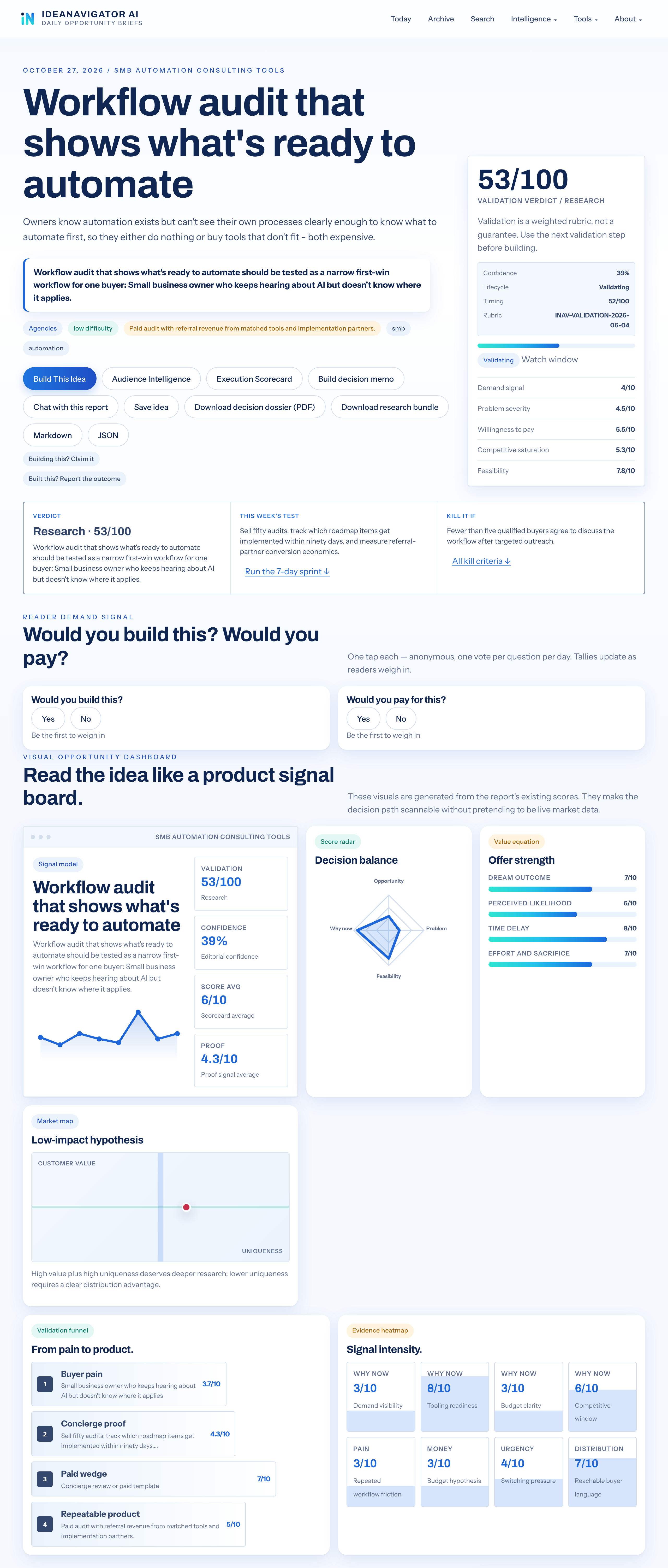
IdeaNavigator AI describes a proposed paid workflow audit for small-business owners unsure where automation fits. The service would map operations, score potential tasks and suggest a 90-day implementation plan, but it is a product concept, not a reported launch; demand and referral economics have not been demonstrated.
IdeaNavigator AI has outlined a proposed workflow audit for small-business owners who are unsure where automation could help, describing a service that would map business processes and produce a prioritized 90-day roadmap. The proposal addresses a practical barrier to adopting AI and other automation tools, but no product launch, customer results or completed validation are reported.
The proposed audit would use a guided interview with an owner to document how the business operates. It would then produce a process map that rates tasks by automation readiness, potential return on investment and difficulty. The intended output is not simply a list of software products, but a sequence of possible changes over the following 90 days.
For each roadmap step, the concept would suggest matched tools and potentially implementation partners. The proposed business model combines a paid audit with referral revenue when customers select recommended tools or partners. No pricing, referral terms, partner agreements or specific software products are given.
The idea is aimed at owners who have heard about AI but cannot tell which parts of their own operations might benefit. Its underlying premise is that owners may either delay action because they cannot identify a starting point or purchase tools that do not fit their processes. The proposal frames both outcomes as costly, but provides no research or customer data quantifying how often they occur or the financial losses involved.
See What May Be Ready To Automate With A Workflow Review
A proposed paid audit would map a small business’s operations, identify tasks that may suit automation, and shape possible next steps into a 90-day roadmap. The concept has not yet been validated through reported customer results.
From scattered work to a prioritized plan
The service is designed to help owners understand their processes before choosing software. Its intended value is a clearer starting point—not a promise that automation will pay off.
Guided interview
Ask an owner how the business runs, documenting recurring tasks, handoffs, and bottlenecks.
Process map
Organize the work and rate candidate tasks by automation readiness, potential return, and difficulty.
90-day roadmap
Sequence possible changes and suggest matched tools or implementation partners for each step.
Describe operations
Capture how work currently gets done.
Map processes
Make tasks and handoffs visible.
Score candidates
Weigh readiness, return, and effort.
Plan next steps
Suggest a sequence to explore over 90 days.
Choose the task before the tool
The concept responds to a familiar decision gap: owners may know automation tools exist but struggle to see where those tools fit their own operations.
A process-first review could help turn general interest in AI into a more specific question: which task, if any, is a suitable candidate? That can give a small firm a way to compare potential changes before committing money and staff time.
Buying software alone does not establish that a process is suitable or that a tool will cover its costs. A useful roadmap would need to account for readiness, implementation effort, and likely value. These are intended benefits of the proposal; no measured outcomes are reported.
The idea also suggests that large language models could make guided process interviews easier to deliver. No technical details or testing results establish whether an automated interview would reliably capture each business’s processes.
Two revenue paths, terms unspecified
The proposal pairs a direct service fee with possible earnings from recommendations. No pricing, referral terms, partner agreements, or software products are given.
Paid workflow audit
A customer would pay for a guided review, process map, and prioritized roadmap. The proposed price is not specified.
Tools and partners
The service may earn referral revenue when customers choose recommended tools or implementation partners. Terms and conversion economics are unknown.
A proposed test—not reported traction
IdeaNavigator AI suggests selling 50 audits, then tracking which roadmap items customers implement within 90 days and whether partner referrals convert economically. No sales, test date, recruitment plan, or results are reported.
What is known—and what is still open
What is the proposed workflow audit?
A service concept that would interview a small-business owner, map processes, and rate possible automation tasks by readiness, potential ROI, and difficulty.
Is the audit available now?
The description does not confirm a launch or give a release date. It presents the audit as a concept to validate.
How would the service make money?
Through a proposed paid audit and referral revenue from matched tools or implementation partners. No prices or referral terms are specified.
Sell 50 audits, track roadmap implementation within 90 days, and measure referral conversion economics. No test results are reported.
A Practical First Step for Automation
The proposal focuses on a problem that can arise before a business chooses an automation platform: understanding the work that could be changed. Owners may know that automation products exist yet lack a clear view of repetitive tasks, handoffs and bottlenecks in their own operations. A structured review could help turn a broad interest in AI into a more specific decision about what to test first.
That distinction matters because buying software does not itself establish that a process is suitable for automation or that the tool will pay for itself. A roadmap that considers readiness, cost and implementation difficulty could give a small firm a way to compare options before committing time and money. However, those are intended benefits of the concept, not proven outcomes.
The proposed paid-audit and referral model also creates a question for prospective customers: recommendations would be tied to revenue opportunities for the service. To judge the product, customers would need clear information about how tools are matched, whether recommendations are independent, and what the audit costs. The proposal does not set out those terms.
Products Worth Considering

Amazon Kindle Paperwhite (12th Generation, 2024), 16 GB, 7-inch Display, Jade

Sonos Era 100 Wireless Smart Speaker, Black

Logitech MX Keys S Wireless Keyboard, Graphite
As an affiliate, we earn on qualifying purchases.
Why Owners Need Process Clarity
The concept is positioned amid a rapid expansion of AI tools, which IdeaNavigator AI says has left some small-business owners facing decision paralysis. Rather than begin with a particular software package, the proposed service would start by asking owners about their operations. This shifts the initial question from “Which tool should I buy?” to “Which task, if any, is a suitable candidate?”
The proposal also argues that guided process-mapping interviews may now be easier to automate with large language models. That is the concept’s rationale for developing an audit product; it is not evidence that an automated interview can reliably capture every business process. The description supplies no testing results, technical details or comparison with a human consultant’s assessment.
IdeaNavigator AI identifies the market as small-business automation consulting tools. It recommends testing the idea by selling 50 audits, then tracking which roadmap items customers implement within 90 days and whether referrals to partners convert economically. That proposed test is a validation plan, not a report that 50 audits have been sold.
Demand and Results Remain Untested
The available description does not say whether the audit exists as a working product, when it might launch, or whether any small businesses have used it. There are no reported sales, customer interviews, implementation rates or measured savings. The suggested 50-audit test remains a plan, and no timeline for carrying it out is provided.
It is also unclear how the service would verify information gathered in an interview, calculate readiness or ROI, and account for differences between businesses. The proposal gives no scoring method or examples of a process map. It does not explain how recommendations would handle sensitive business information, or how referral relationships might affect tool selection. Those details would matter to owners deciding whether to share operational data and rely on the resulting roadmap.
Finally, the concept does not specify audit pricing, the costs of recommended implementation, or what counts as a successful referral. Without those figures, the service’s affordability and the economics of its proposed revenue model cannot yet be assessed.
A 50-Audit Test Is Proposed
The next stated step is to test demand by selling 50 audits. The proposed evaluation would follow whether customers implement roadmap recommendations within 90 days and measure conversion economics for referral partners. No start date, recruitment plan or results have been announced in the description.
If the test proceeds, the key evidence will be more than the number of audits sold: it would include which recommendations customers act on, how long implementation takes, and whether changes produce measurable value relative to their costs. Until such results are available, the workflow review should be treated as a product proposal awaiting validation, not an established automation service or a proven guide to business savings.
Source: IdeaNavigator AI
Key Questions
What is the proposed workflow audit?
It is a proposed service that would interview a small-business owner, map business processes and rate possible automation tasks by readiness, potential ROI and difficulty.
Is the audit available now?
The description does not confirm that a product has launched or provide a release date. It presents the audit as a concept to validate.
How would the service make money?
The proposed model combines a paid audit with referral revenue from matched software tools and implementation partners. No prices or referral terms are specified.
How does IdeaNavigator AI propose to test demand?
It proposes selling 50 audits, tracking which roadmap items customers implement within 90 days, and measuring referral-partner conversion economics. No test results are reported.
Source: IdeaNavigator AI