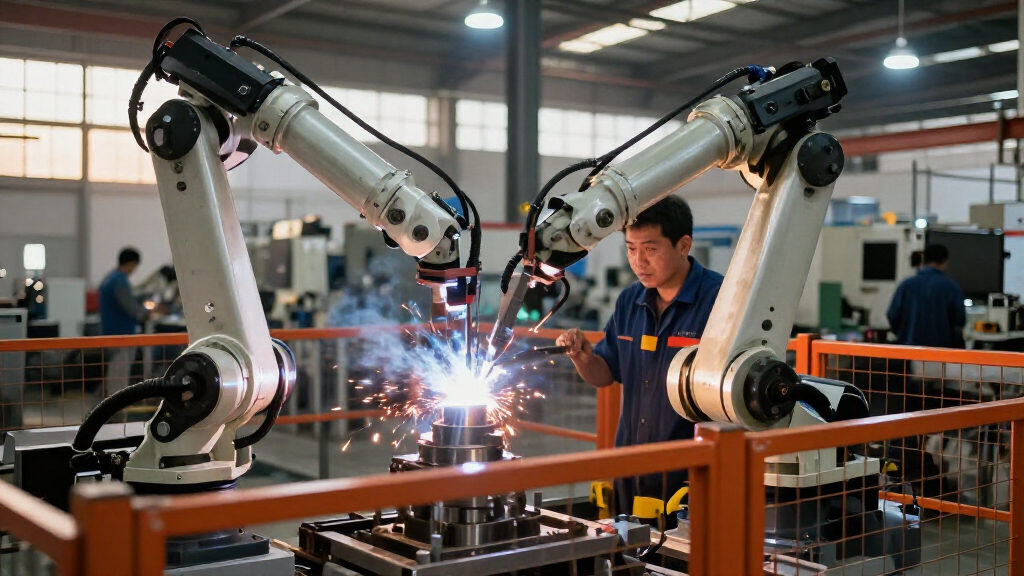

🔍 Read the full analysis: Robots In The Factory on ThorstenMeyerAI.com

Get the latest gadgets delivered free with Prime
- Fast, free delivery on millions of items
- Prime Video, Amazon Music and more included
- Member-only deals all year
TL;DR
The International Federation of Robotics reported 5 million industrial robots operating worldwide in 2025, with China accounting for 59% of new installations. Research finds robots reduced employment in some U.S. labor markets, while German evidence shows service-sector gains offset factory job losses in one study. The overall impact depends on the country, industry and workers counted.
The global stock of industrial robots reached 5 million in 2025, according to the International Federation of Robotics (IFR), as factories installed more than 600,000 new machines. The scale of that expansion sharpens a long-running question for workers and policymakers: research finds that robots can reduce factory employment, but the broader effects vary by country and may include gains in services.
The IFR said the number of robots operating in factories worldwide was 9% higher than in 2024 and more than double the stock seven years earlier. China installed 354,000 robots, or 59% of the global total of new installations. The United States installed almost 38,500, up 12%, while Japan installed 36,219, down 19%. Germany installed fewer than 25,000, down 8%.
Industrial robots first entered a production line in 1961, when General Motors used a Unimate to unload a die-casting press at its Ternstedt plant in Trenton, New Jersey, according to the IFR and The Henry Ford museum, which holds the machine. The 4,000-pound robot handled hot metal parts. Robots subsequently moved into welding and other heavy or hazardous factory tasks. At GM’s Lordstown plant in 1969, more than 90% of body welding was automated, the IFR says.
Employment research does not point to one universal outcome. Economists Daron Acemoglu and Pascual Restrepo estimated that, from 1990 to 2007, each additional industrial robot was associated with the displacement of about 3.3 workers across the U.S. economy, for an estimated total of about 400,000 jobs. A separate account of German research in the source material describes factory job losses of almost two per additional robot, offset by roughly as many service jobs, leaving the overall employment effect near zero.
Infographic 01 · Five million robots
Where the robots work
Sixty-five years after the first Unimate, five million industrial robots work in the world's factories. South Korea has by far the most per worker.
Robots per 10,000 employees in manufacturing · 2024
Where the new robots went · 2025
- China: 354,000 installed, 59% of the world total.
- United States: almost 38,500 (+12%), again the second-largest market.
- Japan 36,219 (−19%) · South Korea 30,000 · Germany fewer than 25,000 (−8%), Europe’s largest market.
Robot density = operational industrial robots per 10,000 employees in manufacturing. China (166 in 2024) is not compared here: the IFR switched to updated Chinese labour data in 2026, which changed the denominator.
Sources: IFR, robot density press release, 8 Apr 2026 (data 2024); IFR, World Robotics 2026 press release, 24 Sep 2026.
Powered by Thorsten Meyer AI
Automation’s Uneven Employment Effects
The figures matter because factory automation is expanding at a time when governments and workers are weighing productivity, industrial competitiveness and job security. The 5 million-robot total describes the scale of deployment, not the number of jobs eliminated: robots can take over specific tasks, while employment outcomes also depend on changes in production, demand and hiring elsewhere.
The contrast between the U.S. and German findings cautions against treating automation as a simple one-for-one exchange of machines for workers. The U.S. estimate counts losses across local labor markets over a defined period. The German result, as summarized in the source, includes employment gains in services. These measures address different labor-market effects, so neither establishes that every worker affected by automation finds another job or that every new robot reduces total employment.
Who is counted also matters. Workers who remain in a factory may experience changes to their duties, while people entering the workforce may never get a job in an automated plant. A headline job total can miss those differences, as well as changes in wages, job quality and the distribution of gains.
Products Worth Considering

DJI Mic Wireless Lavalier Microphone System with 2 Transmitters, 1 Receiver, and Charging Case

Bose QuietComfort Ultra Earbuds (2nd Gen), Wireless Noise-Cancelling Earbuds, Black

Amazon Kindle Scribe Colorsoft 64GB with Premium Pen
As an affiliate, we earn on qualifying purchases.
From Die-Casting to Global Deployment
The first industrial robot followed an earlier invention. George C. Devol filed a U.S. patent in 1954 for a programmed machine that transferred articles; the patent was granted in 1961. Devol and entrepreneur Joseph Engelberger formed Unimation, whose robot was used by GM to remove castings from a press. That early application illustrates a pattern: factories initially assigned robots work that was hot, heavy or dangerous.
Robots later spread to welding and other manufacturing operations. Japan began producing industrial robots under licence in the late 1960s; Kawasaki’s first Unimate was completed in 1969. The source attributes Japanese demand in part to shortages of workers for hard, dirty and dangerous jobs. European manufacturers also developed new machines in the 1970s.
Robot counts and robot density measure different things. The IFR’s 2025 figure is a global operating stock, while its density figures use 2024 data and measure robots per 10,000 manufacturing employees. South Korea led that measure with 1,220, followed by Singapore at 818, Germany at 449 and Japan at 446; the U.S. ranked eighth at 307. The world average was 132.
What Robot Counts Cannot Show
The IFR’s installation and operating-stock figures do not state how many jobs were created or eliminated by the machines. They also do not show how robots affected individual workers’ pay, working conditions or prospects for re-employment. The source gives employment estimates for earlier periods, not a current global estimate of robots’ net effect on jobs.
The U.S. and German findings cover different countries, periods and measures. The German result is summarized here without enough methodological detail to compare it directly with Acemoglu and Restrepo’s U.S. estimate. It is therefore not clear from the available material how much of the difference reflects national labor markets, research design or other economic changes. Nor does the source establish that the historical estimates predict the effects of current deployments.
The Next Test for Factory Work
The next major measure from the IFR is its subsequent World Robotics report, which can show whether installations continue to grow and how deployment shifts among countries. Updated robot-density figures can also help distinguish a large manufacturing sector from one using many robots relative to its workforce.
For workers and policymakers, the more direct test will be employment evidence that tracks both factory and service jobs over time, alongside wages and working conditions. Until those measures are available for the latest wave of installations, the confirmed picture is one of rapid robot adoption and uneven historical employment effects—not a settled forecast of what automation will do to the total number or quality of jobs.
Key Questions
How many industrial robots were operating worldwide in 2025?
The IFR reported 5 million industrial robots in operation worldwide in 2025, 9% more than in 2024.
Which country installed the most robots in 2025?
China installed 354,000 new robots, accounting for 59% of the global total, according to the IFR.
Does research show that robots always eliminate jobs?
No. The studies summarized here report different outcomes. One U.S. estimate found employment displacement during 1990–2007; a German finding described factory losses offset by service-sector gains. The results depend on the country, period and measure.
What does robot density measure?
Robot density is the number of industrial robots per 10,000 manufacturing employees. The IFR’s latest figures cited here are for 2024, when South Korea ranked highest at 1,220.
Source: ThorstenMeyerAI.com