
📊 Full opportunity report: Parental Consent Management For Child-Focused Platforms on IdeaNavigator AI — validation score, market gap, and execution plan.

Get the latest gadgets delivered free with Prime
- Fast, free delivery on millions of items
- Prime Video, Amazon Music and more included
- Member-only deals all year
TL;DR
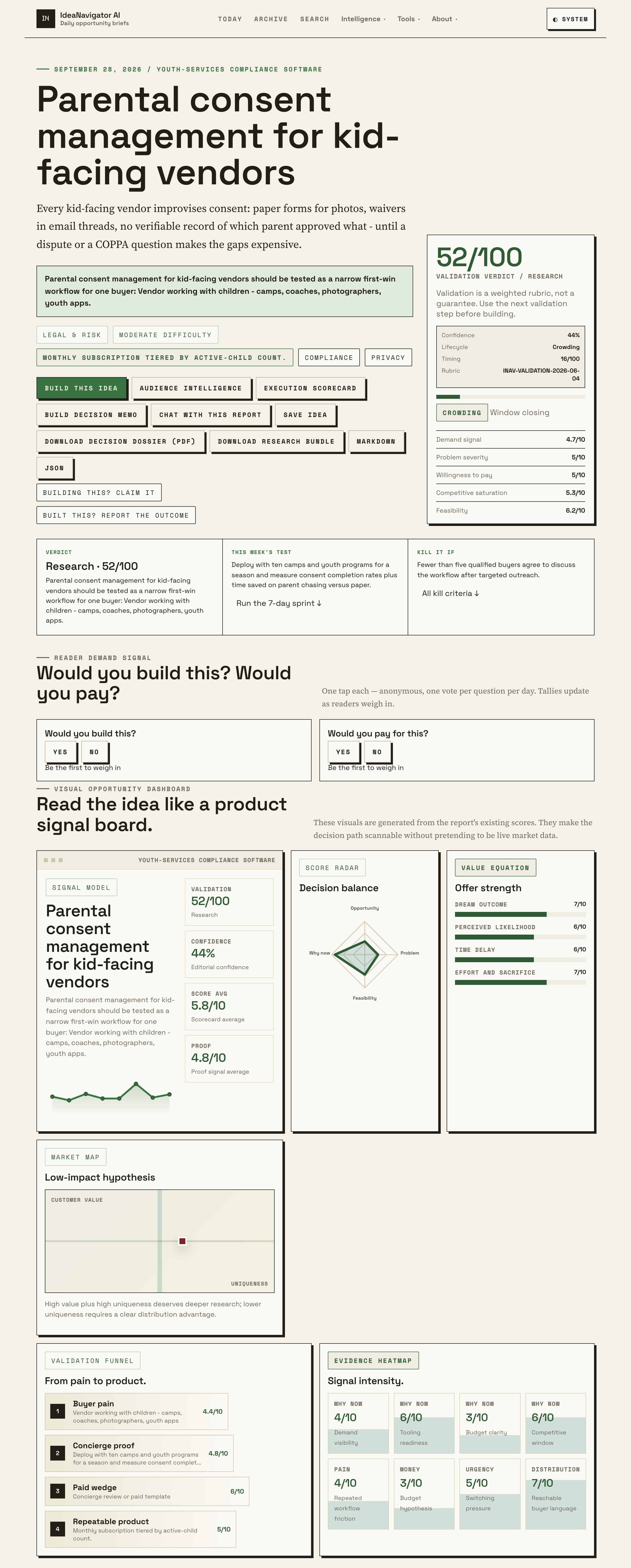
IdeaNavigator AI has proposed a parental consent management service for camps, coaches, photographers and youth apps. The concept would let parents complete vendor-branded forms on phones and give vendors per-child records, expiration tracking and audit exports; no launch or pilot results are reported.
IdeaNavigator AI has outlined a proposed parental consent service for camps, coaches, photographers and youth apps, aiming to replace scattered paper forms and email approvals with phone-based forms and searchable records. The proposal describes a possible product and a way to test demand; it does not report a launched service, participating vendors or measured results.
According to IdeaNavigator AI’s proposal, the service would let each vendor offer parents a branded consent flow on a phone. Forms could cover photo use, data collection, medical information and liability. The proposal also calls for identity checks suited to the risk of each form, a consent ledger for each child, expiration tracking and an option to export records for an audit.
The proposal says the business model under consideration is a monthly subscription tiered by active-child count. Intended customers include organizations that work with children, such as camps, individual coaches, photographers and youth-focused apps. IdeaNavigator AI does not specify subscription prices, a launch schedule, technical methods for verifying a parent’s identity or which legal requirements the product would cover.
To evaluate the idea, IdeaNavigator AI proposes a season-long trial with ten camps and youth programs. The proposal identifies consent completion rates and time spent following up with parents, compared with paper-based processes, as suggested measures. It does not say that a trial is underway, and reports no results.
A Record for Each Child
IdeaNavigator AI’s proposal describes a record system intended to help vendors see who approved which use and whether that approval is still valid. Photo permissions, health details and data collection can involve different choices, so a single signed waiver may not show the scope or duration of every permission. The proposed digital ledger would organize those records for retrieval when a parent asks a question or a vendor reviews its files.
The proposal also identifies staff time spent following up on incomplete forms and sorting email threads as an operational concern for small programs. It suggests that a phone-based process could increase completion and reduce follow-up, but provides no measured results. Its proposed pilot is intended to assess those outcomes.
The proposal does not describe how the service would present choices to parents or record changes and expiration. A centralized record would document approvals, but would not by itself establish that consent was informed or resolve disagreements about later use of a child’s image or information.
Products Worth Considering

Apple MacBook Air 15-inch (2026) with M5 chip, 16GB memory, 512GB SSD — Midnight

Bose TV Speaker Compact Soundbar with Bluetooth and HDMI-ARC, Black

Amazon Kindle Scribe Colorsoft 64GB with Premium Pen
As an affiliate, we earn on qualifying purchases.
Consent Is Often Scattered
IdeaNavigator AI’s proposal characterizes current consent processes among child-focused vendors as inconsistent: photo forms may be on paper, waivers may sit in email threads, and a readily verifiable record linking a parent’s approval to a particular use may be unavailable. The proposal says these gaps can become costly during a dispute or a compliance question. It provides no survey data or examples showing how widespread the problem is.
As a rationale for the proposal, IdeaNavigator AI points to changes in children’s privacy rules and enforcement and to parents challenging photo and data use. It refers broadly to updates to the U.S. Children’s Online Privacy Protection Act, known as COPPA, and state laws, but identifies no specific rule, enforcement action or effective date. The proposal targets small vendors that may lack dedicated compliance staff and provides no market-size estimate.
The proposal presents a product concept within youth-services compliance software; it does not report a policy change or enforcement announcement. A ten-program seasonal test, if conducted, could provide an initial operational assessment, but would not by itself establish that the service meets every legal obligation across different activities, jurisdictions or types of information.
Legal and Product Details
IdeaNavigator AI’s proposal describes no product launch, customer commitments or pilot findings. It does not say whether camps or youth programs have agreed to participate, when a trial might take place, or what completion rates and time savings would count as a successful result. Pricing, data storage, access controls, deletion practices and integration with existing registration systems are also unspecified.
The proposal does not explain how the service would verify a parent’s identity at different risk levels, handle disputes between guardians, or record consent withdrawal. It also leaves open how the system would distinguish permissions for each purpose and apply differing legal requirements. Its references to COPPA updates and state laws are general; it provides no specific legal analysis or compliance guarantee.
A Ten-Program Seasonal Trial
IdeaNavigator AI proposes deploying the service with ten camps and youth programs for one season. The proposal identifies consent completion rates and parent follow-up time as possible measures, but provides no participant names, measurement methods or trial schedule. It does not say whether the trial is planned or has begun.
Until further details or results are reported, the concept remains an early product proposal. The proposed trial would assess whether vendors and parents find the process clear and practical and whether it produces records that reflect each approval and its duration.
Source: IdeaNavigator AI proposal
Key Questions
Has a parental consent platform launched?
No launch is reported. IdeaNavigator AI describes a proposed service and a potential pilot, but gives no release date or available product details.
Who would use the proposed service?
It is aimed at vendors working with children, such as camps, coaches, photographers and youth apps. Parents would complete the consent forms.
What would the service record?
The proposal includes per-child consent records for matters such as photo use, data collection, medical information and liability, with expiration tracking and audit exports.
What would the proposed pilot measure?
A season-long trial with ten camps and youth programs would compare consent completion rates and time spent following up with parents against paper-based processes. No results have been reported.
Source: IdeaNavigator AI