
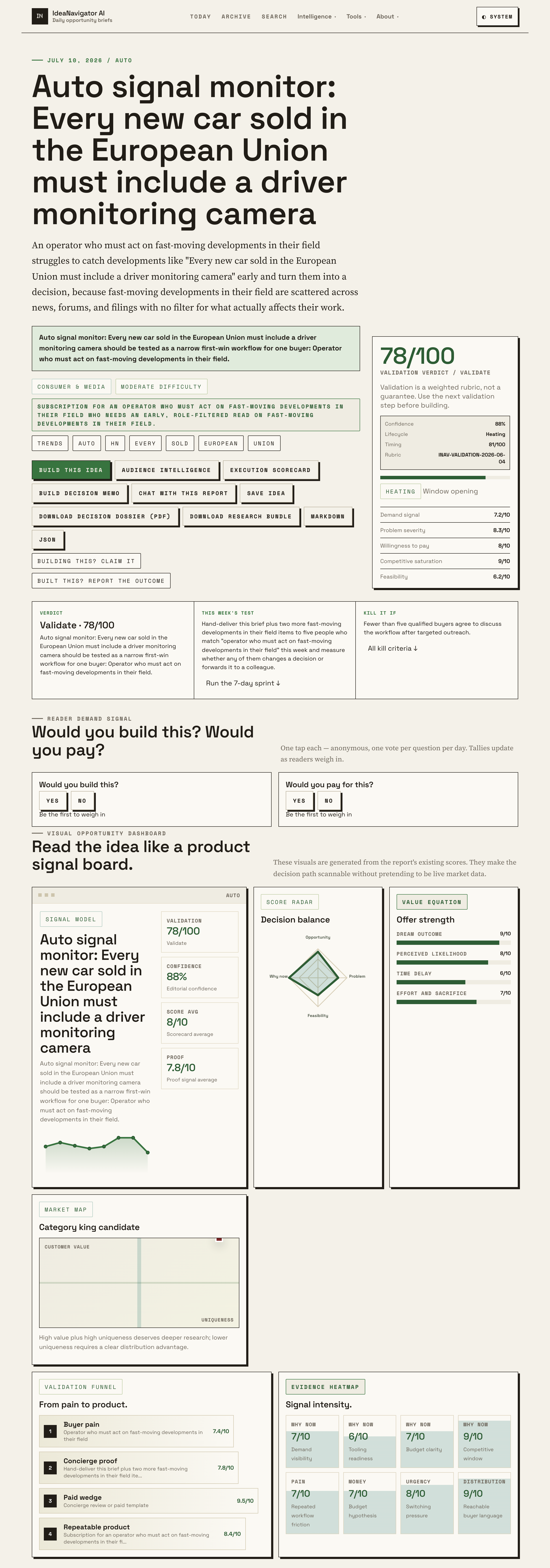
📊 Full opportunity report: Auto Signal Monitor: Every New Car Sold In The European Union Must Include A Driver Monitoring Camera on IdeaNavigator AI — validation score, market gap, and execution plan.

Get the latest gadgets delivered free — and shop member deals
- Fast, free delivery on millions of items
- Access to Prime Big Deal Days deals on October 6–7
- Prime Video, Amazon Music and more included
TL;DR
Every new car sold in the European Union must now include a driver monitoring system capable of detecting drowsiness and distraction, a requirement that has pushed camera-based monitoring into mainstream automotive hardware. The development is being tracked by operators who need fast, role-filtered reads on regulatory changes.
Every new car sold in the European Union must now include a driver monitoring system, with camera-based technology increasingly used to detect drowsiness and distraction behind the wheel. The requirement, which stems from EU vehicle safety regulation and applies to all new vehicle registrations, marks one of the most consequential changes to standard car equipment in years — and it is now being surfaced by monitoring tools as an example of the fast-moving regulatory developments that operators in the automotive sector must act on quickly.
The mandate traces back to the EU’s General Safety Regulation, adopted in 2019 and applied in stages, which requires a suite of safety technologies on new vehicles. Among them is a Driver Drowsiness and Attention Warning (DDAW) system, plus an Advanced Driver Distraction Warning (ADDW) system for certain vehicle categories. Carmakers can meet parts of these requirements through steering-pattern analysis, but camera-based systems that watch the driver’s eyes, head position, and eyelid closure have become the most common route to full compliance, according to industry commentary and technology suppliers.
What this means in practice is that a camera pointed at the driver — typically mounted on the steering column or dashboard — is now standard hardware in new cars delivered to European customers. The systems are designed to detect fatigue and inattention and issue warnings, and they also serve as a foundation for hands-on detection in vehicles marketed with partially automated driving features.
The topic gained fresh attention this week after surfacing on Hacker News with a signal score of 88 out of 100, according to IdeaNavigator AI, which flagged it as a fast-moving development relevant to operators who must make decisions based on regulatory and technology shifts in the automotive field. The company noted that such developments are scattered across news sites, forums, and filings, with no built-in filter for what actually affects a given professional’s work.
Why Cameras in Every New Car Matter
The mandate matters on three levels. For road safety policy, it represents a shift from voluntary assistance features to legally required monitoring of the driver’s state, with fatigue and distraction long identified by EU regulators as major contributors to serious collisions. For the automotive supply chain, it effectively guarantees a large installed base of in-cabin cameras, expanding the market for sensor suppliers, semiconductor makers, and vision-software firms. And for data and privacy debates, it puts a persistent camera inside millions of private vehicles, raising questions that regulators and consumer groups are still working through.
For operators and professionals in the auto, insurance, fleet-management, and mobility sectors, the development is a concrete example of why same-day awareness of regulatory changes matters: the mandate changes what hardware ships, what data vehicles generate, and what compliance questions fleet buyers must ask — decisions that a delayed, generic news roundup may surface too late.
How the EU Mandate Came Into Force
The General Safety Regulation (EU) 2019/2144 set out the framework, requiring a package of safety measures including intelligent speed assistance, lane-keeping assistance, emergency braking, event data recorders, and driver drowsiness and attention warning. The requirements were phased in for new vehicle types and then extended to all new vehicles sold in the EU, meaning manufacturers could no longer sell non-compliant cars once the deadlines passed. Distraction warning requirements followed for additional vehicle categories in later stages.
Driver monitoring had already been spreading before full mandate coverage, largely because partially automated driving systems — where the car steers and manages speed but the human must stay engaged — require reliable detection of whether the driver is watching the road. Euro NCAP, the European crash-safety testing body, also began rewarding camera-based driver monitoring in its ratings, giving manufacturers an additional incentive beyond the legal minimum.
What Is Still Unclear About the Rollout
Several aspects remain unresolved or developing. The exact degree of compliance variation across manufacturers — which use cameras versus steering-based detection, and how sensitive the systems are — is not standardized in a way that is easy for buyers to compare. Data handling rules for in-cabin camera footage differ by jurisdiction, and it is not yet clear how EU privacy law will interact with manufacturer data practices at scale. The original monitoring brief that flagged this development also did not specify the exact date the item surfaced on Hacker News or the underlying thread’s content, so the specifics of this week’s discussion remain unverified beyond the reported signal score.
Next Steps for Operators and the Industry
For the industry, expect continued expansion of driver monitoring capability as distraction-warning requirements extend further and as automated driving features — which regulators will require to verify driver engagement — become more common. Euro NCAP protocol updates are likely to keep raising the bar for camera-based systems in coming rating cycles. For operators, IdeaNavigator AI proposes a validation step: hand-deliver briefs on this and two other fast-moving developments to professionals who match the target role this week, and measure whether any recipient changes a decision or forwards the brief to a colleague. Whether that workflow proves out, and whether broader privacy scrutiny of in-cabin cameras intensifies, are the developments to watch next.
Source: IdeaNavigator AI
Key Questions
Do all new cars in the EU really need a driver monitoring camera?
All new cars sold in the EU must have a driver monitoring capability that detects drowsiness and, for certain categories, distraction. Manufacturers may meet parts of the requirement without a camera, but camera-based systems are the most common compliance approach and are now widespread in new European vehicles.
What does the driver monitoring system actually do?
It watches for signs of fatigue and inattention — such as eyelid closure, gaze direction, and head position — and issues warnings to the driver. It is also used to verify that a driver remains engaged when partially automated driving features are active.
Does the rule apply to used cars or cars already on the road?
No. The mandate applies to new vehicles sold in the EU after the compliance deadlines. Existing vehicles are not required to be retrofitted.
What happens to the camera footage?
Data practices vary by manufacturer and jurisdiction. There is no single EU-wide standard for in-cabin footage retention and use, and how privacy law applies at scale remains an open question.
Why is this being discussed as an operator tool rather than just a car story?
The development was surfaced by monitoring infrastructure (IdeaNavigator AI, via Hacker News) as a test case for same-day, role-filtered briefs that turn regulatory changes into decisions for professionals in affected fields.
Source: IdeaNavigator AI
Fall Picks
fall essentials
As an affiliate, we earn on qualifying purchases.