
📊 Full opportunity report: Benefit Check Bot on IdeaNavigator AI — validation score, market gap, and execution plan.
Listen free for 30 days with Audible
Thousands of audiobooks and originals — cancel anytime.
Start your free trialAs an affiliate, we earn on qualifying purchases.
TL;DR
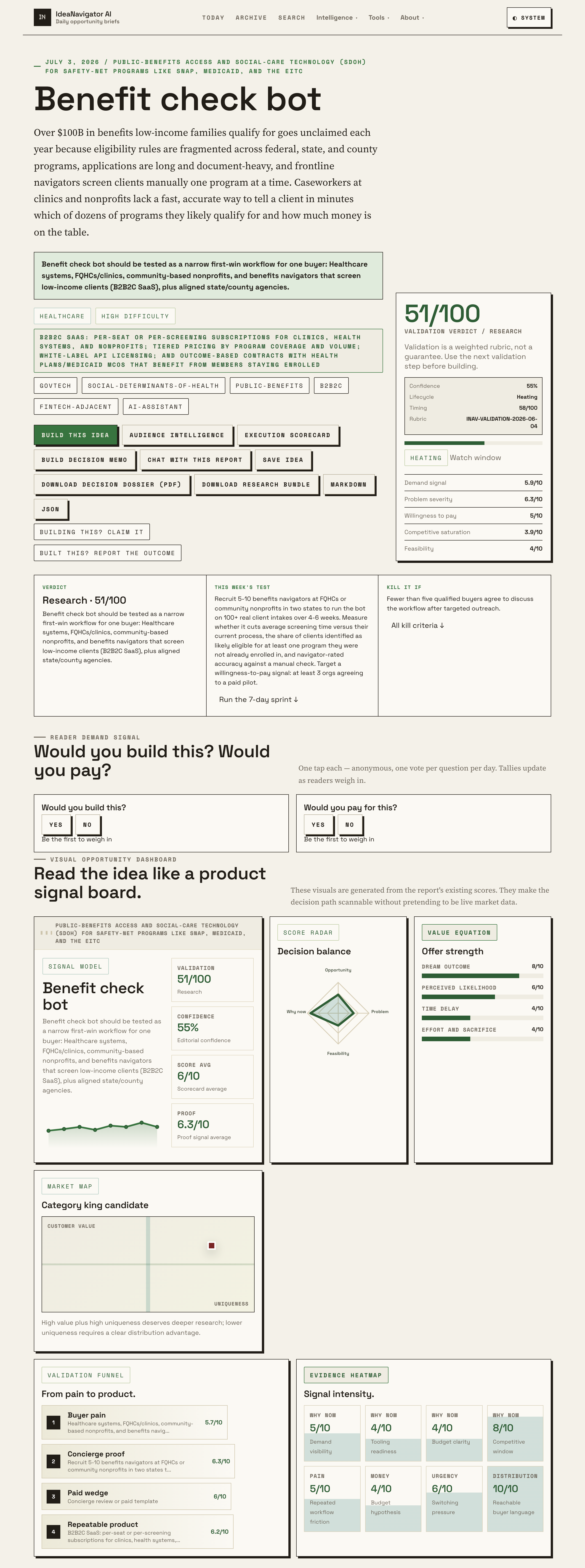
A benefit check bot is being piloted to streamline benefits screening for low-income populations. It addresses a large gap in access caused by the closure of a major nonprofit and rising eligibility checks post-pandemic. The tool could transform benefits access workflows in health and social services.
A new benefit check bot is being tested as a narrow, first-use workflow for healthcare providers, clinics, and community nonprofits to quickly identify benefits programs for low-income clients. This development comes after the shutdown of Benefits Data Trust, a nonprofit that traditionally handled benefits enrollment across several states, creating a significant gap in outsourced benefits access. The tool leverages conversational AI to deliver near-instant, multilingual screening, addressing longstanding challenges in eligibility complexity and manual processing.
The benefit check bot is designed as a white-label, conversational screening tool that clinics and nonprofits can embed on their websites or deliver via SMS. It conducts a short series of yes/no and multiple-choice questions to estimate client eligibility for programs such as SNAP, Medicaid, EITC/CTC, WIC, and LIHEAP, providing benefit estimates to the dollar. The initial pilot will focus on 2-3 states, with participating organizations logging anonymized screening outcomes to evaluate the system’s accuracy, speed, and usability.
The initiative responds to over $100 billion in unclaimed benefits annually, due to fragmented eligibility rules, lengthy applications, and manual screening processes. The shutdown of Benefits Data Trust in 2024 removed a key capacity for benefits navigation, which this new AI tool aims to restore. Post-pandemic Medicaid redeterminations have further increased the need for efficient eligibility checks, making conversational AI a promising approach to reduce costs and improve outcomes. The system can generate a summary for caseworkers to expedite application processes and improve client enrollment rates.
Funding for the project comes from a B2B2C SaaS model, with subscription tiers based on volume and program coverage, as well as licensing API access. The goal is to demonstrate that the tool reduces screening time, increases identification of eligible clients, and maintains high accuracy levels, with at least three organizations willing to pay for a pilot. Validation involves comparing the bot’s outputs against manual checks and assessing client outcomes over a 4-6 week testing window.
Potential Impact on Benefits Access Efficiency
This benefit check bot could significantly improve how healthcare systems, clinics, and nonprofits identify and enroll eligible clients in vital social programs. By automating and streamlining the screening process, it aims to reduce the time and resources spent on manual eligibility checks, which currently hinder access to over $100 billion in unclaimed benefits annually. If successful, the system could lead to higher enrollment rates, better health and economic outcomes for low-income populations, and a more efficient use of social services resources.
Moreover, the tool addresses a critical gap left by the 2024 shutdown of Benefits Data Trust, which previously provided outsourced benefits enrollment services across seven states. Its deployment could serve as a scalable, low-cost solution for other states and agencies facing similar capacity constraints. The multilingual, near-zero marginal cost nature of conversational AI also offers a promising pathway for expanding benefits access in diverse communities, reducing disparities caused by language barriers and complex application procedures.
As an affiliate, we earn on qualifying purchases.
Background on Benefits Access Challenges
For years, low-income families have left over $100 billion in benefits unclaimed each year, due to complex eligibility rules, lengthy applications, and manual screening by caseworkers. Benefits Data Trust, a nonprofit with nearly 300 staff, played a key role in helping clients access programs like SNAP, Medicaid, and EITC across seven states until its shutdown in 2024. This event created a significant gap in capacity for benefits navigation, especially as post-pandemic Medicaid redeterminations have increased the workload for health systems and social agencies.
Simultaneously, advances in conversational AI have made it feasible to develop low-cost, multilingual screening tools capable of delivering accurate program eligibility estimates in real-time. The new benefit check bot builds on these technological trends, aiming to fill the capacity void and improve access for vulnerable populations. The pilot will test whether this approach can match or exceed the accuracy and efficiency of traditional manual screening processes.
As an affiliate, we earn on qualifying purchases.
Uncertainties About Pilot Outcomes and Scalability
It remains unclear how accurately the bot will perform across diverse populations and complex eligibility rules, especially in real-world settings. The pilot’s success depends on factors such as user acceptance, language support, and integration with existing workflows. Additionally, the long-term scalability and sustainability of the model, including funding and organizational buy-in, are still uncertain. Further data from the pilot will be necessary to confirm whether the system can be broadly adopted.
social services benefits enrollment software
As an affiliate, we earn on qualifying purchases.
As an affiliate, we earn on qualifying purchases.
Next Steps for Validation and Expansion
The pilot will begin within the next few months, involving 5-10 benefits navigators at selected clinics and nonprofits in two states. Over 4-6 weeks, participating organizations will test the bot with over 100 real client intakes, comparing its performance to manual screening. Success metrics include reductions in screening time, increases in identified eligible clients, and positive navigator feedback. Pending favorable results, the developers plan to expand the pilot, incorporate additional states and programs, and explore broader deployment options, including API licensing and outcome-based contracts with health plans.
healthcare benefits eligibility AI
As an affiliate, we earn on qualifying purchases.
As an affiliate, we earn on qualifying purchases.
Key Questions
How does the benefit check bot work?
The bot conducts a brief series of yes/no and multiple-choice questions to estimate a client’s eligibility for various programs, then provides a list of likely benefits and application links, all in real-time.
What programs can the bot screen for?
Initially, the system will support screening for SNAP, Medicaid, EITC/CTC, WIC, and LIHEAP, with plans to expand to other programs as it develops.
Will the bot replace human caseworkers?
No. The tool is designed to assist benefits navigators and caseworkers by streamlining initial screening, allowing them to focus on complex cases and application support.
When will the pilot results be available?
Results are expected after the 4-6 week testing period, likely in the second half of the year, with plans to evaluate accuracy, efficiency, and user feedback.
Could this tool be scaled nationally?
Potentially, if pilot results demonstrate effectiveness and cost savings. Broader deployment would require adapting to state-specific rules and securing funding for widespread rollout.
Source: IdeaNavigator AI
Flea & tick season Picks
flea and tick prevention
As an affiliate, we earn on qualifying purchases.