
TL;DR

Get the latest gadgets delivered free with Prime
- Fast, free delivery on millions of items
- Prime Video, Amazon Music and more included
- Member-only deals all year
Avantis Education has announced EduverseSTEM, a new VR/AR platform aimed at transforming STEM education. The platform offers immersive experiences to improve student engagement and understanding. Details about its deployment and features are still emerging.
Avantis Education has launched EduverseSTEM, a new virtual reality (VR) and augmented reality (AR) platform designed specifically for STEM education. The company states that the platform aims to enhance student engagement and comprehension through immersive learning experiences, representing a notable development in educational technology.
The platform, EduverseSTEM, was announced by Avantis Education in March 2024. It offers a suite of VR and AR tools that enable students to explore complex STEM concepts interactively. The company claims that the platform can be integrated into existing curricula across various educational levels, from primary school to higher education.
According to Avantis Education, EduverseSTEM includes virtual labs, 3D modeling, and real-time simulations that allow students to conduct experiments and visualize data in ways not possible with traditional teaching methods. The platform also features adaptive learning components tailored to individual student progress, aiming to improve learning outcomes.
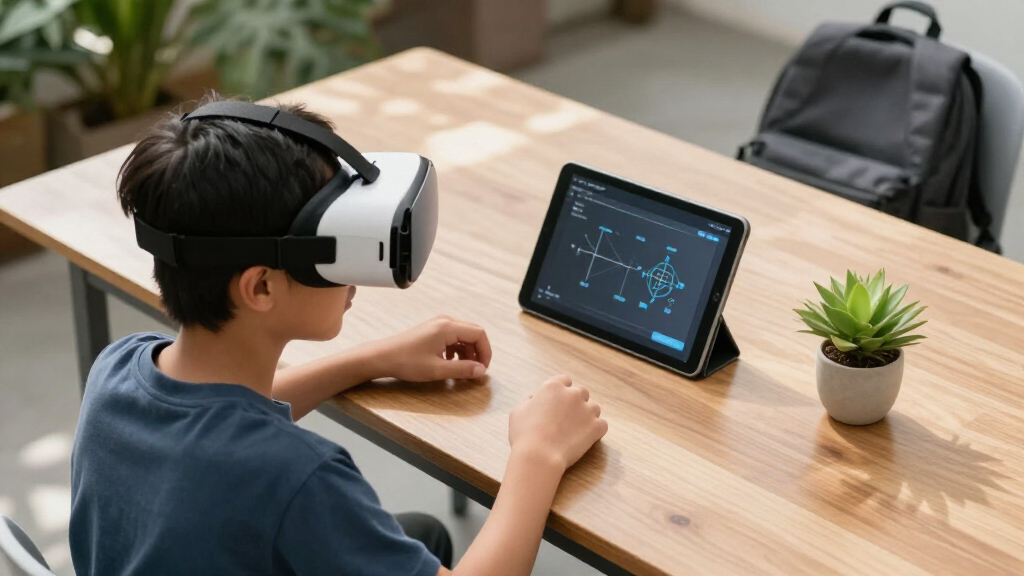
While the company has not yet disclosed detailed deployment plans or pricing, early demonstrations suggest that EduverseSTEM leverages existing VR/AR hardware, such as headsets and tablets, to deliver its content. The platform is expected to be available for pilot programs in select schools starting later this year, with wider rollout anticipated in 2025.
Avantis Education Unveils EduverseSTEM
A new virtual and augmented reality platform aims to make complex STEM concepts more visible, interactive, and engaging—from virtual laboratories to real-time simulations.
Three ways to move STEM beyond the textbook
EduverseSTEM is positioned as a suite of immersive tools rather than a single lesson format, connecting experimentation, visualization, and responsive instruction.
Virtual labs
Students can conduct simulated experiments without the space, consumables, safety constraints, or equipment demands of a physical laboratory.
3D modeling
Abstract structures and systems can be viewed from multiple angles, helping learners examine scale, movement, relationships, and hidden components.
Real-time scenarios
Learners can change variables and observe immediate consequences, turning equations and scientific principles into interactive cause-and-effect experiences.
From abstract concept to observable outcome
The platform’s educational case rests on a simple sequence: make concepts tangible, invite active exploration, and connect feedback to student progress.
Enter a concept
A teacher selects a curriculum-linked STEM topic.
See the system
Students encounter the idea as a spatial or augmented model.
Change variables
Learners manipulate objects, conditions, or inputs.
Observe results
The simulation displays consequences in real time.
Adapt instruction
Progress signals can inform personalized next steps.
Where immersive learning may add value
What is known—and what schools still need to know
The announcement outlines an ambitious learning model, but procurement and implementation decisions depend on details that remain undisclosed.
| Decision area | Current indication | Status | Why it matters |
|---|---|---|---|
| Learning content | Virtual labs, 3D models, and real-time simulations | Outlined | Defines the core classroom experience. |
| Curriculum fit | Intended for integration across educational levels | Claimed | Schools need subject, grade, and standards mapping. |
| Hardware | Early indications point to headsets and tablets | Open | Compatibility affects budget, access, and support. |
| Pricing | No subscription or licensing figures announced | Unknown | Total cost will shape equitable adoption. |
| Teacher training | Support is expected, but details are still emerging | Open | Effective use requires confidence and lesson planning. |
| Learning outcomes | Improved engagement and comprehension are proposed | Unverified | Pilots must test impact beyond novelty and attention. |
Evidence maturity
EduverseSTEM remains closer to product introduction than validated, system-wide classroom practice.
Five questions for school leaders
The route from announcement to adoption
The reported timeline anticipated pilots before wider deployment. Each transition depends on evidence, operational detail, and school readiness.
Announcement
Avantis Education presents EduverseSTEM and its immersive learning proposition.
Pilot programs
Select schools were expected to test usability, engagement, and classroom integration.
Evidence review
Feedback, learning outcomes, cost-efficiency, and technical demands require assessment.
Wider rollout
Broader availability was expected to follow, contingent on pilot results and development.
How the platform’s promise connects
Implications of EduverseSTEM for STEM Education
The introduction of EduverseSTEM could significantly impact how STEM subjects are taught by making complex concepts more accessible and engaging through immersive technology. If successful, it may lead to increased student interest and improved comprehension, especially in areas like physics, chemistry, and engineering, which benefit from visual and hands-on learning.
Educators and policymakers are watching closely, as this platform represents a move toward integrating advanced digital tools into mainstream education. Its potential to supplement or even replace traditional labs and classroom activities could reshape educational strategies and resource allocation in STEM disciplines.
However, the actual effectiveness of EduverseSTEM remains to be validated through pilot studies and broader implementation, and questions about cost, accessibility, and teacher training are yet to be addressed.
Products Worth Considering

LG UltraGear 27-Inch QHD OLED Gaming Monitor, 240Hz, 0.03ms, G-SYNC Compatible, FreeSync Premium Pro, HDMI 2.1

Amazon Kindle Paperwhite Signature Edition (12th Generation, 2024), 32 GB, Metallic Black

Sonos Era 100 Wireless Smart Speaker, Black
As an affiliate, we earn on qualifying purchases.
Background on VR/AR in Education Development
The use of VR and AR in education has been evolving over the past decade, with early pilot projects demonstrating increased engagement but limited widespread adoption. Major tech companies and educational institutions have experimented with immersive tech to teach science, technology, engineering, and mathematics, but challenges around hardware costs, content development, and teacher training have slowed broader integration.
In recent years, several startups and established edtech firms have launched VR/AR platforms aimed at specific subjects or grade levels. However, few have combined comprehensive curricula with immersive technology at scale. Avantis Education’s announcement of EduverseSTEM marks a notable step in this ongoing trend, aiming to bring a more integrated and accessible solution to the market.
Prior to this, Avantis Education has been known for its focus on digital learning tools, but the launch of EduverseSTEM signals a strategic move into immersive technology, aligning with industry trends and increasing demand for engaging digital learning environments.
Unclear Aspects of EduverseSTEM Deployment
Details regarding the specific hardware requirements, pricing models, and the scope of initial pilot programs remain undisclosed. It is also unclear how quickly the platform will be adopted across different education systems and whether it will be accessible to schools with limited resources.
Furthermore, the long-term effectiveness of EduverseSTEM in improving STEM learning outcomes has yet to be validated through independent studies or large-scale implementations. The company’s plans for ongoing content updates and teacher training support are also still emerging.
Next Steps for EduverseSTEM Rollout and Evaluation
Avantis Education plans to initiate pilot programs in select schools later this year to gather feedback and assess the platform’s impact. Broader deployment is expected to follow in 2025, contingent on pilot results and further development.
Educational researchers and industry analysts will likely monitor these pilots to evaluate the platform’s effectiveness and cost-efficiency. The company may also release additional details about hardware compatibility, subscription models, and training resources in the coming months.
Stakeholders in education are advised to watch for updates on pilot outcomes and potential policy implications regarding the integration of VR/AR technologies into standard curricula.
Key Questions
What exactly is EduverseSTEM?
EduverseSTEM is a virtual reality and augmented reality platform developed by Avantis Education to enhance STEM learning through immersive, interactive experiences, including virtual labs and simulations.
When will EduverseSTEM be available for schools?
Initial pilot programs are expected to start later in 2024, with wider availability anticipated in 2025 depending on pilot outcomes and further development.
What hardware does EduverseSTEM require?
Specific hardware requirements have not yet been disclosed, but early indications suggest compatibility with common VR headsets and tablets used in educational settings.
How much will EduverseSTEM cost?
Pricing details have not been announced. The company is likely to offer subscription or licensing models, but exact figures are still unknown.
Will teachers need special training to use EduverseSTEM?
While details are still emerging, it is expected that training resources will be provided, as with other digital platforms, to facilitate effective integration into classrooms.
Source: rss