
TL;DR
Recent studies show that small changes to AI model weights can alter behavior: MIT researchers edited a model to reduce reasoning loops, while Microsoft researchers induced a backdoor by changing seven neurons. A separate paper explored possible weight-space manipulation but explicitly did not demonstrate a self-propagating virus or actual offensive capability.
Research published in November 2026 showed that small changes to AI model weights can alter a model’s behavior, including fixing a reasoning loop or creating a triggered backdoor. The findings make the integrity of model files a security concern, while a separate paper described online as a “weight virus” study says it did not demonstrate self-propagation or actual offensive capabilities.

Get the latest gadgets delivered free with Prime
- Fast, free delivery on millions of items
- Prime Video, Amazon Music and more included
- Member-only deals all year
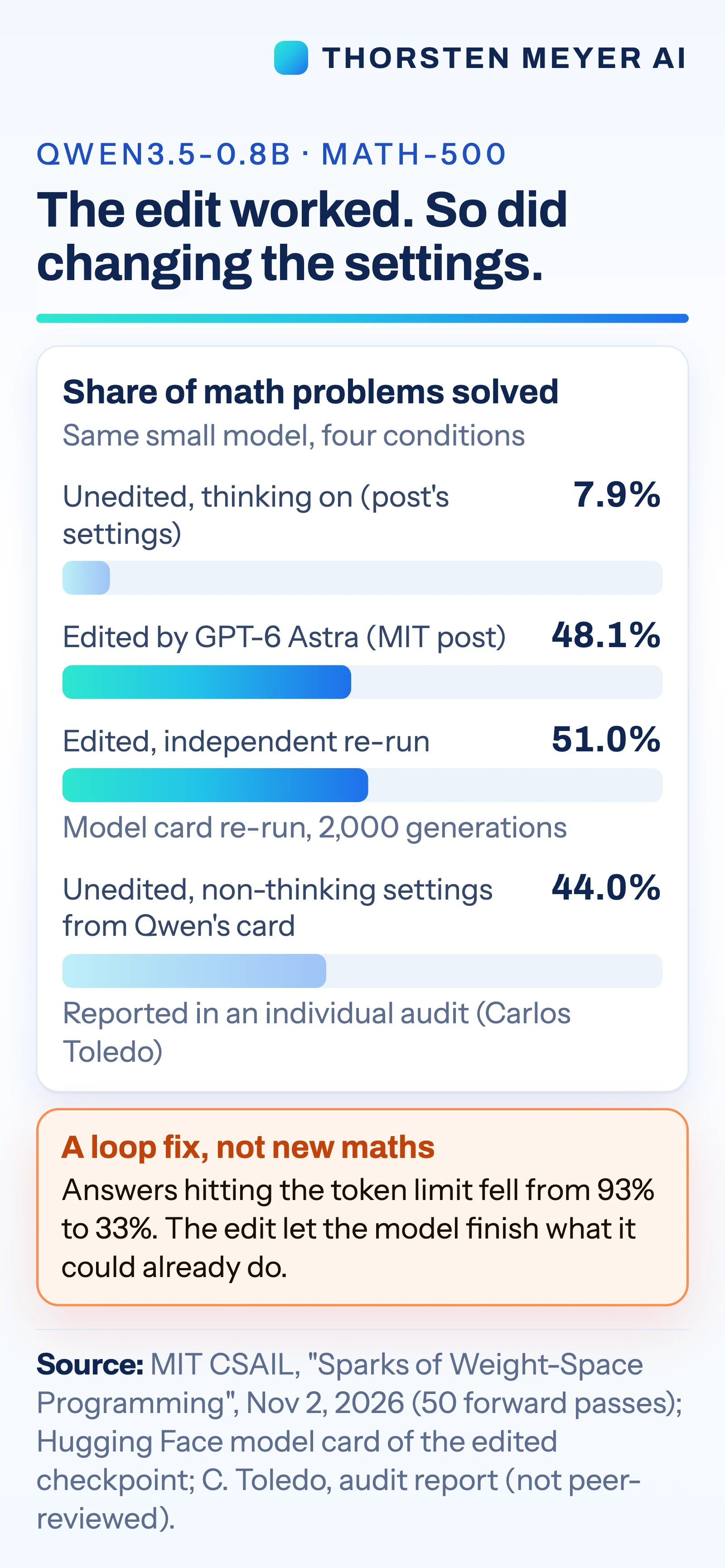
In a November 2 paper, researchers at MIT’s Computer Science and Artificial Intelligence Laboratory reported using GPT-6 Astra to edit 0.016% of a small Qwen model’s weights. They said the change reduced repetitive reasoning loops: the model’s score on MATH-500 rose from 7.9% to 48.1%, while answers cut off by a token limit fell from 93% to 33%. The researchers described the work as removing an obstacle to an existing ability, rather than adding a new mathematical skill.
An independent audit cited in the source material scored the unedited model at 44.0% with different settings, a comparison that complicates claims about how much the weight edit itself contributed. The published edited checkpoint scored 51.0% in an independent rerun, according to the source. Separately, Microsoft researchers reported turning an eight-billion-parameter agent model into a sleeper backdoor by editing seven neurons. Its trigger activated the payload in at least 98.8% of triggered test runs. Microsoft has not seen attackers use the technique, the source says.
A paper titled “Weight Space Misfolding,” by four HCLTech researchers, was discussed on Hacker News on November 13 and posted to alphaXiv on November 14, according to the source. It tested three probes on one small model: one edit worked but also disrupted nearby behavior, while two mostly failed. The authors wrote that they had not created or demonstrated the equivalent of a virus operating in weight space. The source also reports that Fireworks AI said some customers’ “subset of incomplete model weights and datasets were accessed” in a breach; it does not provide further incident details.
Why Weight Integrity Matters
Model weights are the learned numerical values that shape a model’s responses. Unlike ordinary code, they cannot be reviewed by reading a short set of changed instructions: a small numerical edit may have a large behavioral effect, and its meaning can be difficult to infer without running the model. The research described here shows potential benefits as well as risks: edits may correct unwanted behavior, but they can also create hidden behaviors that appear only under a trigger.
That matters to organizations that download, fine-tune, host or deploy models, especially models connected to tools or other systems. A compromised or altered model could behave differently from its published description. The reports do not establish that such attacks are in widespread use, but they show why provenance, file integrity and behavioral checks are relevant parts of deploying models safely.
Products Worth Considering

Logitech MX Mechanical Mini for Mac Wireless Keyboard, Space Gray

Bose QuietComfort Headphones (2nd Gen), Wireless Noise-Cancelling Over-Ear Headphones, Black

DJI Mic 3 Wireless Microphone (2 Transmitters, 1 Receiver, Charging Case)
As an affiliate, we earn on qualifying purchases.
Four Reports, Different Evidence
The November stories concern related but distinct developments: MIT’s work on editing weights to address a reasoning loop; Microsoft’s experiment creating a triggered backdoor; HCLTech’s exploratory probes into “weight space misfolding”; and Fireworks AI’s reported access to some customer model weights and datasets. They should not be treated as a single demonstration. The first two describe experimental weight edits, the third explicitly stops short of demonstrating propagation, and the fourth concerns access to customer data.
The MIT researchers changed 131,072 weights in a model with about 0.8 billion parameters, according to the source. The published model card reportedly identifies two changed tensors and provides their SHA-256 hashes. Such records can help users compare a file with a declared base model, though a matching file alone does not establish that the model behaves safely.
““do not demonstrate self-propagation or actual offensive capabilities.””
— HCLTech researchers, in the “Weight Space Misfolding” paper
Limits of the Current Evidence
The source material does not provide the full methods or results for every study, and it does not establish how well the reported edits would transfer to other models or deployment settings. The MIT score comparison is also affected by the independent audit’s finding that different settings raised the unedited model’s result to 44.0%. The Microsoft result is from a test, and the source says the company has not observed attackers using the technique.
For the HCLTech paper, propagation from one model to another remains a hypothesis, not a demonstrated result. For the Fireworks AI incident, the source does not say when access occurred, how many customers were affected, whether the accessed files could be used, or what remediation followed. The reports do not show that model-weight manipulation is widespread.
Checks Before Model Deployment
Organizations can reduce uncertainty by checking a model’s origin, comparing its weights with the declared base model, recording file hashes, and testing behavior before deployment. The source recommends treating downloaded or fine-tuned weights like code from an unknown source and limiting the actions available to agents built on them.
Further reporting and research would need to establish whether weight edits can be reliably detected, how well backdoors persist across model changes, and whether the reported techniques appear outside controlled experiments. More details from Fireworks AI would also clarify the scope and consequences of the reported access. Until then, the evidence supports careful verification and testing, not claims that a self-spreading model virus has been demonstrated.
Key Questions
Did researchers demonstrate a virus that spreads through model weights?
No. The HCLTech paper says its probes did not demonstrate self-propagation or actual offensive capabilities. Spreading from model to model remains a hypothesis in the source material.
Can changing a few weights alter a model’s behavior?
The reported experiments indicate that it can. MIT researchers edited 0.016% of a small Qwen model’s weights to reduce reasoning loops, and Microsoft researchers reported creating a triggered backdoor by editing seven neurons in an agent model.
Did the MIT edit give the model new math skills?
The researchers said the edit removed an obstacle that hid an existing ability; they did not claim it added a skill the model lacked. An independent audit also found a higher score for the unedited model when it was run with different settings.
What should organizations check before deploying downloaded model weights?
Check where the weights came from, compare them with the declared base model, record hashes, and test model behavior. Limit the actions available to any agent using the model, as the source recommends.
Source: Thorsten Meyer AI