
📊 Full opportunity report: Simulated IEP Meetings: Negotiation Rehearsal Designed For Parents on IdeaNavigator AI — validation score, market gap, and execution plan.

Get the latest gadgets delivered free — and shop member deals
- Fast, free delivery on millions of items
- Access to Prime Big Deal Days deals on October 6–7
- Prime Video, Amazon Music and more included
TL;DR
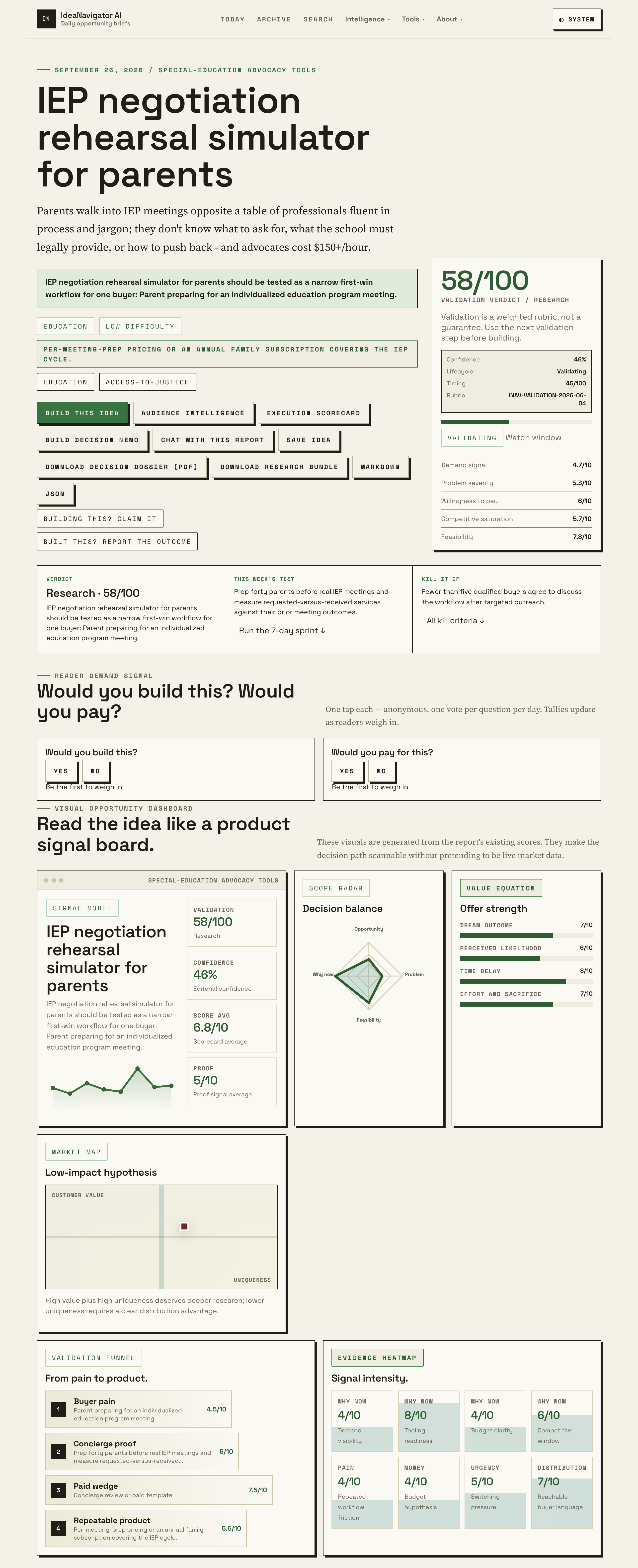
IdeaNavigator AI has outlined a proposed IEP meeting simulator for parents, with document review, plain-language explanations and role-play practice. The proposal describes a pilot with 40 parents, but provides no evidence that the tool has been built or tested, or that it improves services received.
IdeaNavigator AI’s proposal describes testing a simulator to help parents prepare for individualized education program meetings, where families discuss a student’s special education needs and services with school staff. The plan outlines document review and simulated negotiation, but does not report a product launch, completed trial or measured results.
According to the proposal, the tool is aimed at one user: a parent preparing for an IEP meeting. Families would upload a current IEP and evaluation reports. The simulator would then explain information in plain language, generate a list of possible requests with legal grounding, and let a parent rehearse a meeting through role-play that includes realistic pushback.
The proposal frames the product as preparation support, not as a substitute for an advocate or a school team. It identifies a difficulty for parents who may face professionals familiar with education procedures and terminology while trying to understand what services to request and how to respond to disagreement. The proposal also cites advocacy fees of $150 or more per hour; it provides no location, date range or pricing survey for that figure.
IdeaNavigator AI proposes two possible revenue models: a per-meeting preparation fee or an annual family subscription covering an IEP cycle. To assess demand and outcomes, the proposal suggests preparing 40 parents before real meetings and comparing services requested with services received, alongside each family’s prior meeting outcomes. It supplies no pilot results or study design details.
A Test of Parent Meeting Preparation
IEP meetings can shape the educational support a student receives, so preparation may matter to families trying to understand reports, describe needs and make specific requests. A tool that helps parents practice those conversations could make procedural language easier to handle and give them a structured way to prepare before meeting school staff.
The central question remains whether rehearsal changes outcomes. The proposal’s suggested comparison of requested and received services could offer an early measure, but those figures alone would not establish that the simulator caused any difference. Student needs, school decisions and the services available to a district can all affect what is ultimately provided. The proposal does not describe how it would account for those factors.
The idea also raises practical questions about access to advocacy. If families can use a lower-cost preparation option, it may broaden access to some kinds of support. The proposal gives no price for the simulator, however, and does not show whether families would find its guidance accurate or useful. Its value will depend on the quality of its explanations and role-play as well as the limits it sets around legal guidance.
From Meeting Burden to MVP
IdeaNavigator AI’s proposal identifies a narrow first use case rather than a broad special education platform: helping one parent prepare for one IEP meeting. The workflow starts with the family’s existing documents, turns them into plain-language explanations and a request list, then offers practice responding to school staff. The proposal presents this sequence as a way to connect document review with speaking preparation.
The proposal says recent language model capabilities make realistic role-play possible and points to rising special education identification and tighter district resources as reasons to pursue the idea now. These are rationales offered by IdeaNavigator AI; the proposal provides no specific statistics, trend dates or independent evidence establishing either claim.
The proposed validation would focus on 40 parents preparing for actual meetings. Their requested and received services would be compared with prior outcomes. The proposal does not specify how parents would be recruited, which education systems or jurisdictions would be included, how prior outcomes would be recorded, or whether a comparison group would be used.
Pilot Design and Guidance Limits
IdeaNavigator AI reports no working simulator or pilot results in its proposal. The document does not say when testing might begin, who would build or review the tool, what it would cost, or whether families have been interviewed about the workflow. It also gives no evidence that a simulated school response would reflect the range of real meeting practices.
The legal grounding for suggested requests is another open issue. Special education rules and procedures vary by jurisdiction, and the proposal does not identify where the tool would operate or how it would keep guidance current. It also does not explain how uploaded IEPs and evaluation reports would be stored, protected or deleted. These documents can contain sensitive information about children.
Finally, requested-versus-received services would be one measure of meeting outcomes, but the proposal does not define what counts as a service, how changes in student needs would be treated, or how it would distinguish the simulator’s effect from other factors. Without those details, the suggested pilot would not by itself show whether the product improves educational support.
A 40-Parent Pilot Is Proposed
IdeaNavigator AI’s proposal describes a pilot preparing 40 parents ahead of real IEP meetings, followed by a comparison between the services they request and receive and their own prior meeting outcomes. The proposal provides no start date, recruitment plan or public reporting schedule.
Further details would be needed to judge the findings, including how the tool’s legal explanations would be checked, what privacy protections would apply and how outcomes would be measured across different cases. Until a pilot is reported, the simulator remains a product concept with a suggested validation approach.
Key Questions
Has the IEP meeting simulator launched?
IdeaNavigator AI’s proposal does not say that a product has launched. It outlines a proposed minimum viable product and a possible pilot.
What would the proposed simulator do?
According to the proposal, parents would upload an IEP and evaluation reports. The tool would explain them in plain language, suggest requests with legal grounding and provide role-play practice for a meeting.
Would it replace a special education advocate?
The proposal presents the simulator as parent preparation support. It does not establish that the tool can replace individualized advice from an advocate or legal professional.
How would the idea be tested?
The proposed pilot would prepare 40 parents before real meetings and compare services requested and received with those families’ prior meeting outcomes. IdeaNavigator AI reports no results or detailed study methods.
What remains unknown about the tool?
Its availability, price, accuracy, privacy safeguards, jurisdictional coverage and effect on meeting outcomes are not specified in the proposal.
Source: IdeaNavigator AI
Fall Picks
fall essentials
As an affiliate, we earn on qualifying purchases.