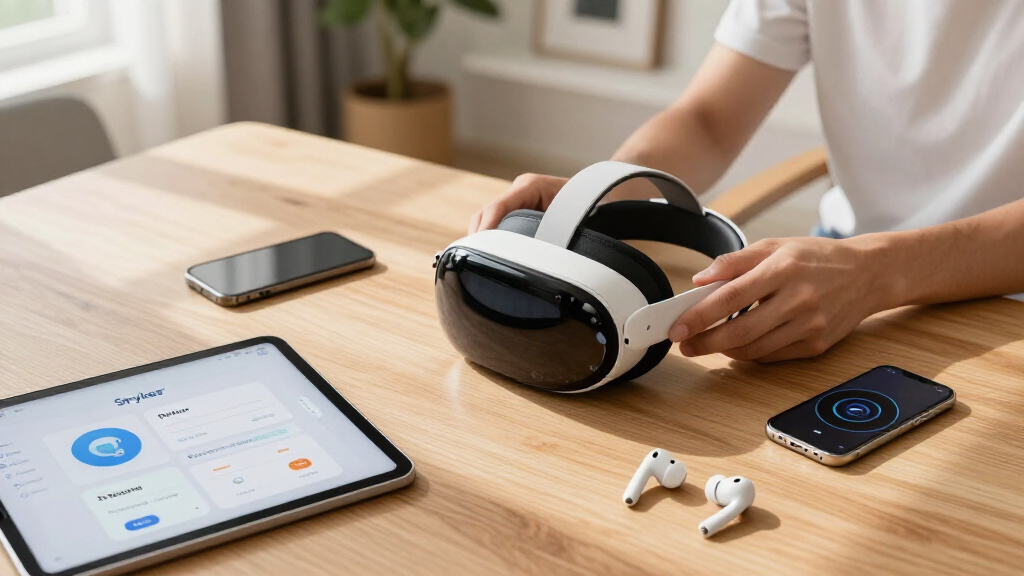

TL;DR

Get the latest gadgets delivered free with Prime
- Fast, free delivery on millions of items
- Prime Video, Amazon Music and more included
- Member-only deals all year
Stryker has unveiled an FDA-approved app that showcases the use of virtual reality in conjunction with Apple Vision Pro for surgical procedures. This development signals a new era of immersive medical training and operation planning, but details about specific applications remain limited.
Stryker has received FDA approval for an app that utilizes Apple’s Vision Pro headset to enhance surgical planning and training through virtual reality. This marks a significant step in integrating consumer-grade VR technology into medical procedures, with potential implications for precision and training in surgery.
The FDA approval pertains to Stryker’s VR application, which is designed to work with the Apple Vision Pro headset. The app enables surgeons to visualize complex anatomical structures in a 3D immersive environment, aiming to improve preoperative planning and intraoperative guidance. It is the first known FDA-approved application of VR technology that leverages Apple’s mixed-reality device for surgical purposes.
According to Stryker, the app allows for detailed anatomical mapping, surgical simulation, and real-time guidance, although specific functionalities and procedures tested remain undisclosed. The approval was granted after rigorous review of safety and efficacy data submitted by Stryker, indicating the company’s commitment to integrating emerging tech into clinical workflows.
Officials from Stryker emphasized that this development is part of a broader push toward digital surgery, where augmented and virtual reality tools enhance surgeon capabilities. The FDA approval signifies a critical regulatory milestone, potentially paving the way for broader adoption of VR in healthcare settings.
How Stryker’s FDA App Unveils the Role of VR in Apple Vision Pro Procedures
Stryker’s reported regulatory milestone points toward immersive anatomical visualization, surgical simulation, and procedure planning on Apple Vision Pro—while leaving important questions about clinical scope, evidence, and deployment unanswered.
What immersive surgery could add
The app’s reported value is not simply “VR in the operating room.” It is the ability to place patient-specific spatial information inside an interactive environment that supports preparation, rehearsal, and potentially guidance.
Detailed anatomical mapping
Complex structures can be viewed as layered three-dimensional models, potentially making spatial relationships easier to interpret than on a flat display.
Preoperative planning
Surgeons may inspect anatomy, evaluate access routes, and anticipate procedural challenges before entering the operating room.
Virtual rehearsal
Interactive models could let clinical teams review complex procedures and explore alternative approaches without placing a patient at risk.
Immersive training
Students and residents could build procedural familiarity through repeatable practice before progressing to supervised patient care.
Shared case understanding
Three-dimensional case reviews may help multidisciplinary teams discuss anatomy and surgical strategy using a common visual reference.
Potential real-time support
Intraoperative guidance is a possible direction, but the precise approved functionality and procedures have not been publicly detailed.
The proposed immersive workflow
A clinical mixed-reality system connects medical imaging, software interpretation, spatial display, and surgeon judgment. Each connection must be validated for reliability and workflow fit.
Capture
Patient imaging supplies the anatomical data used to construct a case-specific model.
Reconstruct
Software converts imaging data into navigable three-dimensional structures.
Explore
Vision Pro presents anatomy at scale and from multiple perspectives.
Plan
The surgical team evaluates approach, orientation, and potential constraints.
Validate
Clinical trials and real-world use measure safety, accuracy, and outcomes.
FDA authorization is an important gate, but it does not establish universal clinical benefit, immediate hospital availability, or suitability for every procedure.
What is established—and what remains open
The strongest interpretation separates the reported platform capabilities from anticipated benefits that still require specialty-specific clinical evidence.
| Area | Current signal | Evidence status | What comes next |
|---|---|---|---|
| Anatomy | Immersive 3D visualization | Supported | Validate accuracy across cases and specialties |
| Planning | Interactive case preparation | Promising | Measure changes in planning quality and time |
| Training | Repeatable virtual simulation | Promising | Compare skill transfer with standard training |
| Guidance | Possible intraoperative support | Unclear | Disclose approved use and tested procedures |
| Outcomes | Potential precision gains | Unproven | Publish long-term safety and outcome data |
Four questions will shape adoption
Hospitals need more than an authorization headline. They need clarity on indication, performance, implementation, and measurable benefit.
Which procedures are included?
Orthopedics and neurosurgery are plausible applications, but the specific tested and authorized procedures remain undisclosed in the supplied report.
Planning or live guidance?
The clinical and regulatory distinction between preoperative review and real-time intraoperative use is critical for understanding the app’s actual scope.
How will hospitals integrate it?
Deployment depends on imaging pipelines, device management, sterilization protocols, staff training, cybersecurity, and existing surgical systems.
Will outcomes improve?
Reduced errors, better recovery, and greater precision remain hypotheses until comparative clinical studies demonstrate durable patient benefit.
Note: Regulatory authorization and clinical availability can differ by intended use, configuration, institution, and jurisdiction.
How the milestone could translate into impact
The route from immersive hardware to better patient care is a sequence of dependent steps—not an automatic result of adopting a headset.
Patient data
Accurate imaging and reliable model reconstruction establish the clinical foundation.
Spatial display
Apple Vision Pro makes complex anatomical information immersive and interactive.
Surgeon insight
Clinical expertise converts visualization into a procedure-specific plan.
Patient benefit
Only validated improvements in safety, precision, or recovery complete the chain.
Stryker’s reported app signals regulatory recognition of immersive surgical tools and a possible bridge between consumer-grade mixed reality and clinical workflows. Its long-term importance will depend on transparent indications, published trial data, practical hospital integration, and demonstrated patient outcomes.
Implications of FDA-Approved VR for Surgical Innovation
This development matters because it signals a shift toward immersive technology in surgical environments, potentially improving accuracy, training, and patient outcomes. The approval of Stryker’s app demonstrates regulatory recognition of VR’s safety and utility in medicine, which could accelerate adoption across hospitals and clinics. Additionally, leveraging Apple Vision Pro — a consumer device — for professional medical applications suggests a future where cost-effective and accessible VR solutions become commonplace in surgical workflows.
For patients, this could mean more precise surgeries with reduced errors and improved recovery times. For surgeons, it offers a new dimension of visualization and simulation that was previously limited to high-cost, specialized equipment. The integration of VR into standard surgical practice could also influence medical training, allowing students and residents to practice complex procedures virtually before performing them on patients.
As an affiliate, we earn on qualifying purchases.
Background on VR and Apple Vision Pro in Healthcare
Virtual reality has been explored in healthcare for several years, primarily in training, therapy, and preoperative planning. However, most applications have been experimental or limited to specialized research settings. The release of Apple Vision Pro, with its advanced mixed-reality capabilities, opened new possibilities for consumer-grade devices to be used in professional contexts.
Stryker, a major medical technology company, has been investing in digital surgery solutions, including augmented reality and visualization tools. Prior to this FDA approval, there were reports of pilot projects and prototypes integrating VR with surgical planning, but no applications had received formal regulatory clearance. This approval marks a significant milestone in transitioning VR from experimental to approved clinical use.
While details about the specific procedures tested are scarce, industry experts have noted that applications could include orthopedics, neurosurgery, and other complex specialties where detailed anatomical visualization is crucial. The FDA’s green light suggests confidence in the safety and potential benefits of this approach.
As an affiliate, we earn on qualifying purchases.
Unanswered Questions About VR Application Scope
It is not yet clear which specific surgical procedures have been tested with the FDA-approved app or how widely it will be adopted in clinical practice. Details about the app’s functionalities, such as real-time intraoperative use versus preoperative planning, remain undisclosed. Additionally, the long-term safety and effectiveness data are still to be published, and regulatory approval does not guarantee immediate widespread implementation.
As an affiliate, we earn on qualifying purchases.
Next Steps for Regulatory Approval and Clinical Trials
Following this approval, Stryker is expected to conduct broader clinical trials to validate the app across various surgical specialties. The company may also seek approvals in other jurisdictions, such as Europe. Hospitals and surgical centers will likely begin pilot programs to evaluate real-world utility and integration into existing workflows. Further updates on procedural outcomes and user feedback are anticipated in the coming months.
3D anatomical visualization headset
As an affiliate, we earn on qualifying purchases.
As an affiliate, we earn on qualifying purchases.
Key Questions
What procedures can the Stryker VR app be used for?
Specific procedures have not been publicly disclosed, but potential applications include orthopedics, neurosurgery, and other complex surgeries requiring detailed anatomical visualization.
How does the Apple Vision Pro enhance surgical procedures?
The device provides immersive 3D visualization, allowing surgeons to view detailed anatomy and simulate surgeries, which could improve precision and planning.
Is this technology available for widespread use now?
No, the FDA approval is an initial regulatory milestone. Broader clinical adoption will depend on further trials, training, and integration efforts.
What are the benefits of using VR in surgery?
VR can improve anatomical understanding, surgical accuracy, and training effectiveness, potentially leading to better patient outcomes.
Will this technology reduce surgical errors?
While promising, it remains to be seen how significantly VR will impact error rates, as ongoing studies are needed to confirm long-term benefits.
Source: rss
Halloween Picks
halloween
As an affiliate, we earn on qualifying purchases.