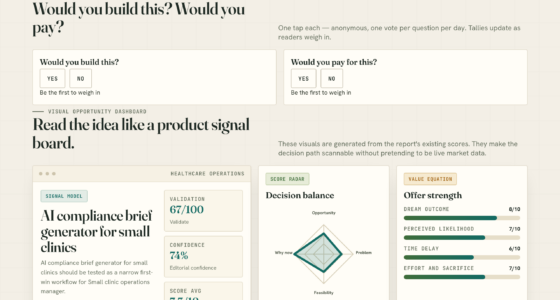
📊 Full opportunity report: Human-review Tracker For AI-assisted Agency Delivery on IdeaNavigator AI — validation score, market gap, and execution plan.
TL;DR
An AI-assisted services agency is testing a new human-review tracker designed to improve oversight of AI-generated tasks. The tool aims to address visibility gaps and reduce quality issues in AI-inserted workflows. The initiative is in early pilot stages, with initial validation planned through live client engagements.
A new human-review tracker is being tested at an AI-assisted services agency to improve visibility into client tasks and ensure quality control in workflows that incorporate AI. The tracker allows delivery leads to log, monitor, and manage AI-generated versus human-owned tasks, addressing a critical gap in current project management tools.
The tracker is designed as a minimum viable product (MVP) for a delivery board where project leads can record each client task as either AI-generated or human-owned. It enables marking review statuses and provides a consolidated view of which outputs still require human sign-off before delivery. This addresses an industry-wide challenge where agencies struggle to identify which parts of a project are model-produced and where work is delayed or quality is compromised due to lack of visibility.
The initiative is being piloted by recruiting eight AI-assisted service agencies, each running a single live client engagement through the tracker for a period of three weeks. The primary goal is to measure whether the new workflow catches issues earlier than traditional methods, reducing errors and improving client satisfaction. The tracker is offered as a per-seat monthly subscription for the agency’s delivery team, fitting into existing service-delivery operations software.
Why Improved Task Visibility in AI Workflows Matters
This development is significant because it targets a key visibility gap in AI-assisted service delivery, where agencies often cannot easily distinguish between human and model outputs. Without clear review processes, errors and quality issues tend to surface only after client complaints, risking reputational damage and rework costs. The tracker aims to embed review gates directly into workflows, enabling proactive quality control and smoother handoffs.
As AI integration accelerates across industries, tools that enhance oversight and accountability are increasingly vital. This solution could set a precedent for standardizing review processes in AI-powered service operations, potentially influencing broader industry practices and software offerings.

Building AI-Powered Products: The Essential Guide to AI and GenAI Product Management
As an affiliate, we earn on qualifying purchases.
As an affiliate, we earn on qualifying purchases.
Background on AI Integration in Service Delivery
Over recent years, agencies have rapidly adopted AI tools to automate and augment client work, from content generation to data analysis. However, these workflows often lack integrated oversight mechanisms, leading to challenges in tracking which tasks are AI-produced and whether they meet quality standards. Existing project management tools are typically not designed to handle the unique needs of AI-involved tasks, creating a visibility and quality control gap.
Previous efforts to manage AI outputs have relied on manual checks or separate review processes, which are often inefficient and prone to oversight. The need for a dedicated, integrated review system has become more urgent as AI becomes a core part of service delivery, prompting experimentation with specialized tools like the human-review tracker currently in pilot testing.
“Integrating review steps directly into AI-assisted workflows can significantly reduce errors and improve client satisfaction.”
— an anonymous researcher

AI Workflow Planner: Daily System for Planning, Prompting and Tracking Your AI Projects
As an affiliate, we earn on qualifying purchases.
As an affiliate, we earn on qualifying purchases.
Uncertainties About Tracker Effectiveness and Adoption
It is not yet clear whether the tracker will significantly reduce errors or improve workflow efficiency during the pilot phase. The effectiveness depends on how well agencies adopt and integrate the tool into their existing processes. Additionally, the long-term impact on client satisfaction and operational costs remains to be seen, as the pilot is limited to a small number of agencies and a short timeframe.

AI-Assisted Quality Control: A Practical Framework for Quality 4.0 in Manufacturing
As an affiliate, we earn on qualifying purchases.
As an affiliate, we earn on qualifying purchases.
Next Steps for Validation and Broader Deployment
Following the three-week pilot, agencies will evaluate the tracker’s performance in catching issues earlier and streamlining review processes. If successful, the developers plan to refine the tool based on user feedback and expand testing to more agencies. Broader adoption could follow, with potential integration into existing project management platforms and further development of features to support larger teams and more complex workflows.

BIM and Construction Management: Proven Tools, Methods, and Workflows
As an affiliate, we earn on qualifying purchases.
As an affiliate, we earn on qualifying purchases.
Key Questions
What specific problems does the human-review tracker aim to solve?
The tracker aims to improve visibility into which client tasks are AI-generated versus human-owned, track review statuses, and prevent errors from slipping through due to lack of oversight.
How will success be measured during the pilot?
Success will be measured by whether the tracker enables earlier detection of issues, reduces rework, and improves client satisfaction compared to previous workflows.
Is this tracker intended for all types of AI-assisted services?
Initially, the tracker is being tested in a narrow scope with select agencies to validate its core functionality before broader deployment across different service types.
Will the tracker be integrated with existing project management tools?
The current plan involves a standalone delivery board, but future versions may integrate with popular project management platforms based on user feedback.
When will the results of the pilot be available?
The pilot is ongoing, with evaluation planned after three weeks of live testing. Results are expected shortly thereafter.
Source: IdeaNavigator AI