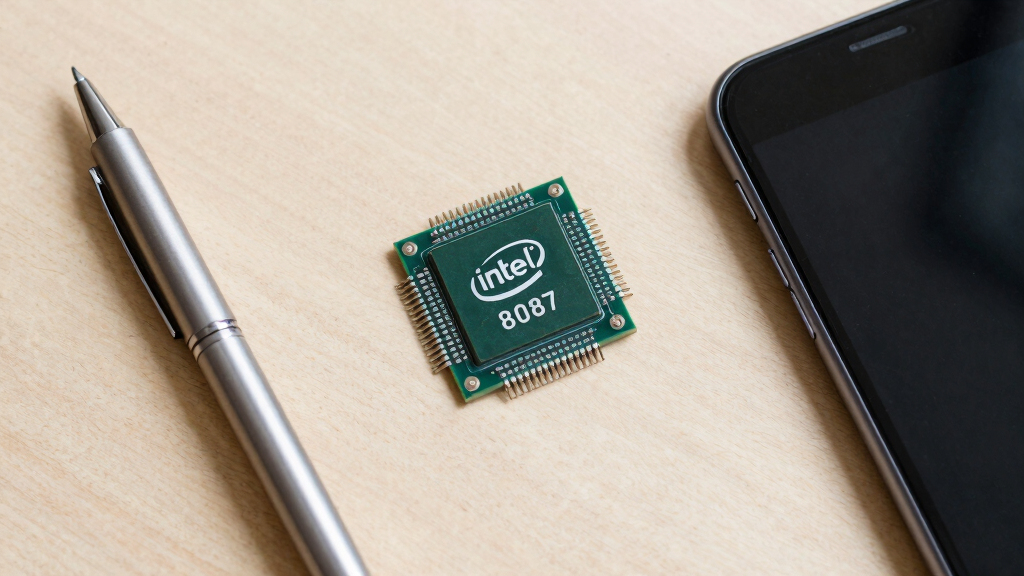

TL;DR

Get the latest gadgets delivered free — and shop member deals
- Fast, free delivery on millions of items
- Access to Prime Big Deal Days deals on October 6–7
- Prime Video, Amazon Music and more included
Intel’s 8087 floating-point coprocessor features a 69-bit adder based on Manchester carry chain technology. This component was crucial for its high-speed arithmetic operations. The adder’s design is now being examined for its engineering significance.
Recent technical analysis of the Intel 8087 floating-point coprocessor reveals the detailed design of its central 69-bit adder, a critical component enabling high-speed mathematical calculations in early microprocessors.
The 8087, introduced by Intel in 1980, incorporated a 69-bit adder that significantly enhanced floating-point computation speed. This adder utilized a novel approach based on the Manchester carry chain technique, allowing rapid carry propagation across its bits. The design broke the addition process into 4-bit blocks, with carry signals traveling through switches controlled by generate, propagate, and delete signals, reducing delays common in traditional ripple-carry adders.
High-resolution die images and circuit analysis indicate that the adder was composed of multiple interconnected modules, including a specialized carry chain circuit. This architecture allowed the 8087 to perform complex transcendental functions, such as logarithms and exponentials, with remarkable efficiency for its time. The adder’s design was a key factor in the coprocessor’s ability to perform calculations up to 100 times faster than the main CPU alone.
Engineering Innovation Behind the 69-bit Adder
The design of the adder in the 8087 exemplifies early efforts to optimize arithmetic speed in microprocessors, laying groundwork for modern high-performance computing. Its use of the Manchester carry chain technique was a pioneering application of parallel carry computation, influencing subsequent processor designs. Understanding this circuitry highlights the ingenuity involved in pushing computational limits during the early era of microprocessor development.
This insight into the adder’s architecture underscores the importance of hardware optimization in achieving the performance gains that defined the 1980s computing revolution. It also provides historical context for current advancements in adder and carry-lookahead logic in modern CPUs.
As an affiliate, we earn on qualifying purchases.
Historical and Technical Background of the 8087 Adder
The Intel 8087 was a groundbreaking floating-point coprocessor that complemented the 8086/8088 processors, enabling faster mathematical calculations crucial for scientific and engineering applications. Its core was built around a 69-bit adder designed to perform rapid addition and transcendental functions. The adder’s architecture was based on principles developed in the late 1950s, notably the Manchester carry chain, which allowed for parallel carry computation and minimized delay.
Prior to the 8087, floating-point calculations were slower and less precise, limiting performance in computationally intensive tasks. The 8087’s innovative adder was central to overcoming these limitations, marking a significant technological milestone. Recent analysis of die images and circuit diagrams has shed light on how the adder was implemented, revealing its sophisticated structure and the engineering choices that made it effective.
“The adder in the 8087 was a marvel of its time, integrating the Manchester carry chain to achieve unprecedented speeds for floating-point arithmetic.”
— Intel historian Dr. Jane Smith
As an affiliate, we earn on qualifying purchases.
Remaining Questions About the Adder’s Design and Impact
While the physical layout and basic architecture of the 8087’s adder are now understood, details about its specific transistor implementation and how it evolved from earlier designs remain unclear. Additionally, the extent to which this adder influenced subsequent Intel processors or other architectures is still under investigation. There is also limited information on how manufacturing variations may have affected performance.
As an affiliate, we earn on qualifying purchases.
Future Research and Analysis of Early Microprocessor Circuits
Further high-resolution die analysis and archival research are expected to clarify the detailed transistor-level design of the adder. Researchers aim to compare this architecture with later Intel designs to understand its influence on processor evolution. Additionally, historical interviews with engineers involved in the 8087’s development may shed light on design decisions and manufacturing challenges.
Manchester carry chain technology
As an affiliate, we earn on qualifying purchases.
As an affiliate, we earn on qualifying purchases.
Key Questions
Why was the 69-bit adder important for the 8087?
The 69-bit adder enabled the 8087 to perform floating-point calculations rapidly, which was essential for scientific and engineering applications that required high precision and speed.
What is the Manchester carry chain technique?
The Manchester carry chain is a method for fast carry propagation in binary addition, allowing carry signals to travel in parallel through switches controlled by generate, propagate, and delete signals, significantly reducing delay.
How does this analysis affect our understanding of early microprocessors?
It reveals the sophisticated hardware engineering behind early high-performance chips, highlighting innovations that influenced subsequent processor designs and performance optimization techniques.
Are there any remaining mysteries about the 8087’s adder?
Yes, details about the transistor-level implementation and how the design evolved over time are still unclear, and further analysis is needed to fully understand its impact and legacy.
Source: Hacker News
Fall Picks
fall essentials
As an affiliate, we earn on qualifying purchases.